TheJakartaPost
Please Update your browser
Your browser is out of date, and may not be compatible with our website. A list of the most popular web browsers can be found below.
Just click on the icons to get to the download page.


Popular Reads
Top Results
No results found. Please check your search term and try again
Can't find what you're looking for?
View all search results
Popular Reads
Top Results
No results found. Please check your search term and try again
Can't find what you're looking for?
View all search resultsFossil-fuel investments are a fiduciary risk
The global fallout from the United States-Israeli war against Iran war demonstrates once again that for investors, fossil fuels are not just another commodity exposure, but a geopolitical liability.
Change text size
Gift Premium Articles
to Anyone
Share the best of The Jakarta Post with friends, family, or colleagues. As a subscriber, you can gift 3 to 5 articles each month that anyone can read—no subscription needed!
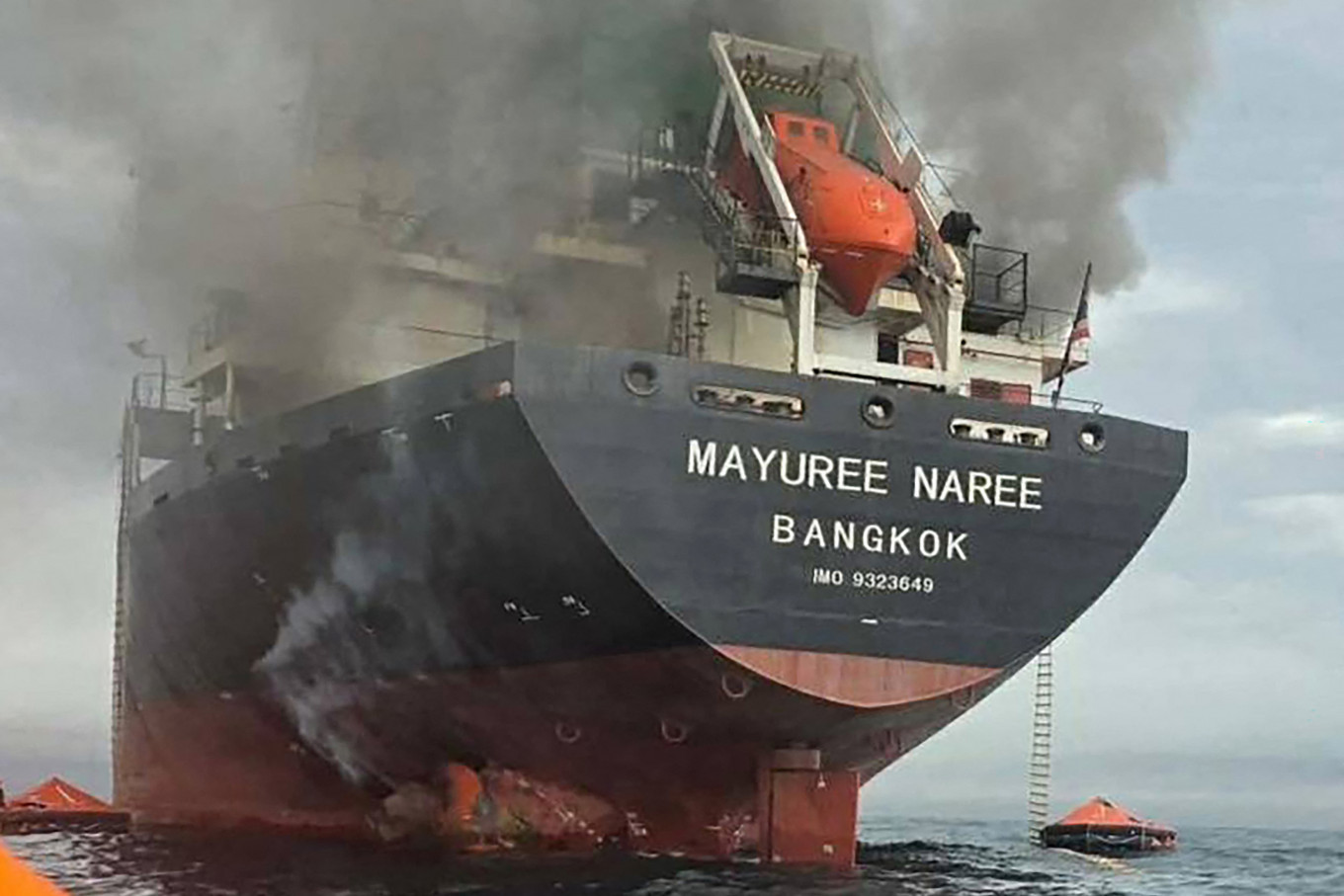 Smoke rises from the Thai bulk carrier 'Mayuree Naree' near the Strait of Hormuz after an attack on March 11, 2026. (AFP/Handout/Royal Thai Navy)
T
he global fallout from the United States-Israeli war against Iran war demonstrates once again that for investors, fossil fuels are not just another commodity exposure, but a geopolitical liability. Oil and gas prices have always been structurally unstable, such that supply disruptions anywhere can trigger sudden economic shocks everywhere. And because oil sits at the center of the global energy system, volatility spreads quickly through the financial system.
The consequences are particularly acute for African economies, whose currencies come under pressure whenever oil prices surge. Every additional dollar per barrel increases import costs and tightens foreign-exchange constraints. The South African rand, the East African shillings, and many other currencies bear the brunt of the shock.
The same dynamic then exposes a deeper problem for banks and institutional investors. Although financing for fossil fuels is often framed as a way of supporting energy security or economic development, it often produces the opposite effect, entrenching dependence on a volatile global commodity whose price responds to conflicts thousands of miles away.
The implications for fiduciaries are far-reaching. Trustees, directors, and asset managers must act in the best interests of their beneficiaries. They are required to manage risk prudently and protect long-term value, which in practice means building portfolios that can withstand geopolitical shocks and structural economic change.
Fossil-fuel exposure increasingly runs afoul of this obligation. After all, the volatility we have seen during this latest crisis is not an anomaly. It is a structural feature of the fossil-fuel system. Oil prices respond immediately to geopolitical tensions, sanctions, shipping disruptions and political instability. Investors who rely on stable energy markets are therefore betting on continued geopolitical calm. That is not a responsible or sustainable investment strategy.
The Iran conflict highlights another growing risk: stranded assets. Investors often treat this as an issue that may arise decades from now as the energy transition proceeds. But recent events suggest the risk may materialize much sooner.

When oil prices skyrocketed in early March, many African economies simply could not afford the imports. Energy costs rose sharply, utilities struggled to pay suppliers and governments faced mounting fiscal pressure. Under these conditions, fossil-fuel infrastructure could become economically stranded long before the end of its expected life. If customers cannot afford the fuel, the asset stops delivering reliable returns today, not in 20 years.