The Jakarta Post
Please Update your browser
Your browser is out of date, and may not be compatible with our website. A list of the most popular web browsers can be found below.
Just click on the icons to get to the download page.


Popular Reads
Top Results
No results found. Please check your search term and try again
Can't find what you're looking for?
View all search results
Popular Reads
Top Results
No results found. Please check your search term and try again
Can't find what you're looking for?
View all search resultsBlue economy: Empty promises for Indonesia?
While Indonesia’s Blue Economy Road Map promises a sustainable future, a widening execution gap threatens to leave coastal communities behind in favor of elite industrial interests.
Change text size
Gift Premium Articles
to Anyone
Share the best of The Jakarta Post with friends, family, or colleagues. As a subscriber, you can gift 3 to 5 articles each month that anyone can read—no subscription needed!
 Set as preferred source
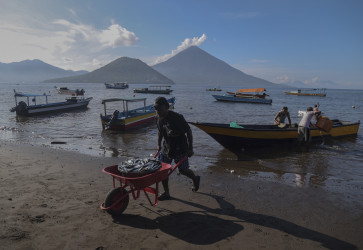
 Fishermen unload their catch from a boat in Fitu fishing village in Ternate, North Maluku, on Sept. 15, 2025. (Antara/Andri Saputra)
T
he blue economy is defined as the sustainable use of ocean resources for economic growth, improved livelihoods and jobs, while preserving ocean ecosystem health. This concept has been integrated into Indonesia’s Blue Economy Road Map as a fresh approach to boost economic growth and now anchors the National Mid-Term Development Plan (RPJMN) 2025–2029.
While this signals a bold shift toward inclusive ocean development, such ambition faces stark challenges. The road map reveals deep gaps in coordination, equity and data.
Indonesia’s blue economy unfolds within unequal power relations, characterized by decentralized governance, fragmented ministries and investment-driven development. These factors frequently privilege capital-intensive projects over ecological protection. The nation suffers not from a vision gap, but an execution gap.
Success is undermined by weak coordination, poor monitoring guidelines, limited local capacity, fiscal tightening and a lack of labor protections for fishers. The real test is whether institutions can truly deliver.
Progress has stalled due to policy friction between the National Planning Agency (Bappenas) and the Maritime Affairs and Fisheries Ministry. This rift came to light following nickel exploration by the Energy and Mineral Resources Ministry, which threatened the marine resources of Raja Ampat. The conflict eventually forced President Prabowo Subianto to revoke four mining permits to protect the region.
As industrial aquaculture and energy expansion reshape coastal landscapes, small-scale fishers and indigenous communities are pushed to the margins. This shift reveals how elite economic interests can quietly undermine sustainability commitments. Indonesia’s policymakers are avoiding uncomfortable truths: the current model may generate impressive metrics, but it is deepening inequality. Without empirical research on subnational governance, the road map risks becoming "blind policymaking", unable to measure progress or grasp local realities.

Regulatory fragmentation has fueled calls for reform. Indonesia’s commitment to ratifying International Labour Organization (ILO) Convention No. 188 by 2026 could establish minimum standards for fishing crews. However, policymakers have prioritized conservation area size and productivity indicators while neglecting worker safety.