TheJakartaPost
Please Update your browser
Your browser is out of date, and may not be compatible with our website. A list of the most popular web browsers can be found below.
Just click on the icons to get to the download page.


Popular Reads
Top Results
No results found. Please check your search term and try again
Can't find what you're looking for?
View all search results
Popular Reads
Top Results
No results found. Please check your search term and try again
Can't find what you're looking for?
View all search resultsSilencing critics, losing touch
Indonesian democracy is regressing not through a sudden coup, but through what experts call the “gradual, subtle and even legal” subversion of democratic norms.
Change text size
Gift Premium Articles
to Anyone
Share the best of The Jakarta Post with friends, family, or colleagues. As a subscriber, you can gift 3 to 5 articles each month that anyone can read—no subscription needed!
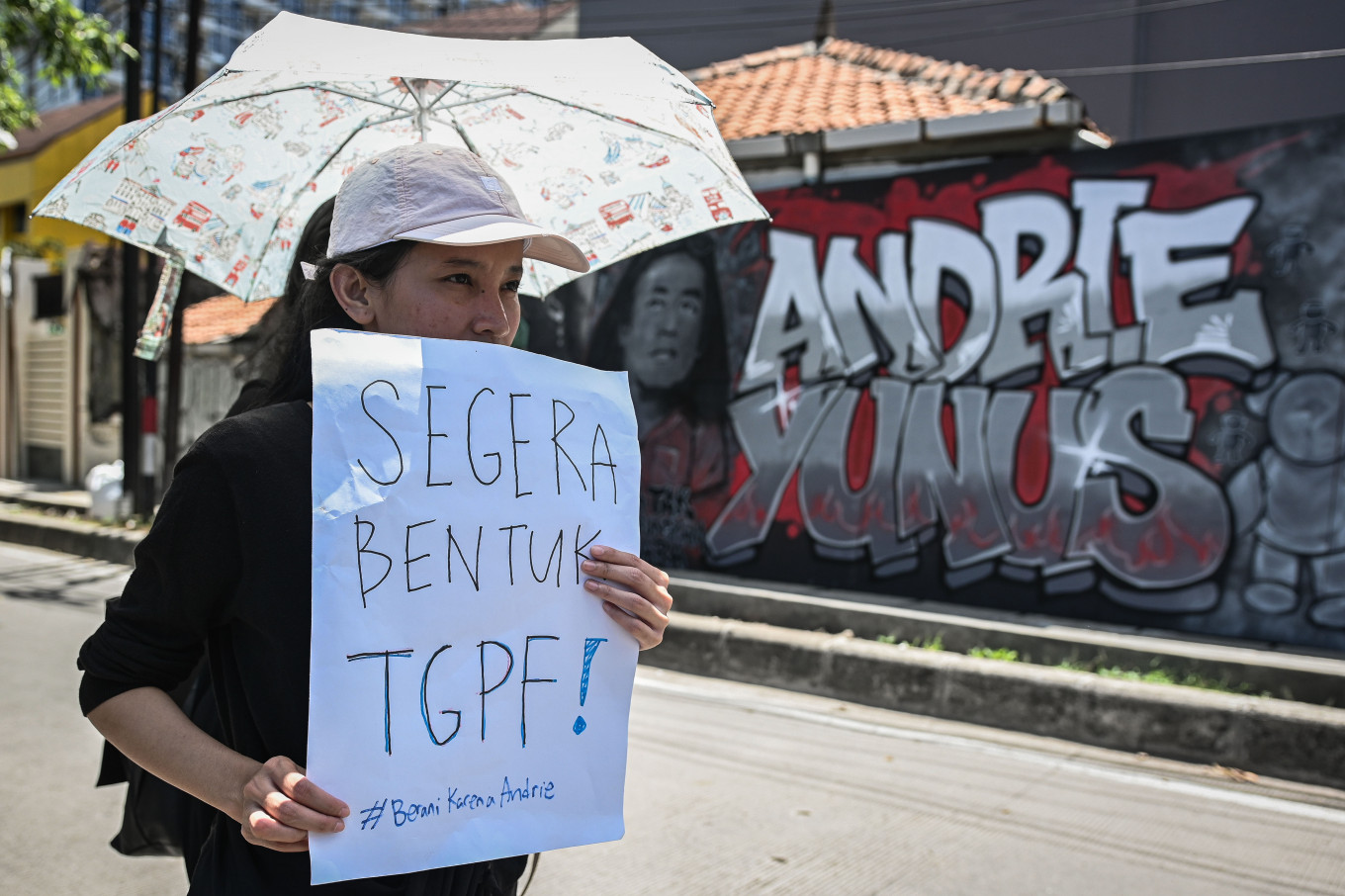 A woman carries a poster on April 12 calling for the creation of a joint fact-finding team (TGPF), during a commemoration marking 30 days since the acid attack on human rights activist Andrie Yunus, on Jl. Salemba I, Senen, Central Jakarta. (Antara/Sulthony Hasanuddin)
O
n the night of March 12, Andrie Yunus left a podcast recording studio in Central Jakarta and rode into an ambush. Two men on a motorcycle threw acid at the 27-year-old human rights activist, leaving severe burns on his face, hands and chest, possibly costing him his sight in his right eye. The podcast he had just recorded was titled “Remilitarism and Judicial Review in Indonesia.”
The timing was not coincidental. The Military Police subsequently detained four of the Indonesian Military’s (TNI) Strategic Intelligence Agency (BAIS) personnel in connection with the attack, and an independent fact finding team identified 16 individuals they believe were involved. The case has since been transferred to military jurisdiction.
Less than three weeks later, academics and analysts gathered in Jakarta for an event pointedly titled “Before the Observers Are Disciplined.” The name turned out to be prophetic. Political scientist and polling pioneer Saiful Mujani was reported to police on allegations of sedition for saying at that gathering that formal impeachment was unlikely to work and that Indonesians should instead “consolidate to bring Prabowo down.”
Days later, constitutional law scholar Feri Amsari, another participant of the event, was also reported for publicly challenging the government’s food self-sufficiency claims, citing rice import data he argued flatly contradicted official figures.
Whatever one thinks of their choice of words, both Saiful and Feri were expressing political and analytical opinions of a kind voiced in democracies the world over. The appropriate answer should be a counterargument, not a police report.
The complaints against them were filed by pro-government groups, but the clip of Saiful’s remarks was first amplified by a presidential staff advisor who branded him a “provocateur in academic clothing”; a reminder that informal state networks can drive a chilling effect without leaving obvious fingerprints.

Meanwhile, Cabinet Secretary Teddy Indra Wijaya, a military officer holding a civilian post, itself a point of ongoing democratic concern, took to the Presidential Palace steps to warn of an “inflation of observers.”