TheJakartaPost
Please Update your browser
Your browser is out of date, and may not be compatible with our website. A list of the most popular web browsers can be found below.
Just click on the icons to get to the download page.


Popular Reads
Top Results
No results found. Please check your search term and try again
Can't find what you're looking for?
View all search results
Popular Reads
Top Results
No results found. Please check your search term and try again
Can't find what you're looking for?
View all search resultsThree lessons from history: Understanding US trade pact ‘traps’
The ART may look like a diplomatic win for Indonesia, but history warns of a hidden "American trap." From dismantled French giants to eroded Mexican sovereignty, these three case studies reveal how Washington uses legal fine print to turn partners into subordinates.
Change text size
Gift Premium Articles
to Anyone
Share the best of The Jakarta Post with friends, family, or colleagues. As a subscriber, you can gift 3 to 5 articles each month that anyone can read—no subscription needed!
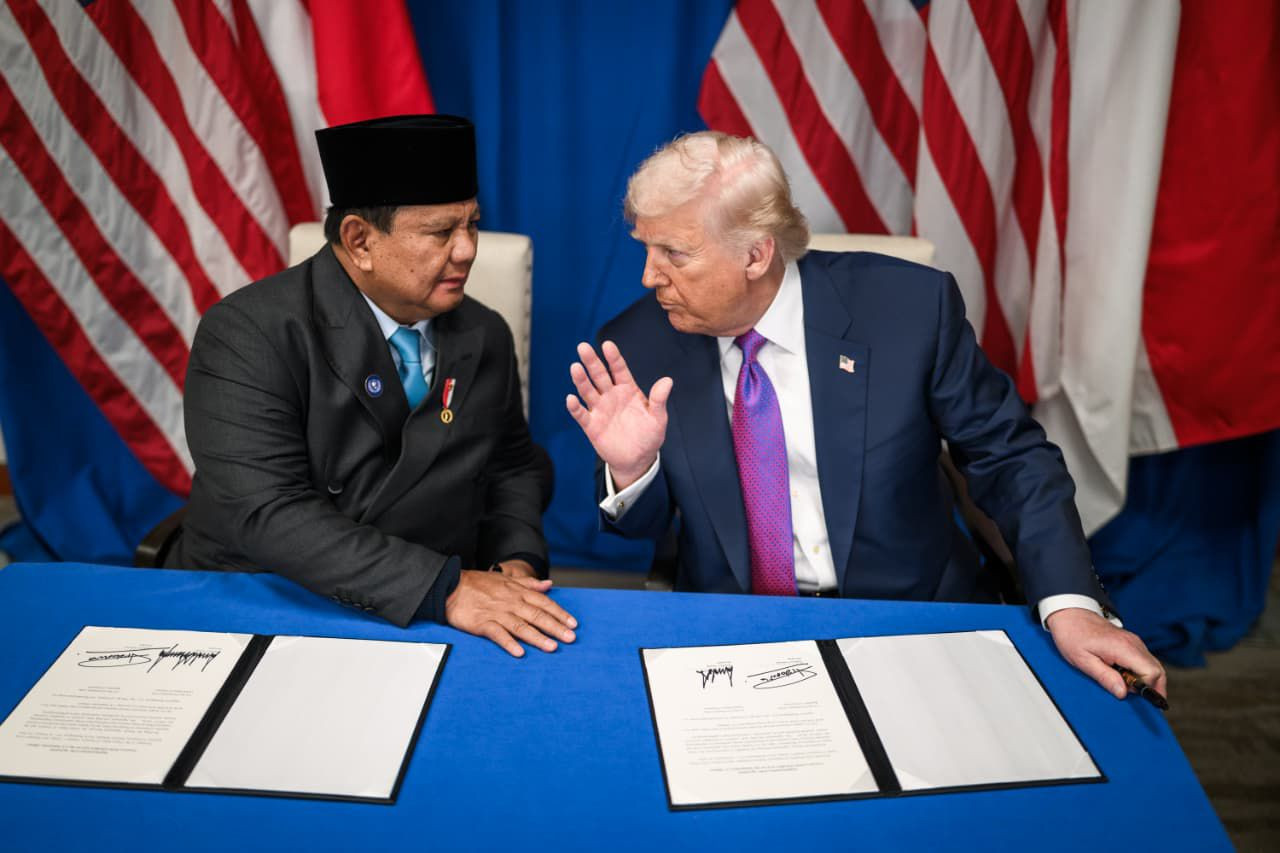 President Prabowo Subianto (left) speaks to United States President Donald Trump during the signing of the US-Indonesia Agreement on Reciprocal Tariffs (ART) in Washington, DC, on Feb. 19, 2026. The trade deal locks in tariff rates and non-tariff barriers to commerce between Indonesia and the US. (Courtesy of Presidential Secretariat/White House)
W
hen Indonesia and the United States signed the Agreement on Reciprocal Trade (ART) in February 2026, many hailed it as a diplomatic victory for energy security, especially amid the threatened closure of the Strait of Hormuz. But a closer look at the fine print reveals something far more troubling.
Buried within the ART are exemptions from Indonesia's local content rules (TKDN), the forced adoption of US Food and Drug Agency (FDA), Federal Motor Vehicle and Genetically Modified Organism standards, and a ban on taxing digital transactions. These are not mere trade rules; they are tools of asymmetric alignment used previously, from Cuba to France to Mexico, to serve US strategic priorities.
Three landmark cases show how Washington weaponizes legal frameworks to strip partner nations of autonomy. Their stories serve as a caution for Indonesia.
First, Helms-Burton, the blueprint for extraterritorial control.
In 1996, the US enacted the Helms-Burton Act, ratcheting up its decades-long embargo on Cuba. Its most venomous weapon was Title III, a provision that allowed American citizens to sue any company on Earth that “trafficked” in property seized after the 1959 Cuban revolution. This meant that Canadian mining firms, Spanish tourism groups and Mexican exporters, all companies engaged in legal trade with Cuba, suddenly faced the threat of US courtrooms.
For 23 years, US presidents waived Title III every six months for fear of a diplomatic backlash. Then, in 2019, the administration of President Donald Trump flipped the switch, fully activating the provision for the first time. European and Canadian governments protested fiercely; then-Spanish foreign minister Josep Borrell said it put the US “radically at odds” with allies. Yet, the White House pressed ahead.

The fallout was instantaneous. European and Canadian companies operating in Cuba were trapped in a legal vice. Within months, lawsuits flooded Florida federal courts against major global firms in shipping, banking and tourism, including A.P. Moller-Maersk, BNP Paribas, Société Générale, Booking.com and Meliá.