The Jakarta Post
Please Update your browser
Your browser is out of date, and may not be compatible with our website. A list of the most popular web browsers can be found below.
Just click on the icons to get to the download page.


Popular Reads
Top Results
No results found. Please check your search term and try again
Can't find what you're looking for?
View all search results
Popular Reads
Top Results
No results found. Please check your search term and try again
Can't find what you're looking for?
View all search resultsAnalysis: US-Iran conflict boosts Indonesia’s rising inflation via plastics
Change text size
Gift Premium Articles
to Anyone
Share the best of The Jakarta Post with friends, family, or colleagues. As a subscriber, you can gift 3 to 5 articles each month that anyone can read—no subscription needed!
 Set as preferred source
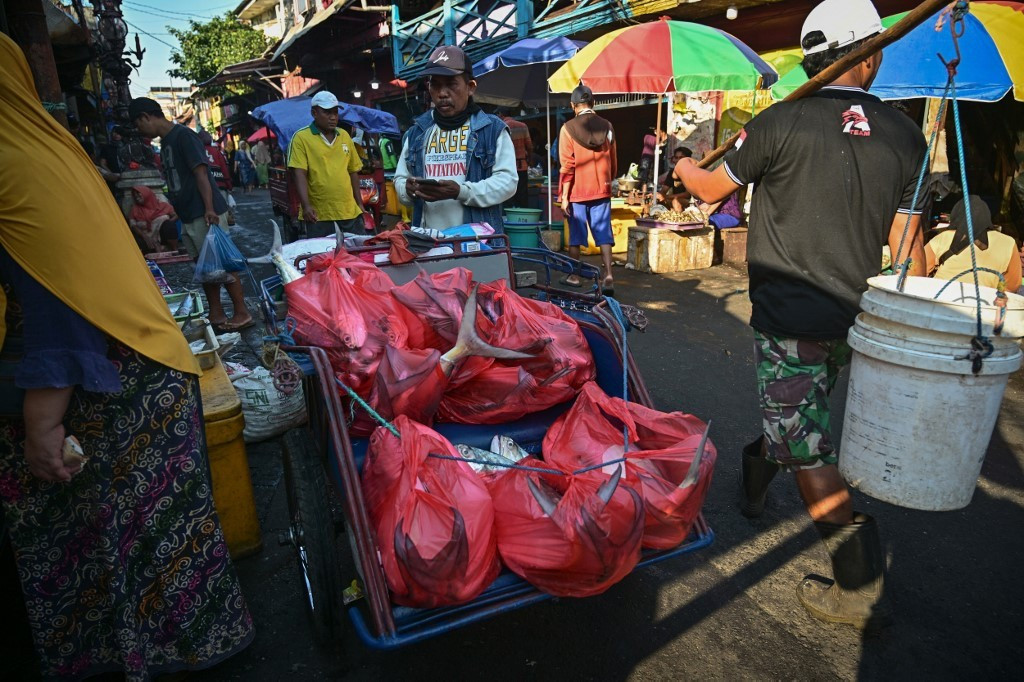 A becak (pedicab) driver delivers fish packed in plastic bags on Oct. 9, 2025, at a traditional fish market in Surabaya, East Java. (AFP/Juni Kriswanto)
T
he prolonged United States-Israeli war on Iran, coupled with the effective closure of the Strait of Hormuz, is beginning to ripple through global supply chains, particularly in oil and gas. The conflict is fueling cost-push inflation through rising prices of oil-derived products, especially plastics. Yet in Indonesia, the policy response remains limited, even as the economic impact becomes increasingly visible.
When the conflict escalated on Feb. 28, global crude oil prices surged. Brent crude climbed from around US$70 per barrel to a peak of $111 on March 20, driven in part by disruptions in the Strait of Hormuz, a critical artery for global energy trade. Although prices have since eased below $100, the downstream effects are only beginning to materialize.
One of the clearest transmission channels is plastics. Nearly 99 percent of global plastics are derived from fossil fuels, making them highly sensitive to oil price fluctuations. Two of the most widely used raw materials, polyethylene (PE) and polypropylene (PP), are heavily supplied by the Middle East, accounting for roughly a quarter of global production. As supply tightens and input costs rise, plastic prices have surged by up to 40 percent.
Plastics are deeply embedded across Indonesia’s consumer goods supply chain, particularly in packaging. As existing inventories deplete, producers are beginning to face significantly higher input costs, with few viable substitutes in the short term.
Indonesia’s vulnerability is compounded by its reliance on imported plastics, primarily from China, Thailand and South Korea. At the same time, major regional producers, including The Polyolefin Company, Rayong Olefins Company and Chandra Asri Pacific, have scaled back production in response to rising costs and supply constraints.
For businesses, especially micro, small and medium enterprises (MSMEs), this creates a difficult trade-off. Some firms have begun to pass on higher costs to consumers, but many lack pricing power due to weak demand and competitive pressures, forcing them to absorb the shock through shrinking profit margins.

The impact is already spilling over into households. Cooking oil prices, particularly for premium brands, have risen by 2.03 percent within a month, while increases in subsidized cooking oil Minyakita remain more contained at 0.48 percent. This reflects not only higher crude palm oil (CPO) prices but also rising packaging costs, highlighting the cascading effect of plastic price inflation.