TheJakartaPost
Please Update your browser
Your browser is out of date, and may not be compatible with our website. A list of the most popular web browsers can be found below.
Just click on the icons to get to the download page.


Popular Reads
Top Results
No results found. Please check your search term and try again
Can't find what you're looking for?
View all search results
Popular Reads
Top Results
No results found. Please check your search term and try again
Can't find what you're looking for?
View all search resultsAnalysis: Can Indonesia transform creativity into growth?
Change text size
Gift Premium Articles
to Anyone
Share the best of The Jakarta Post with friends, family, or colleagues. As a subscriber, you can gift 3 to 5 articles each month that anyone can read—no subscription needed!
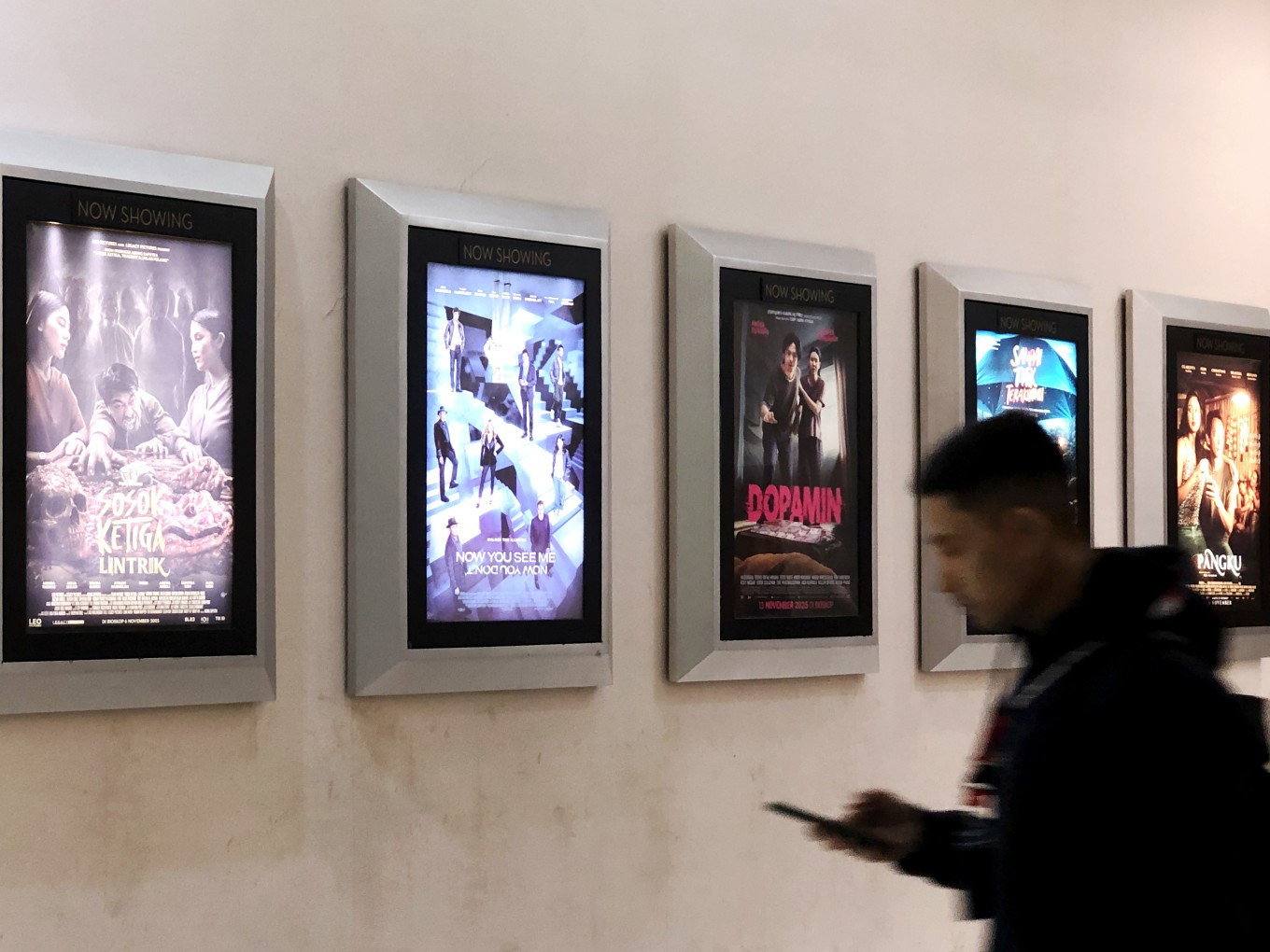 View of the 'Now Showing’ movie list as seen in front of Cinema XXI inside a shopping mall on Jl. Basuki Rachmat, East Jakarta, on Nov. 13, 2025. (The Jakarta Post/Iqro Rinaldi)
I
ndonesian popular culture is gaining global traction, with Joko Anwar’s Ghost in the Cell (2026) set to screen in 86 countries and music artists like NIKI, Anggun, Rossa and Voice of Baceprot touring internationally. Yet these successes remain largely driven by individual efforts, leaving the country’s creative industries with a fragmented and under-institutionalized global presence, highlighting the need to position the sector as a strategic industry.
Unlike South Korea, which has treated its culture as a strategic pillar of its creative economy as early as the 1990s, Indonesia is yet to place the sector at the center of its development strategy. Instead, the national economy remains heavily reliant on natural resource, particularly coal and palm oil as well as manufacturing industries. Without a well-defined policy framework and stronger government support, Indonesia risks underutilizing its creative industries, leaving their potential unfulfilled.
In 1994, South Korean president Kim Young-sam reportedly watched the Hollywood hit Jurassic Park and came away with a striking realization: the movie generated revenue equivalent to exporting 1.5 million cars, more than twice that country’s annual automobile exports at the time. That moment helped shift the policy mindset to position culture not merely as art but as a high-value industry.
Today, the Korean Wave is a global phenomenon and a core pillar of South Korea’s economic strategy. Its impact extends far beyond screens and stages and by 2025, cultural exports including music, games and film, alongside related sectors such as K-beauty and K-food, had reached an estimated US$37.94 billion, making culture the country’s fourth-largest export sector.
In Indonesia, the spillover effects of the creative economy are already visible, particularly in film. One notable example is Laskar Pelangi (The Rainbow Troops, 2008), which significantly boosted local tourism for Belitung Island with a surge in visitor arrivals following its release, contributing to a 20 percent increase in hotel occupancy between 2008 until 2009.
More recently, Ngeri-Ngeri Sedap (Missing Home, 2022) showcased the landscapes of North Sumatra, particularly around Lake Toba, while highlighting Batak culture. The film received strong institutional backing, including promotion by former tourism minister Sandiaga Uno. Although official data remain limited, early indications suggest a similar boost in tourism following its release in 2022. These cases demonstrate that, much like South Korea, Indonesia’s cultural products can generate meaningful economic spillovers.

Investment in the creative economy is gaining momentum and reached Rp 183.01 trillion ($10.68 billion) last year, or 9.48 percent of total investment. This reflects growing interest from both domestic and foreign investors, particularly in digital subsectors such as mobile applications and content development. Further, the sector is projected to absorb 27.4 million workers, underscoring its expanding role in job creation. Indonesia’s creative capacity, therefore, is no longer in question.