The Jakarta Post
Please Update your browser
Your browser is out of date, and may not be compatible with our website. A list of the most popular web browsers can be found below.
Just click on the icons to get to the download page.


Popular Reads
Top Results
No results found. Please check your search term and try again
Can't find what you're looking for?
View all search results
Popular Reads
Top Results
No results found. Please check your search term and try again
Can't find what you're looking for?
View all search resultsThe costs of Iran's permanent revolution
The room for maneuver of the ruling elite in Tehran is currently being hemmed in by a confluence of rigidity, fracture, decay and war, the very dynamics that have historically led to the erosion of revolutionary regimes and their incipient end.
Change text size
Gift Premium Articles
to Anyone
Share the best of The Jakarta Post with friends, family, or colleagues. As a subscriber, you can gift 3 to 5 articles each month that anyone can read—no subscription needed!
 Set as preferred source
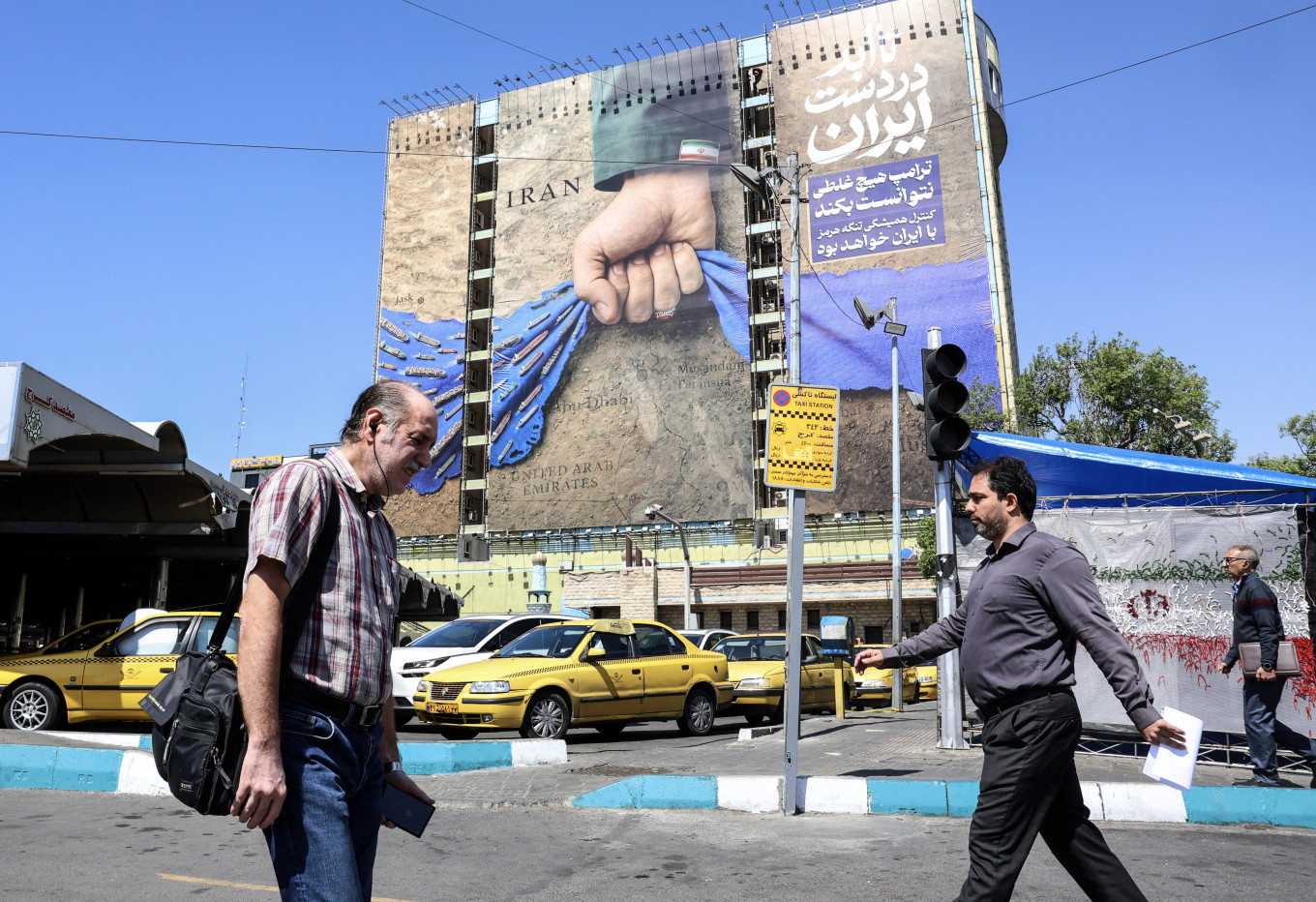 Two men walk past a billboard referring to the Strait of Hormuz on April 15, 2026, in Vanak Square, Tehran. (AFP/Stringer)
R
evolutionary regimes rarely collapse in a single dramatic moment. They fray, tire and lose coherence long before they stumble and fall. Their decline begins not in the streets but within the squabbles of the revolutionary elite. Over time, revolutionary institutions grow rigid, self-serving and detached from the societies in whose name they rule.
Iran’s present crisis, deepened by war, economic strain and political turbulence, offers a compelling moment to reflect on how such regimes unravel.
Developments over 2025-2026 have placed the Islamic Republic of Iran under extraordinary stress. Two rounds of coordinated United States-Israeli air strikes on its nuclear and military facilities have decimated, if not eliminated, Iran’s military deterrent.
Meanwhile, an economy battered by sanctions, isolation and structural mismanagement is grappling with punishing inflation that has eroded household incomes and deepened social frustration.
The popular anger that erupted in protests in late 2025 has not disappeared; it has merely been bottled up by the war and internal repression. Yet the underlying contradiction remains stark: between a regime that defines itself through revolutionary defiance and a society that increasingly demands economic stability and political normalcy.
History tells us change is inevitable; we have seen revolutionary regimes evolve over time or collapse.

China’s post-Mao turn under Deng Xiaoping in 1978 demonstrated how revolutionary regimes can reinvent themselves: by abandoning rigid ideology in favor of pragmatic adaptation in enlightened self-interest. The Vietnamese communists did much the same in the 1990s.