TheJakartaPost
Please Update your browser
Your browser is out of date, and may not be compatible with our website. A list of the most popular web browsers can be found below.
Just click on the icons to get to the download page.


Popular Reads
Top Results
No results found. Please check your search term and try again
Can't find what you're looking for?
View all search results
Popular Reads
Top Results
No results found. Please check your search term and try again
Can't find what you're looking for?
View all search resultsIn a fractured world order, where does the Global South fit in?
The era of a Western-dominated world order is over. This is obvious, but it will take some time to sink in across the West.
Change text size
Gift Premium Articles
to Anyone
Share the best of The Jakarta Post with friends, family, or colleagues. As a subscriber, you can gift 3 to 5 articles each month that anyone can read—no subscription needed!
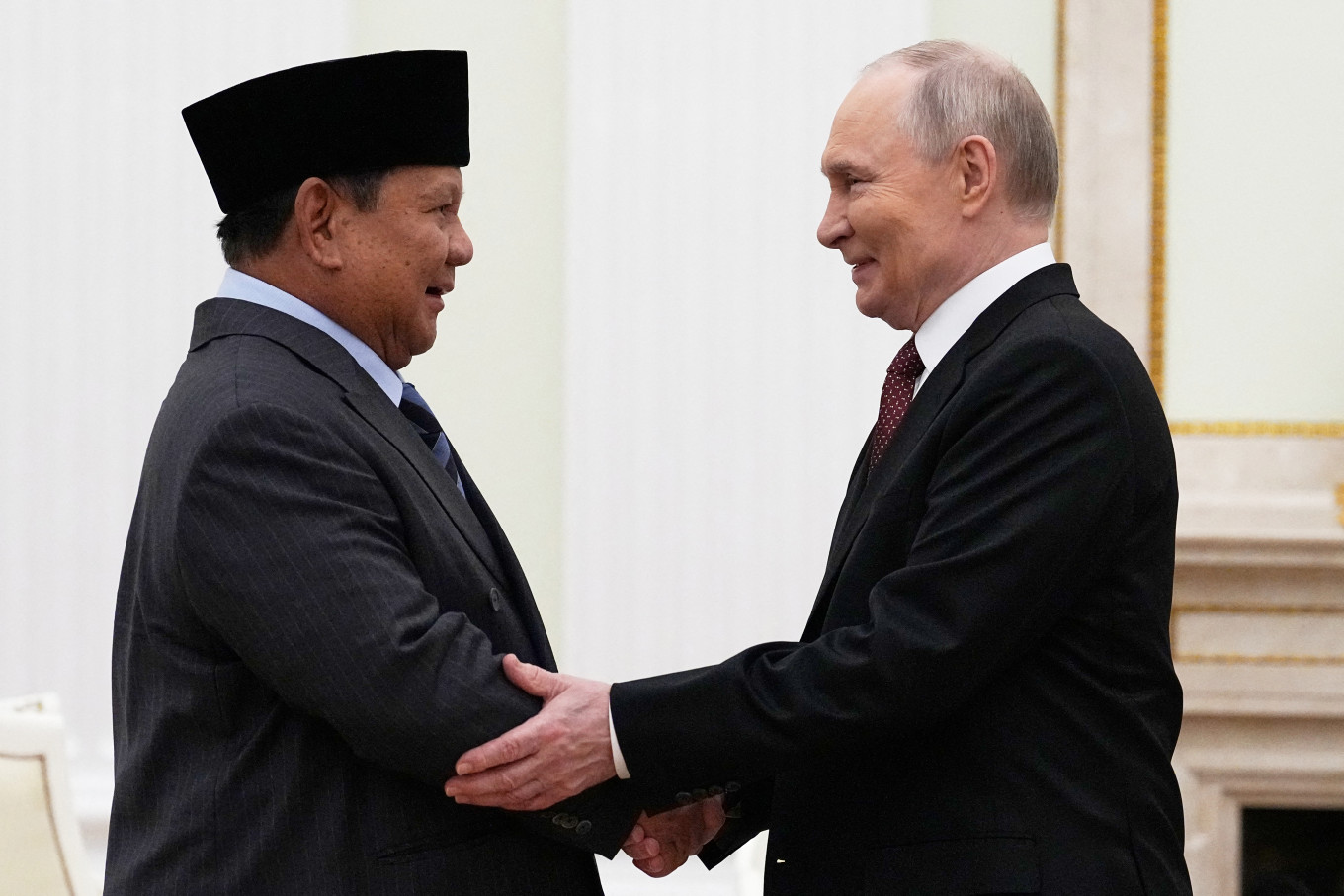 President Prabowo Subianto (left) and Russian President Vladimir Putin shake hands during their meeting on Dec, 10, 2025, at the Senate Palace of the Kremlin in Moscow. (AFP/Pool/Alexander Zemlianichenko)
C
anadian Prime Minister Mark Carney was one of the first world leaders to speak out about the “ruptured” world order caused by United States President Donald Trump's administration. He called for middle powers to band together to safeguard what’s left of the liberal world order.
But what role will the Global South play in all of this?
Some believe it will be decisive. Earlier this year, Finland’s president Alexander Stubb said at a conference in India, “the Global South will decide what the next world order will look like”.
The global balance of power has shifted. The Global South has both demography and economy on its side. The era of a Western-dominated world order is over. This is obvious, but it will take some time to sink in across the West.
So, how can the Global South influence which direction the world takes?
It may be too early to declare the end of the Western-dominated world order. While the war in Iran may be leading some countries to question the current system, in which might appears to make right, the Global South is far from a unified bloc.

First, there is no agreed definition or scope of the “Global South”. The name infers countries located in the Southern Hemisphere, but many Global South countries are north of the equator, while Australia and New Zealand are considered part of the “Global North”.
Some lump Africa, Latin America and Asia together in the Global South grouping, but this is too simplistic. And what to make of a major economy like China? Some include it in the Global South, while others do not.
An important feature of the Global South is there is no single state widely accepted as its leader, nor is there strong support for such leadership.
While China is influential in parts of the developing world through its “noninterference” foreign policy approach, India, with its strong ties to the West, is unlikely to accept Chinese global leadership.
Whatever definition one uses, the behavior of some states in the Global South shows they are trying to conduct foreign policy with multiple players, joining different clubs to pursue their national interests above all else.
These groups, however, haven’t proven to be very effective or united in responding to recent conflicts, raising questions about their level of influence.
Take the BRICS, for example. The coalition has expanded in recent years to ten countries, including Iran and the United Arab Emirates, which has been attacked by Iran in the current war.
Yet the group has failed to take a unified position on the war. China and Russia have condemned the US–Israeli attacks on Iran, while other members such as India have taken a cautious approach, calling for de-escalation.
Some commentators have noted a central problem: the BRICS members remain divided on many core strategic issues, without a central platform to resolve disputes.
When it comes to the Iran conflict and the future of the Middle East, individual nations in the Global South have their own agendas, as well.
China, for instance, would lose a key partner if the Iranian regime were to collapse. Iran is a member of the China-led Shanghai Cooperation Organisation and an important partner in China’s efforts to create alternatives to Western-dominated governance. Moreover, China relies on a stable, secure access to oil and gas shipments through the Strait of Hormuz.
Pakistan has emerged as a key mediator between the US and Iran. This is a chance for it to take a much bigger role on the global stage. But it is also keen to ensure its defense partner, Saudi Arabia, is not drawn into a wider war. Under their defense arrangement, Pakistan would have to assist Saudi Arabia if the kingdom were attacked.
And India maintains an independent foreign policy based on “strategic autonomy”, allowing it to manage relations across competing blocs. As India's Foreign Minister S. Jaishankar has noted, India is not a Western country, nor is it “anti-Western”. This allows it to remain a key strategic partner to the US, while also renewing purchases of Iranian oil and gas.
In his recent book, The Triangle of Power, Stubb argues the world is dividing into three parts, the global west (still led by the US), the global east (led by China and Russia) and the Global South (comprised of middle and small powers in Africa, Latin America, the Middle East and Asia).
According to Stubb, the global order is at a crossroads between west and east, with the south being the pendulum that will decide which way the world swings. To maintain the old liberal world order, the west needs to get the south on its side.
But again, this is too simplistic a view. I believe nations in the Global South have a preference for multipolarity, this is, a world order not dominated by one power, such as the US or China.
They are also interested in having their voices heard in the global arena. Because many Global South countries are former colonies of Western powers, they want to address the harm or injustices of colonialism they perceive as continuing in the current international system. South Africa’s move to hold Israel accountable at the International Court of Justice for its war in Gaza is an example of this.
At the same time, the current rupture in the international system has reinforced the importance of alternative diplomatic spaces and flexible alignments, allowing states to shift partnerships where it best serves their interests.
That means cooperating with the West when it suits them, while simultaneously cooperating with China, Russia or other blocs and powers.
Indonesia is a case in point. In the past month, it has signed a major defense agreement with Washington, while President Prabowo Subianto also visited Moscow to meet with Russian President Vladimir Putin.
The Global South is clearly becoming more relevant in today’s power politics. Just how these nations choose to exert their influence remains to be seen.
---
The writer is a lecturer at the National Security College, Australian National University. This article is republished under a Creative Commons license.