The Jakarta Post
Please Update your browser
Your browser is out of date, and may not be compatible with our website. A list of the most popular web browsers can be found below.
Just click on the icons to get to the download page.


Popular Reads
Top Results
No results found. Please check your search term and try again
Can't find what you're looking for?
View all search results
Popular Reads
Top Results
No results found. Please check your search term and try again
Can't find what you're looking for?
View all search resultsReading the 2026 fuel adjustment: A middle-class story
With Pertalite access tightening and Pertamax prices moving at the same time, households need a predictable schedule to plan around when making decisions about vehicle choices, mobility patterns and monthly budgets.
Change text size
Gift Premium Articles
to Anyone
Share the best of The Jakarta Post with friends, family, or colleagues. As a subscriber, you can gift 3 to 5 articles each month that anyone can read—no subscription needed!
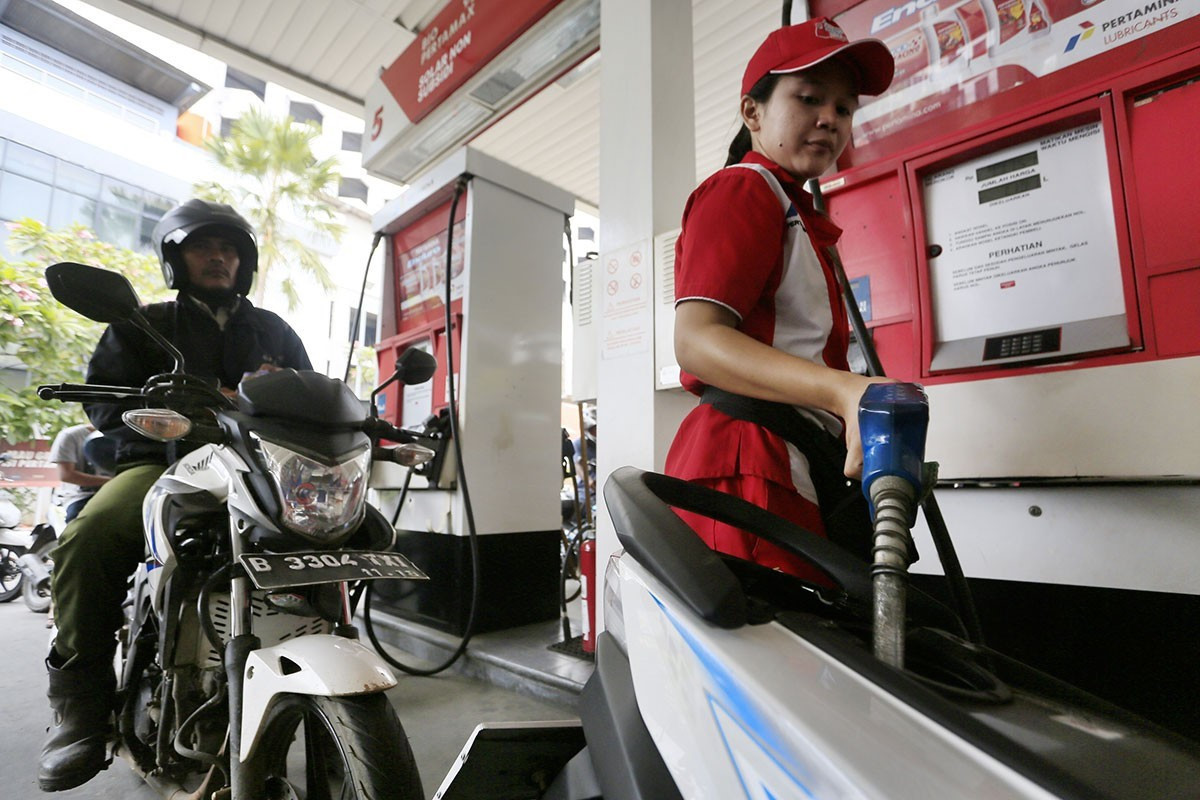 An attendant fills up a motorcycle with gasoline at a gas station owned by state-owned oil and gas company Pertamina in Jakarta. (JP/Dhoni Setiawan) (JP/Dhoni Setiawan)
H
ans Rosling, in his book Factfulness, once wrote that what matters about numbers is not the numbers themselves, but what they tell us about the lives behind them. The numbers behind Indonesia’s 2026 fuel price adjustment tell one such story: this shock is narrower than in 2022, but for the households it does reach, the room to absorb it has become much tighter.
In September 2022, fuel prices rose broadly across both subsidized and nonsubsidized categories, affecting households at every income level. The government responded with cash transfers for lower-income families, helping cushion the impact of a nationwide shock.
In 2026, the picture is different. Only selected nonsubsidized fuels have seen price hikes. On April 18, the prices of Pertamax Turbo, Dexlite and Pertamina Dex were adjusted upward, while Pertamax, the most widely used nonsubsidized fuel, remains unchanged for now. Pertalite, the subsidized fuel, has also stayed at its current price, as part of a deliberate effort to protect the poorest.
As a result, households relying on subsidized fuel are largely insulated, but the pressure is falling on the middle class.
Our analysis based on the National Socioeconomic Survey (Susenas) shows how uneven that exposure is. Upper-class households consume about 36 liters of fuel per person per month on average, while poor households use closer to 2 liters.
But when we look at how much of the non-food budget fuel actually takes up, the picture inverts. Fuel accounts for 11 percent of the non-food budget for vulnerable households and around 9 percent for the lower-middle class, compared to just 5 percent for the upper class. The middle class is not the biggest consumer of fuel in absolute terms, but a fuel price shock takes a bigger bite out of its monthly budget.

That exposure is falling on a lower-middle class (with expenditure 3.5–8.5 times the poverty line) that is already under pressure. Between 2019 and 2025, the lower-middle-class population shrank by roughly 11 million people, from 51.9 million to 40.8 million.