The Jakarta Post
Please Update your browser
Your browser is out of date, and may not be compatible with our website. A list of the most popular web browsers can be found below.
Just click on the icons to get to the download page.


Popular Reads
Top Results
No results found. Please check your search term and try again
Can't find what you're looking for?
View all search results
Popular Reads
Top Results
No results found. Please check your search term and try again
Can't find what you're looking for?
View all search resultsEast Asia’s stability cannot be taken for granted
What lessons can our region, East Asia, learn to avoid falling into security predicaments and instability?
Change text size
Gift Premium Articles
to Anyone
Share the best of The Jakarta Post with friends, family, or colleagues. As a subscriber, you can gift 3 to 5 articles each month that anyone can read—no subscription needed!
 Set as preferred source
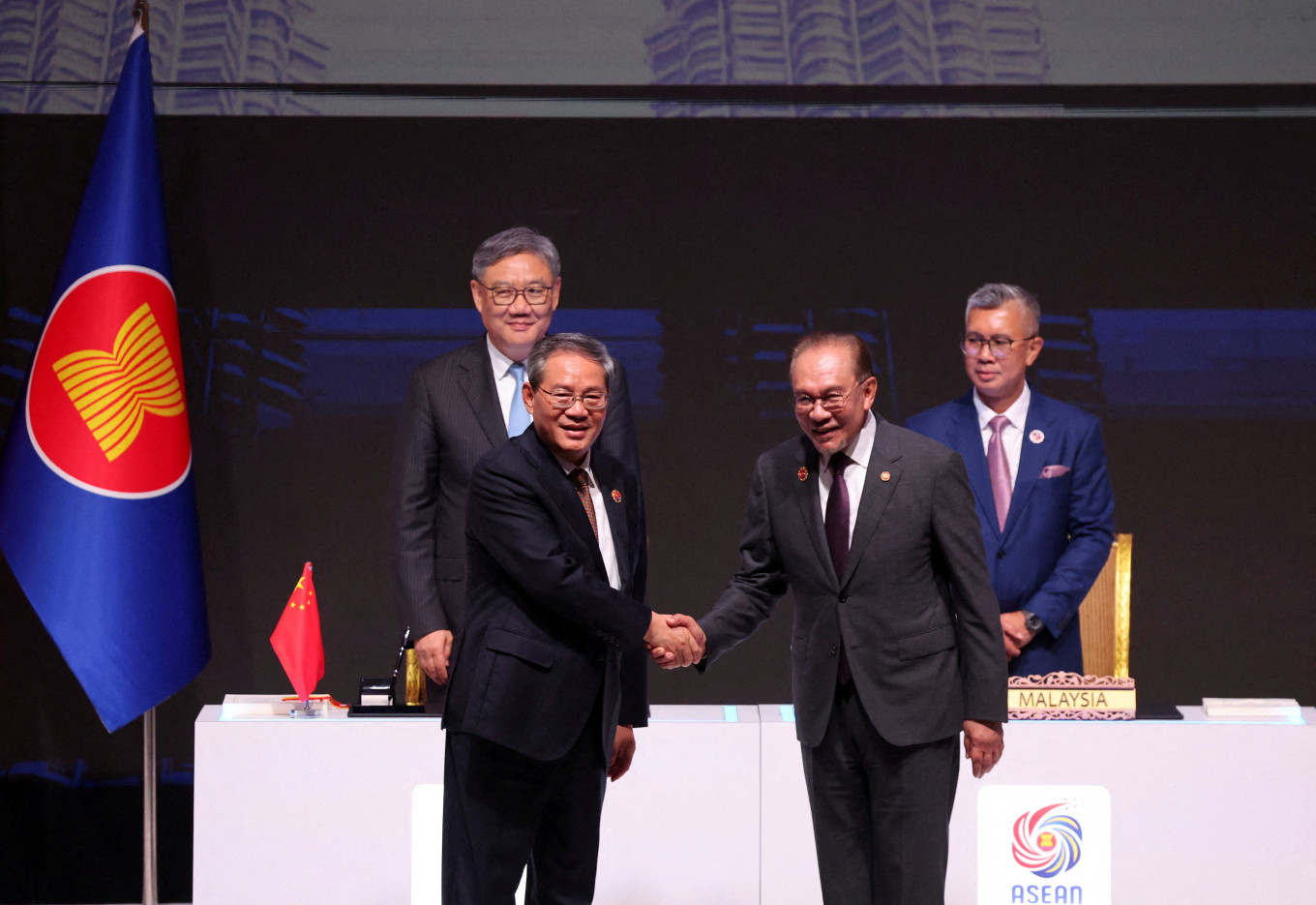 ASEAN chairman and Malaysia's Prime Minister Anwar Ibrahim and Chinese Premier Li Qiang shake hands after witnessing the signing of the ASEAN-China Free Trade Area 3.0 Upgrade signed by Malaysia Trade Minister and ASEAN Economic Ministers chairman Tengku Zafrul Aziz and Chinese Commerce Minister Wang Wentao ahead of the 28th ASEAN–China Summit, held as part of the 47th ASEAN Summit in Kuala Lumpur, Malaysia on Oct. 28, 2025. (Reuters/Hasnoor Hussain)
T
he world today is far from being tranquil. The Ukraine crisis is still dragging on. The war in the Middle East has put both the existing world order and the global economy under severe challenge. Efforts are being made in the international community to help the region emerge from the shadows of conflict at an early date.
China is also working actively and constructively to restore peace to the Middle East. Recently, President Xi Jinping put forward four propositions on promoting peace and stability in the Middle East. Earlier, China and Pakistan also jointly proposed a five-point initiative for restoring peace and stability in the Gulf and Middle East region.
As we strive to deal with the chaotic situation in the Middle East and overcome its spillover effects, we should also seriously ponder on this one big question: What lessons can our region, East Asia, learn to avoid falling into security predicaments and instability?
Compared with the pain of Europe and the chaos in the Middle East, East Asia has for long maintained overall stability and rapid economic growth. However, peace and development can never be taken for granted.
Our region is still facing many uncertainties and destabilizing factors. Hot-spot issues remain unresolved with new manifestations from time to time. Disputes over territorial sovereignty and maritime rights and interests persist. Acts of "neo-militarism" by an individual country are posing a direct threat to the post-war international order. Some countries outside the region are busy cobbling together exclusive "small circles" in the name of security cooperation and provoking confrontation for their own geopolitical interests.
Against an international situation fraught with chaos and changes, and in the face of regional security challenges, we should uphold the idea of building a community with a shared future, and adopt a security perspective that emphasizes common, comprehensive, cooperative and sustainable security.

We should eliminate the root causes of conflicts through development, address security challenges with a win-win mindset, and foster an enabling environment for development through security cooperation. We should say no to the Cold War mentality, zero-sum games and confrontation by exclusive "small-circles" and join hands in building a peaceful, safe and secure home for us all.