TheJakartaPost
Please Update your browser
Your browser is out of date, and may not be compatible with our website. A list of the most popular web browsers can be found below.
Just click on the icons to get to the download page.


Popular Reads
Top Results
No results found. Please check your search term and try again
Can't find what you're looking for?
View all search results
Popular Reads
Top Results
No results found. Please check your search term and try again
Can't find what you're looking for?
View all search resultsWeakening rupiah: No panic required, professional heads-up urged
As the rupiah grapples with a "perfect storm" of global dollar strength and domestic regulatory uncertainty, Indonesia faces a critical test of market confidence that may require a fresh infusion of professional leadership to resolve.
Change text size
Gift Premium Articles
to Anyone
Share the best of The Jakarta Post with friends, family, or colleagues. As a subscriber, you can gift 3 to 5 articles each month that anyone can read—no subscription needed!
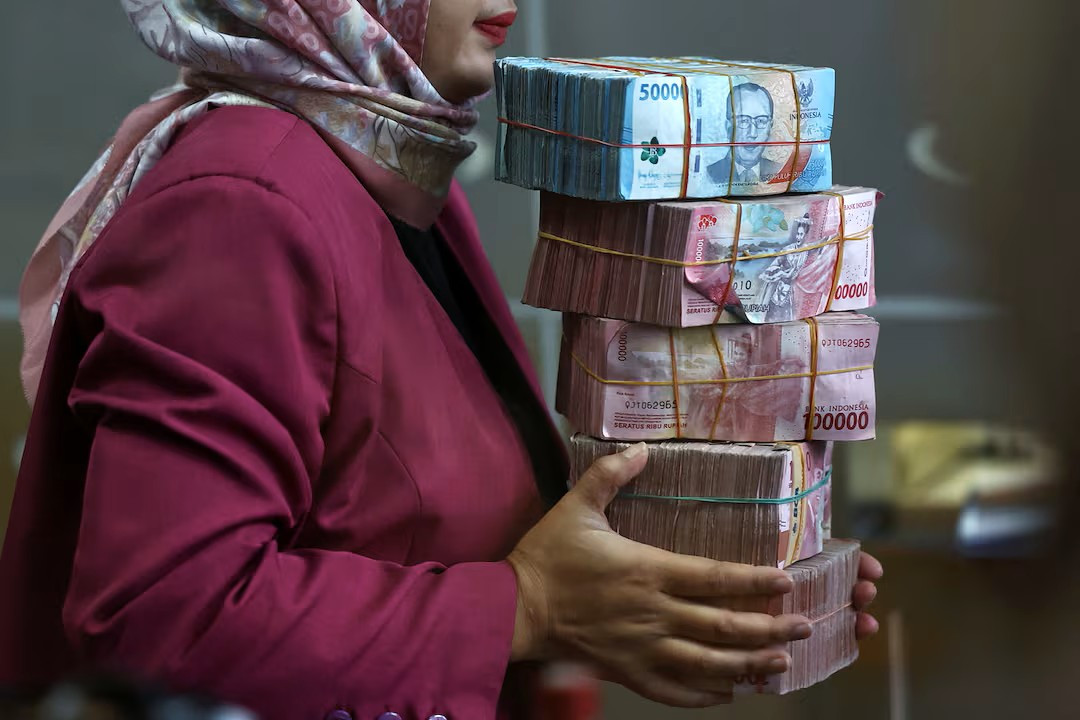 A teller, seen through a window, holds rupiah bank notes at a money changer in Jakarta on April 9, 2025. (Reuters/Willy Kurniawan)
T
he rupiah weakened to its new low of 17,400 per United States dollar on Wednesday, due to pressures from a convergence of global dollar strength, capital outflows, policy uncertainty and structural vulnerabilities in the country’s equity and bond markets, according to analysts and market data.
The depreciation came as investors continued to reduce exposure to Indonesian assets amid heightened risk aversion and lingering concerns raised by global index provider MSCI. Market participants say the move reflects stacked pressures rather than a single shock, with global factors amplifying domestic confidence risks.
The dominant driver remains a resilient US dollar, underpinned by elevated US interest rates and strong demand for safe-haven assets. With US Treasury yields still attractive, emerging-market currencies such as the rupiah have come under renewed pressure as investors unwind carry trades and shift funds into dollar-denominated assets.
Strategists note that even countries with relatively stable macroeconomic fundamentals have struggled to resist this global trend, particularly those with open capital accounts.
Adding to the pressure, MSCI stated on April 21 that it would extend its review of Indonesia’s equity market to June, citing the need for more time to assess the effectiveness of recent reforms aimed at improving transparency and free-float quality.
While MSCI acknowledged regulatory progress, including expanded shareholder disclosures and higher minimum free-float requirements, it maintained all interim restrictions, including freezes on index additions and foreign inclusion factors. Crucially, MSCI left open the risk of a future downgrade from emerging-market to frontier-market status if reforms are not sufficiently validated.

For currency markets, analysts say this perpetuates uncertainty rather than providing a resolution.