TheJakartaPost
Please Update your browser
Your browser is out of date, and may not be compatible with our website. A list of the most popular web browsers can be found below.
Just click on the icons to get to the download page.


Popular Reads
Top Results
No results found. Please check your search term and try again
Can't find what you're looking for?
View all search results
Popular Reads
Top Results
No results found. Please check your search term and try again
Can't find what you're looking for?
View all search resultsWarning lights flash as aluminum reels from Gulf shock
Change text size
Gift Premium Articles
to Anyone
Share the best of The Jakarta Post with friends, family, or colleagues. As a subscriber, you can gift 3 to 5 articles each month that anyone can read—no subscription needed!
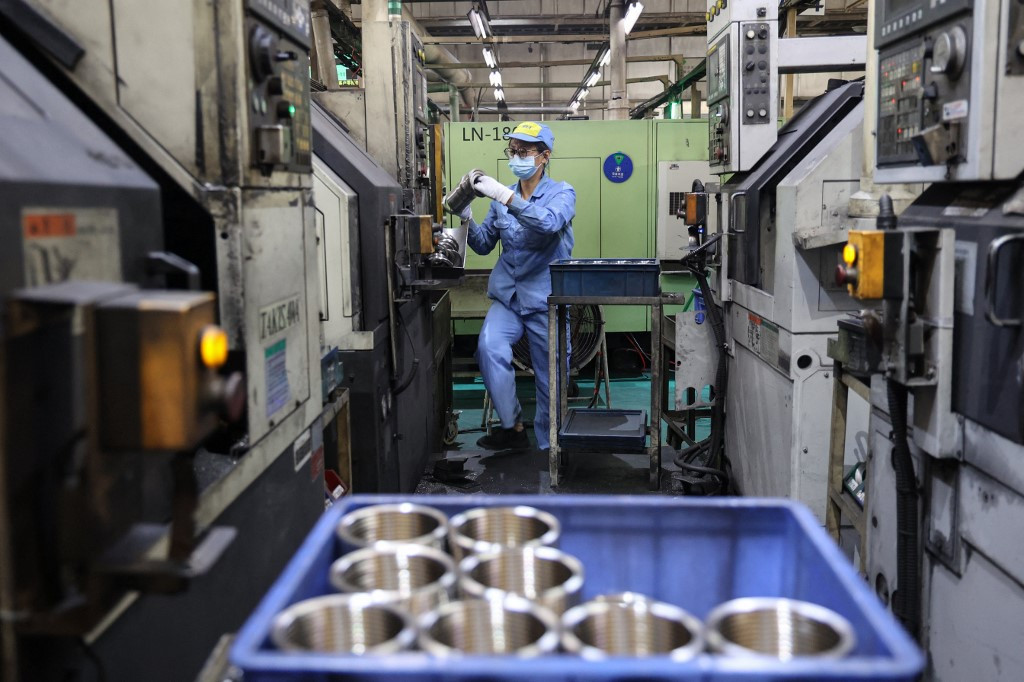 An employee works on an aluminum piston ring production line at a factory that produces car parts in Binzhou, in eastern China's Shandong province on Oct. 14, 2024. (AFP/-)
The Iran war is shaping up to be one of the biggest supply shocks in the history of the aluminum market.
Gulf production of the metal, which is used across sectors as diverse as transportation, packaging and solar panels, has plummeted to its lowest level in over a decade in April, according to the International aluminum Institute (IAI). Regional run-rates dropped by an annualized 2 million tonnes over March and April.
Two Gulf aluminum smelters have been damaged in missile strikes. Emirates Global aluminum's Al Taweelah plant will take a year to repair. At least one other producer, Qatalum, has reduced capacity.
The continued closure of the Strait of Hormuz is causing major logistical problems for those still operating.
The Gulf accounts for over a fifth of non-Chinese production and is a core supplier to buyers in Japan, South Korea, the European Union and the United States.
The scale of the supply hit is not obvious from the London Metal Exchange (LME) price, which at US$3,650 per tonne is up by just 14 percent since the start of hostilities and has yet to scale the 2022 heights that followed Russia's invasion of Ukraine.

But red lights are flashing on the market dashboard.
The first is the sharp tightening in LME time-spreads. The LME's benchmark cash-to-three-months spread flipped into backwardation in early March and cash is currently trading at an $80 premium, the tightest the market has been since 2007. Back then it was a short-lived squeeze on short position holders. This time around the tightness is persistent and looks structural.
That is because LME stocks, which were already low, have been raided as traders look to fill the supply-chain gaps opening up due to the loss of Gulf production.
LME registered stocks have fallen by a third to 339,475 tonnes since the start of the year. The last couple of weeks have seen almost 68,000 tonnes canceled in preparation for physical load-out.
The residual tonnage left on LME warrant is now largely Russian aluminum being stored at the South Korean port of Gwangyang. That is no use to either US or European buyers due to sanctions imposed over the Ukraine war.
The recent daily drawdowns have not been transferred to off-warrant storage. These LME "shadow" stocks have also been draining away and are the lowest they've been since the exchange started reporting off-warrant stocks in 2020.
The second warning sign is the rise in physical premiums around the world.
The CME spot premium for Japan has more than doubled to $316 per tonne over the LME price since the start of hostilities. Japanese buyers have accepted a premium of $350 for their second-quarter deliveries, which is the highest surcharge in 11 years.
The European duty-paid premium has jumped by 58 percent and the duty-unpaid by 75 percent since the start of March.
The US Midwest premium has risen by a relatively modest 8 percent but American buyers were already paying record numbers to secure physical metal thanks to the impact of 50 percent import tariffs.
These are the most visible manifestations of the Gulf supply shock. Less visible is what is going on in non-exchange-traded segments of the market such as billet, a product used by construction and transportation sectors.
In Rotterdam, the premium for aluminum extrusion billet has more than doubled to $1,100 over the LME base price, according to price reporting agency Fastmarkets.
The relative calm of the LME outright price belies a severe tightening of availability along the processing chain.
While LME traders are pricing in the ebb and flow of headlines around the Iran war, physical buyers are paying up just to secure enough metal in a market that is heading toward a structural supply deficit.
The loss of production in the Gulf has been compounded by the closure due to high energy prices of the Mozal smelter in Mozambique.
The combined hit has been a 2.4-million-tonne drop in Western production over the last two months, according to the IAI's latest figures. Things may get worse depending on whether those Gulf smelters are still producing enough raw materials via routes that circumvent the Strait of Hormuz.
China's giant aluminum production base has stepped up production but is now running close to the government's capacity cap, leaving little room for further significant upside.
While the country is showing signs of increasing exports in reaction to the Gulf supply hit, these shipments will mostly be in the form of semi-processed products such as strip, foil and bars rather than raw metal.
Inventories, both exchange and non-exchange, can provide some short-term buffer but the longer the Strait of Hormuz remains closed, the thinner that cushion becomes.
All of this is a generational shock for a market that has lived with structural oversupply and high inventories for the last 20 years.
The aluminum price is not yet reflecting the tectonic changes in the supply chain. Physical buyers, however, already know how much the landscape has changed.
---
The writer is a columnist for Reuters. The views expressed are personal.