TheJakartaPost
Please Update your browser
Your browser is out of date, and may not be compatible with our website. A list of the most popular web browsers can be found below.
Just click on the icons to get to the download page.


Popular Reads
Top Results
No results found. Please check your search term and try again
Can't find what you're looking for?
View all search results
Popular Reads
Top Results
No results found. Please check your search term and try again
Can't find what you're looking for?
View all search resultsHow to leverage trade to fight and recover from COVID-19
The RCEP marks the culmination of integration efforts that began decades ago in Asia and the Pacific.
Change text size
Gift Premium Articles
to Anyone
Share the best of The Jakarta Post with friends, family, or colleagues. As a subscriber, you can gift 3 to 5 articles each month that anyone can read—no subscription needed!
E
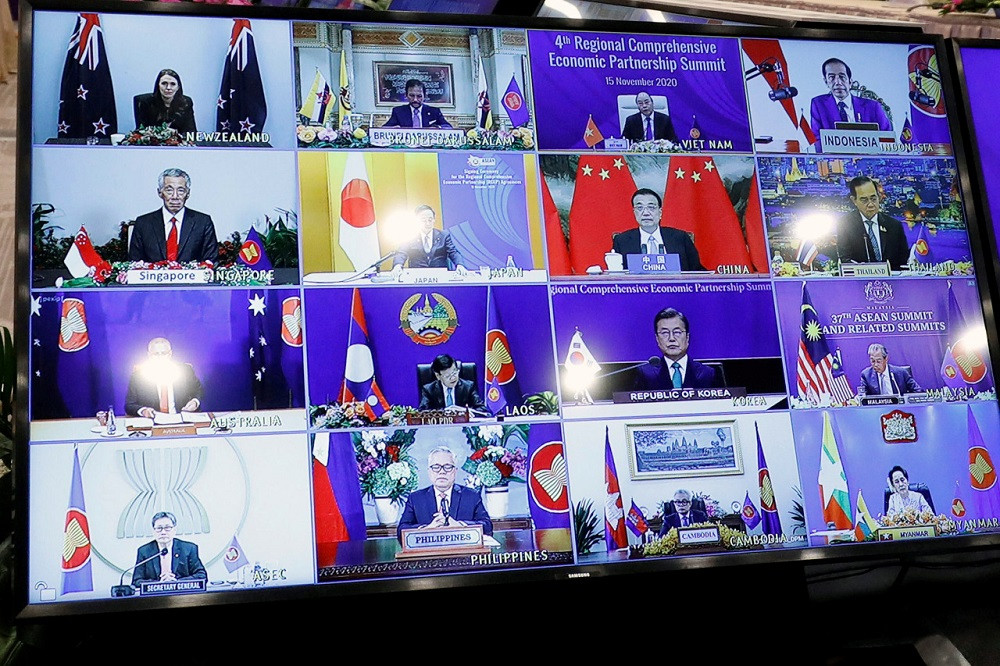
arlier this month, 15 Asian and Pacific countries signed the Regional Comprehensive Economic Partnership (RCEP) in a virtual ceremony in Hanoi. The agreement reflects the firm belief of Asian and Pacific leaders that deepening trade boosts prosperity in the entire region.
After a transition period, it will eliminate tariffs on more than 80 percent of products traded intra-regionally. It will also harmonize more regulations and policies between members, including favorable cumulative rules of origin.
The RCEP will become the largest plurilateral trade agreement in the world, involving about 30 percent of global GDP and about the same share of the world’s population. It is expected to add US$186 billion to the world economy.
The RCEP marks the culmination of integration efforts that began decades ago in Asia and the Pacific. Embracing openness and regional cooperation, the region’s trade-to-GDP ratio rose from 17 percent in 1965 to 53 percent in 2018, contributing to unprecedentedly rapid economic growth. In the same period, the region’s share of global GDP increased from 13 percent to 33 percent.
What’s more, the ongoing COVID-19 pandemic has demonstrated that trade is not only a reliable engine of growth in the region, but has also been instrumental in fighting the virus. At the start of the pandemic, trade restrictions and export bans severely interrupted international supply chains. However, governments in Asia and the Pacific quickly realized the crucial role of trade in balancing the swings in demand and supply and filling domestic gaps.
As a result, struggling economies were able to import critical goods from other economies, which were able to continue production. Many early trade restrictions were, thus, subsequently lifted, as governments recognized that open borders were vital to ensuring adequate supply of critical goods, not least the personal protective equipment so crucial in this pandemic.
Trade has thus been a key tool in fighting COVID-19, and looking ahead, it will be vital for economic recovery. Indeed, the pandemic will have lasting impact on how we trade and do business across borders.
First, the pandemic has accelerated digital transformation across Asia and the Pacific, with profound implications for international trade. For example, agricultural businesses, including those of small farmers, tried new ways to market their produce by offering them directly to consumers online.
Using online platforms to sell products domestically is a first big step toward selling them internationally and linking up to the global value chain. In the years to come, we will see digital trade contribute to new growth opportunities for companies, especially small firms, throughout the region.
Second, COVID-19 has changed the way we work. Many of us have seen our workplaces shift from office buildings to home offices. Many companies have seen that an employee’s physical presence is no longer essential. Modern information and telecommunication technology allows us to work together remotely and productively. These work arrangements may not be feasible for all jobs in all economic sectors, but the potential is enormous. Most jobs done remotely within countries can also be carried out across borders.
The digital transformation triggered by COVID-19 will, thus, spur services trade under the mode-1 type of the World Trade Organization’s General Agreement on Trade in Services. This means that services are supplied from one country to the other through telecommunication or postal infrastructure, without people having to cross borders. This type of trade in services presents many opportunities for developing countries during the pandemic, as services can be delivered remotely.
Third, the pandemic has triggered the reorganization of international supply chains. Firms have realized that overreliance on a limited number of suppliers carries a high risk during a natural or health disaster. Multinational companies will likely lead efforts to diversify supply chains and, thus, increase their robustness. This is a departure from traditional just-in-time supply chain management. Developing countries will benefit from this trend if they can offer viable options for production of tradeable goods and services.
However, the opportunities offered by the accelerated digitalization and the reorganization of global supply chains will not be automatic. Access to affordable internet needs to expand. To ensure these opportunities translate into gains for large population segments, governments also need to invest heavily to improve the quality of education and vocational training.
With accelerating technological advances—through artificial intelligence, robotics, machine learning, and others—routine jobs in services will no longer require heavy human capital inputs. It is, therefore, crucial that the workforce has the skill sets to undertake complex tasks, using adroit technologies and knowledge. We expect that well-trained workers in developing countries will be able to continue to work remotely and find well-paid jobs in services.
Furthermore, to reap the benefits of expanded and diversified value chains, more investments are needed to build reliable and efficient physical transport infrastructure, thereby supporting seamless flows of goods. Besides hard infrastructure, “soft” logistics also must improve. This can happen by modernizing port, airport and border-crossing management information systems; by facilitating digital and paperless trade; and by simplifying administrative procedures through measures like single-window systems.
Finally, regional cooperation and integration should be enhanced through regulatory harmonization and policy coordination, as showcased by the latest regulation in RCEP.
The challenges of the pandemic remain unprecedented, but we can transform these into opportunities by seizing the momentum of evolving global value chains and by embracing the potential offered by technologies and services trade. Regional cooperation initiatives such as RCEP will hopefully make this task easier.
***
The writer is Asian Development Bank vice-president for knowledge management and sustainable development.