TheJakartaPost
Please Update your browser
Your browser is out of date, and may not be compatible with our website. A list of the most popular web browsers can be found below.
Just click on the icons to get to the download page.


Popular Reads
Top Results
No results found. Please check your search term and try again
Can't find what you're looking for?
View all search results
Popular Reads
Top Results
No results found. Please check your search term and try again
Can't find what you're looking for?
View all search resultsWorld Bank holds Indonesia’s GDP growth forecast for 2021
The bank found that Indonesia lagged behind some Asian countries in its approach to containing the COVID-19 pandemic.
Change text size
Gift Premium Articles
to Anyone
Share the best of The Jakarta Post with friends, family, or colleagues. As a subscriber, you can gift 3 to 5 articles each month that anyone can read—no subscription needed!
T
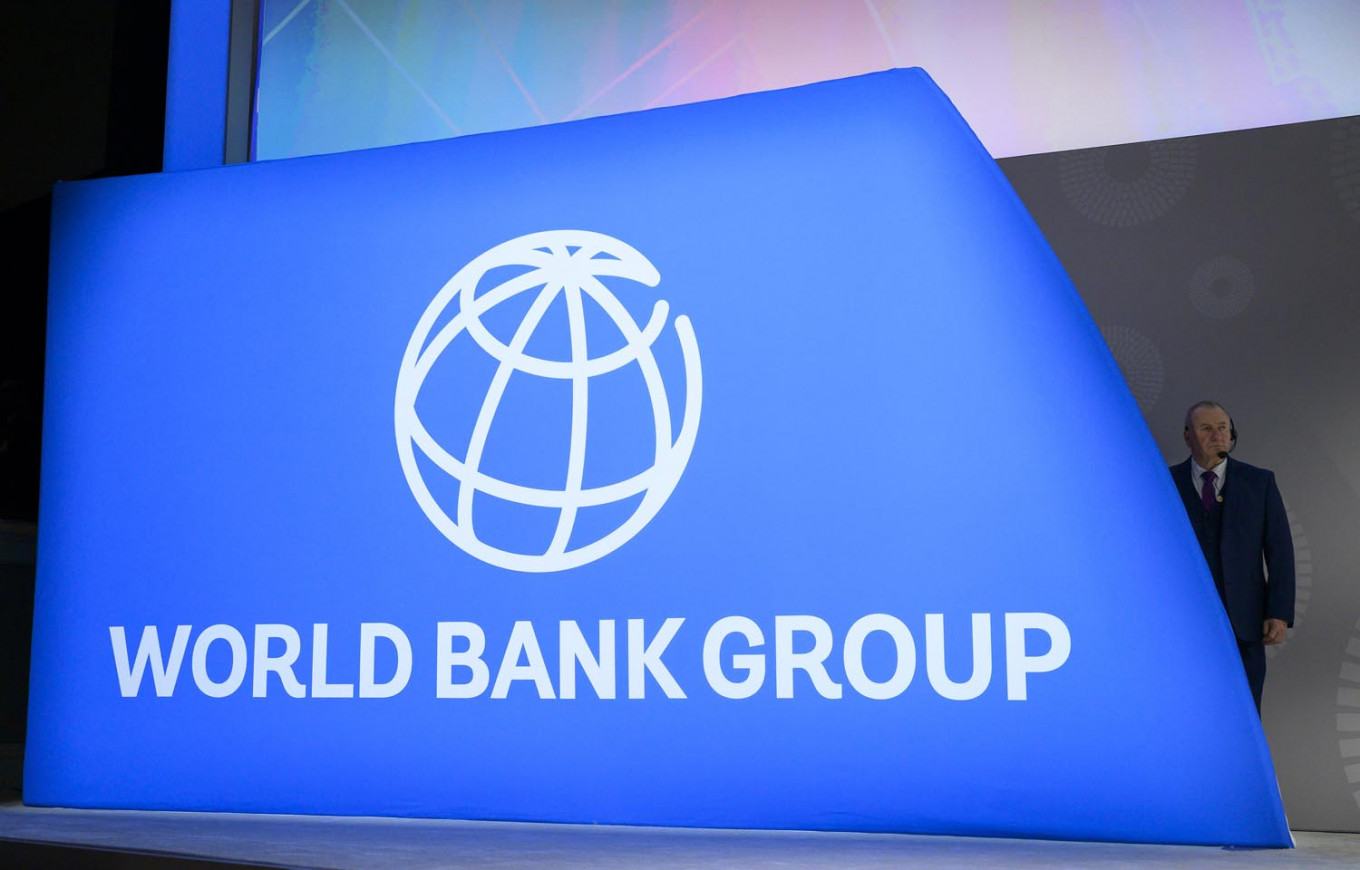
he World Bank has maintained its forecast for Indonesia’s gross domestic product (GDP) growth for this year as the country lags behind some Asian economies in containing COVID-19 and in trading manufactured goods.
In its March outlook, the Washington-based lender projects Indonesia’s GDP to grow 4.4 percent this year, an unchanged figure from its December outlook.
The forecast stands at the same level as the average growth expected for the East Asia and the Pacific (EAP) region, excluding China and Vietnam.
“Indonesia chose not to fight hard the disease by hurting livelihoods,” World Bank EAP chief economist Aaditya Mattoo told The Jakarta Post in a video interview on Thursday.
“In a way, it had a more accommodative approach to the disease, which made the economic distress in the short run less a shock than in the Philippines, but the long-term prospects were correspondingly less promising than those in Vietnam."
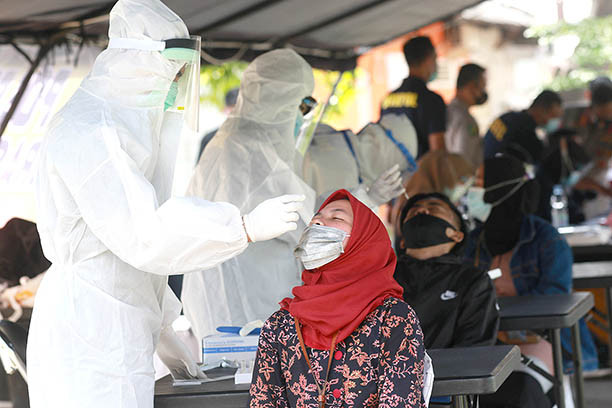
The outlook noted that Indonesia still largely relied on prolonging mobility restrictions, locally called micro-scale public activity restrictions (PPKM Mikro), to contain the pandemic, whereas countries such as China and Vietnam relied on the more effective mass testing and tracing strategy.
Read also: Positivity rate remains high amid drop in testing, recorded cases
The bank noted that Indonesia had also failed to capture the revival of global trade in manufactured goods, such as electronics, when compared to its neighbors. Instead, the country’s recovery is poised to ride on recovering commodity prices such as coal and palm oil.
The World Bank adds to a list of multilateral organizations that forecast Indonesia to achieve a near-economic recovery in 2021 as its GDP grows above 4 percent, reversing the 2.07 percent contraction last year, but short of the 5 percent growth it enjoyed in the decade before COVID-19 struck the global economy.
In January, the International Monetary Fund (IMF), the World Bank’s twin intergovernmental body, also downgraded its forecast for Indonesia’s annual economic growth this year by 1.3 percentage points to 4.8 percent, a stronger growth figure than the World Bank’s.
The IMF warned in a March 2 statement that a delay in the COVID-19 vaccination rollout would lead to a longer pandemic, which posed a downside risk to economic growth, even though the vaccination program and various stimulus programs ensured the forecast remained positive.
“[IMF directors] observed that risks to the outlook are tilted to the downside, mainly due to domestic and global uncertainties associated with the pandemic,” read the press release.
“They observed that Indonesia has the macroeconomic policy space to provide additional support if downside risks materialize.”
Contrary to the World Bank and the IMF, the Organization for Economic Cooperation and Development (OECD), in its March outlook, upgraded the country’s annual growth forecast for this year by 0.9 percentage points to 4.9 percent.
Read also: OECD upgrades Indonesia’s two-year GDP growth forecast
The World Bank’s Aaditya said the region was seeing positive developments in the form of vaccination campaigns, although the current stocks and allocations of vaccines might force countries to adjust their vaccination strategy and complement it with other interventions.
“But the slow rollout of the vaccines could reduce growth as much as 1 percentage point,” said Aaditya.
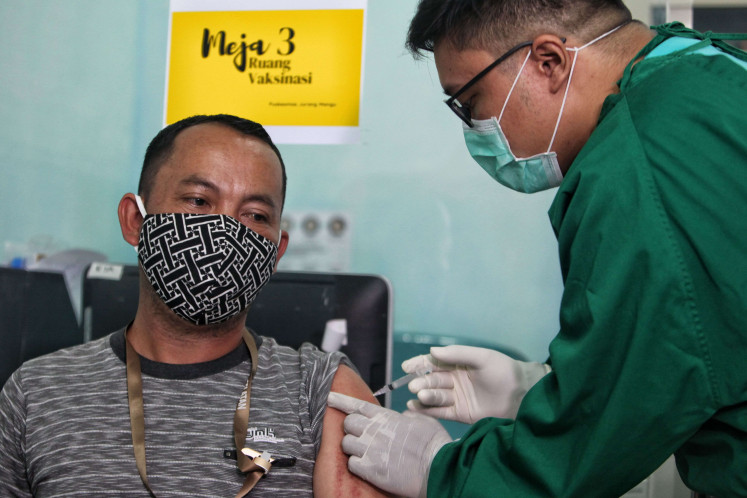
The Indonesian government started the COVID-19 vaccination program in mid-January wherein at least 6 million people, mostly medical workers and public workers, have received the first jab as of Thursday, according to data from the Health Ministry.
At the same time, the government is imposing PPKM in some cities or regencies across Java and Bali islands, as well as South Kalimantan, Central Kalimantan, South Sulawesi, East Nusa Tenggara and West Nusa Tenggara until April 5.
However, COVID-19 testing remains low in Indonesia as the country’s COVID-19 positivity rate stood at 20.13 percent as of Friday, official data show. That is much higher than the 5 percent standard of the World Health Organization (WHO).
With the country transitioning to a recovery phase, the World Bank is also suggesting a more targeted fiscal support so it can generate a larger multiplier effect and improve the efficiency of the country’s expenditure.
For this year, the government raised the economic recovery (PEN) budget by 20.6 percent year-on-year (yoy) to Rp 699.4 trillion (US$48.51 billion), of which 27 percent is for small business assistance and one-fourth for health care. The government had spent 10.9 percent of the budget as of March 17.
The bank reported that households whose incomes were not affected by the pandemic were as likely to get assistance as those who suffered income losses. Firms whose sales were not hit were also as likely to get support as those who did.
“As it transitions to recovery, the multipliers, which we call ‘return to government spending’, are higher when they are more targeted,” said World Bank economist Ergys Islamaj. “Focus on sectors that are more in need. For example, the tourism sector will not recover in the short term.”
The World Bank also forecast a pickup in Indonesia’s inflation rate this year to 2.3 percent, which stood within Bank Indonesia’s target. The IMF’s expected inflation rate, by comparison, is 3 percent.
“Not a dramatic increase because it is in an economy that has a large negative output gap, so we do not expect the core inflation to pick up rapidly,” said Habib Rab, another World Bank economist. “If there is some lift, it probably comes from the non-core side, with recovery in commodity prices and food prices as well.”