TheJakartaPost
Please Update your browser
Your browser is out of date, and may not be compatible with our website. A list of the most popular web browsers can be found below.
Just click on the icons to get to the download page.


Popular Reads
Top Results
No results found. Please check your search term and try again
Can't find what you're looking for?
View all search results
Popular Reads
Top Results
No results found. Please check your search term and try again
Can't find what you're looking for?
View all search resultsRenewed strategy to UN peacekeeping
Participation in UN peacekeeping is an opportunity to showcase the products of Indonesia’s defense industries to other countries.
Change text size
Gift Premium Articles
to Anyone
Share the best of The Jakarta Post with friends, family, or colleagues. As a subscriber, you can gift 3 to 5 articles each month that anyone can read—no subscription needed!
O
n Aug. 18, United Nations Secretary-General Antonio Guterres outlined his newly released Digital Transformation Strategy for UN Peacekeeping at the high-level Security Council open debate on UN Peacekeeping Operations: Technology and Peacekeeping.
He said new technologies were changing the character and nature of conflicts, with an indelible impact on civilians. He also emphasized that the UN and its 12 peacekeeping missions around the world must fully embrace new technologies in the face of ever-changing challenges.
This will be the future direction of UN peacekeeping and this is why a renewed approach is needed.
Participation in UN peacekeeping is an integral part of Indonesia’s constitutional mandate and its independent and active foreign policy doctrine.
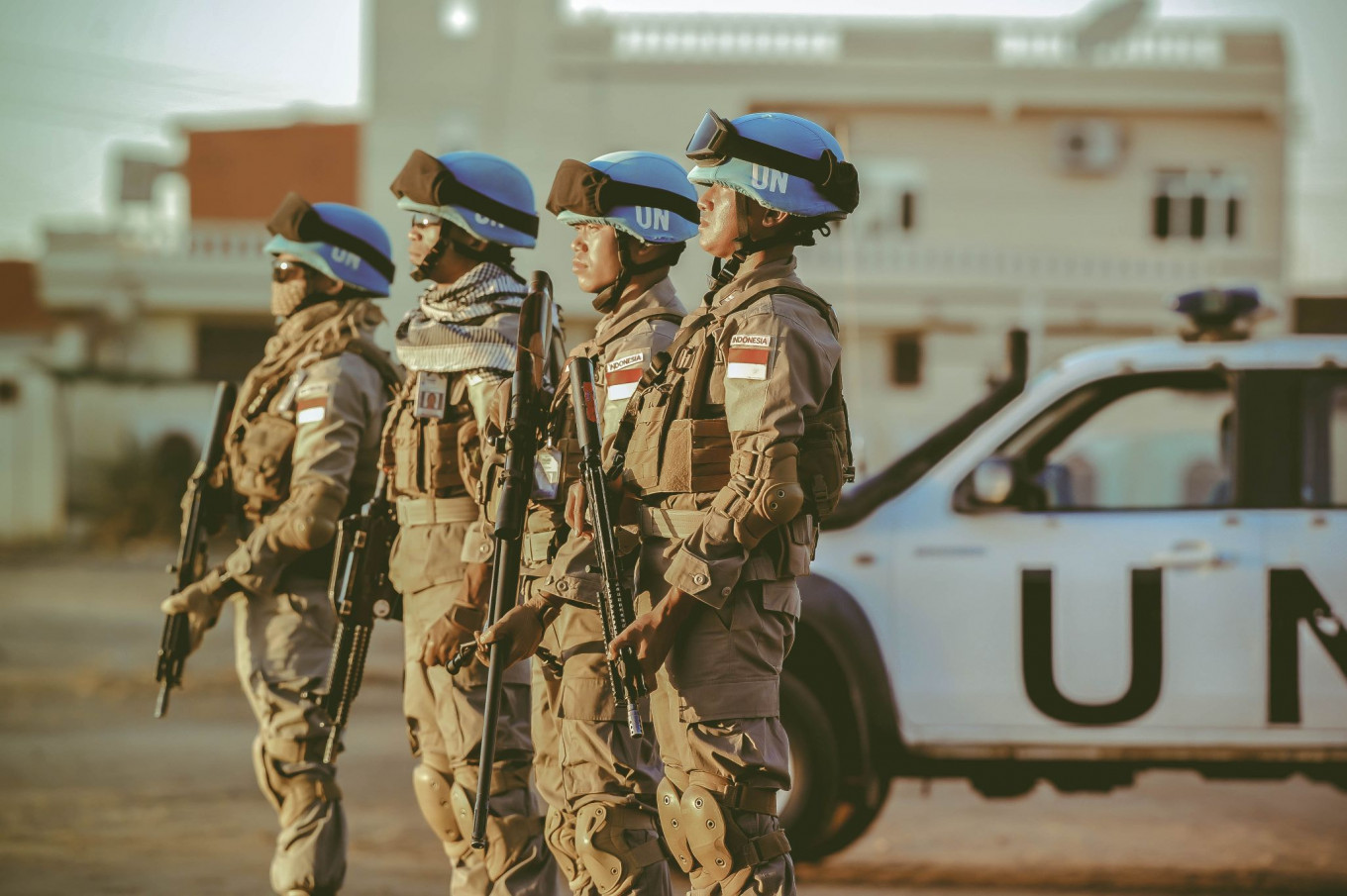
Over the past two decades, Indonesia’s approach to UN peacekeeping has always focused on increasing the number of its peacekeepers on the ground.
This was particularly evident with the outlining of Vision 4,000 Peacekeepers in 2012, designed to place Indonesia among the top 10 contributors to UN peacekeeping through the deployment of up to 4,000 peacekeepers by 2019.
The strategy proved to be a sound one. Indonesian peacekeepers on the ground significantly increased in number from a mere 199 by the end of 2005 to 2,827 after 15 years. Indonesia also accomplished the goal of becoming a top 10 contributor in January 2017 — a position it retains until today.
To date, Indonesia has not yet pronounced a new vision regarding its contribution to UN peacekeeping after 2019. However, it is apparent that a strong emphasis is still placed on sending more peacekeepers and maintaining its position among the top 10 contributors as stipulated in the 2019-2024 Medium-Term National Development Plan (RPJMN).
While it is only natural for Indonesia to aspire for increased contribution, Indonesia must not lose sight of trends that might limit our opportunities.
With the phenomena of the COVID-19 pandemic, increased asymmetric threats against peacekeepers, the downsizing of UN peacekeeping missions and their reconfiguration into smaller missions or special political missions, as well as digital transformation, Indonesia may want to start exploring some untapped potentials beyond numbers.
In this regard, there are three strategies for Indonesia to keep its stature as a major player in the UN peacekeeping field in the coming years.
First, strengthening Indonesia’s intellectual contribution to UN peacekeeping.
As a top contributor, Indonesia’s views on peacekeeping issues are always well-respected, especially at the UN. Indonesia was recently part of a core group that formulated the Action for Peacekeeping (A4P), which was aimed at renewing collective support to UN peacekeeping.
During its membership in the UN Security Council in 2019-2020, Indonesia also successfully initiated the first presidential statement on training for peacekeepers and the first stand-alone resolution on women peacekeepers.
Moving forward, it is pertinent for Indonesia to groom its own peacekeeping experts from think-tank and academic communities, and have them involved in discussions on peacekeeping issues, including in the UN. An immediate possible partnership between the Foreign Ministry and them will be pertinent in the development of Indonesia’s A4P National Action Plan.
The development of 2015 High-Level Independent Panel on Peace Operations Report and the 2017 Cruz Report was striking evidence of how academic and think-tank communities and former peacekeepers can contribute to the UN’s policy-making in peacekeeping.
Niche issues that Indonesia could champion include training for peacekeepers, women peacekeepers and also community engagement, which could be developed in a way to support the digital transformation of UN peacekeeping.
Second, advancing Indonesia’s economic contribution in peacekeeping.
Participation in UN peacekeeping is an opportunity to showcase the products of Indonesia’s defense industries to other countries. The time is ripe to optimize the utilization of Indonesia’s national strategic industries and technology to assist UN peacekeeping.
At the same time, Indonesian businesses may also seek contracts to supply goods and services to UN peacekeeping. Greater awareness is needed among Indonesian businesses of such opportunities. This could be done by organizing seminars and coaching clinics with the presence of resource persons from the UN.
Outreach must also be directed toward the State-Owned Enterprises Ministry and the Defense Industry Policy Committee to discuss ways and means to advance our economic contribution to UN peacekeeping.
Third, increasing the number of Indonesians at the UN Secretariat and peacekeeping missions.
As a top contributor, Indonesian nationals should be adequately represented at the UN Secretariat and peacekeeping missions. Our nationals at the UN Secretariat may contribute to shaping UN peacekeeping policies and facilitate information-sharing regarding deployment opportunities or vacancies.
In the context of the ongoing digital transformation of UN peacekeeping, our nationals at the UN Secretariat could contribute greatly to improving the UN’s policies. This could be done by adapting some of the best practices and experiences of Indonesia’s contingents in applying technological solutions in peacekeeping missions.
The good thing is we have a big pool of experienced former peacekeepers, both from the military and police, and civilians with peacebuilding expertise that may be needed at the UN Secretariat and peacekeeping missions, such as democracy, electoral support, human rights and good governance.
Facilitating greater awareness about such career opportunities will be significant. We could also maintain a roster of Indonesian nationals with the expertise and experience needed by UN peacekeeping.
What we need now, therefore, is to generate understanding among line ministries and the Indonesian Peacekeeping Center on the need for a renewed strategy to UN peacekeeping to optimize our potential participation therein, in line with the future direction of UN peacekeeping.
***
Both writers are Indonesian diplomats assigned to the Foreign Ministry. The views expressed are their own.