TheJakartaPost
Please Update your browser
Your browser is out of date, and may not be compatible with our website. A list of the most popular web browsers can be found below.
Just click on the icons to get to the download page.


Popular Reads
Top Results
No results found. Please check your search term and try again
Can't find what you're looking for?
View all search results
Popular Reads
Top Results
No results found. Please check your search term and try again
Can't find what you're looking for?
View all search resultsChina or Japan: Govt mulls over Jakarta-Surabaya railway plans
The government wants to extend the Jakarta-Bandung railway to make the project more economically viable, as multiple delays – due to land acquisition issues and other problems – have led to a cost overrun.
Change text size
Gift Premium Articles
to Anyone
Share the best of The Jakarta Post with friends, family, or colleagues. As a subscriber, you can gift 3 to 5 articles each month that anyone can read—no subscription needed!
I
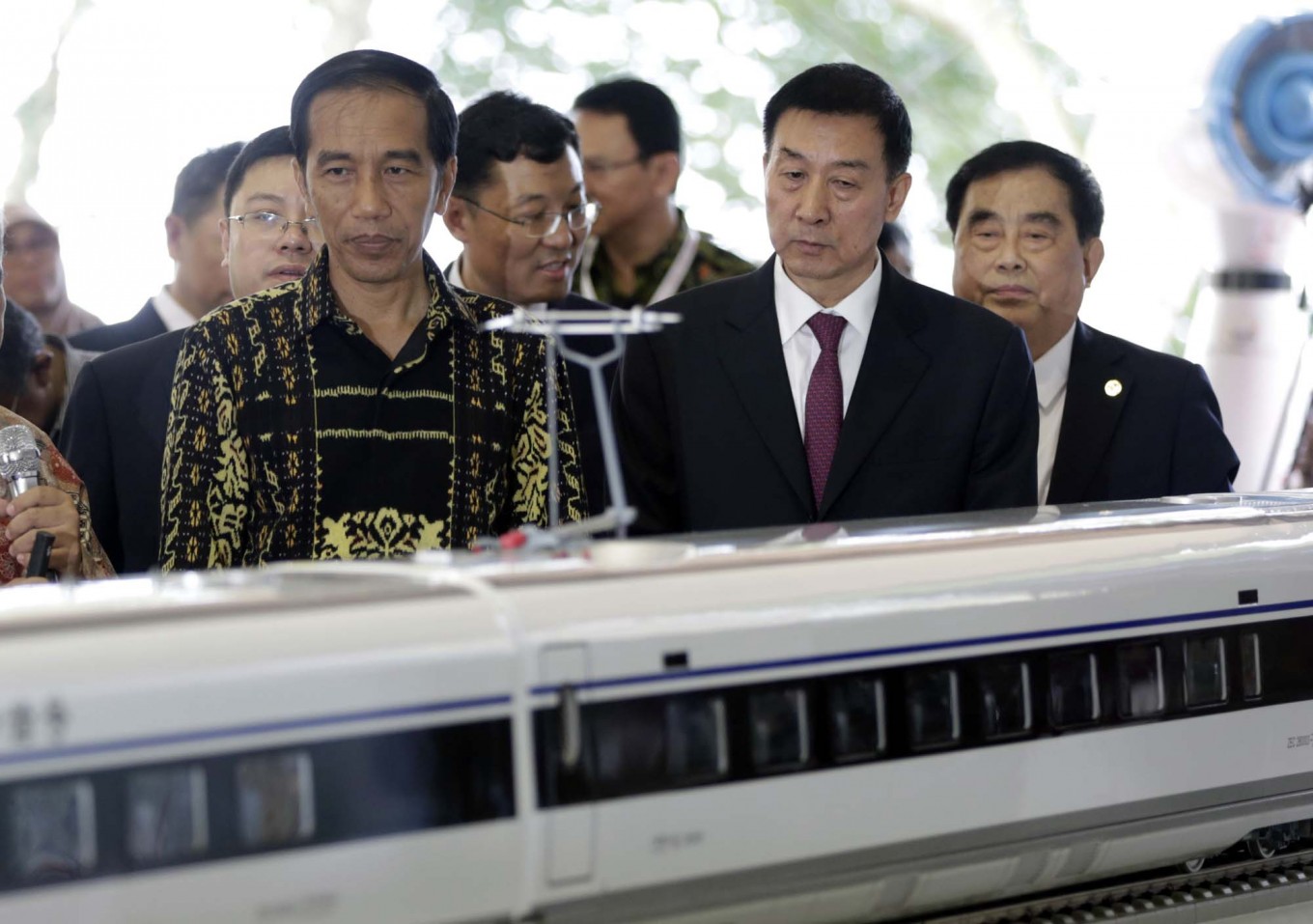
ndonesia’s plan to invite China to submit a proposal for the Jakarta-Surabaya railway project has caught some by surprise, as the project appeared to be earmarked for Japan.
Questions emerged when Coordinating Economics Minister Airlangga Hartarto announced in May 2020 that the government had decided to extend the China-backed Jakarta-Bandung high-speed railway project to Surabaya in East Java, along a route similar to one Japan had begun studying in 2018.
In January, Coordinating Maritime Affairs and Investment Minister Luhut Pandjaitan said President Joko “Jokowi” Widodo wanted China to work on the extension. In May this year, Luhut was tasked with meeting representatives from China to discuss the project.
Tokyo would not have forgotten how, in 2015, the government closed the deal for the Jakarta-Bandung project with China, even though Japan had been studying the plan since 2014.
Septian Hario Seto, deputy for investment and mining at the Office of the Coordinating Maritime Affairs and Investment Minister, told The Jakarta Post on Friday that the government had not yet made any decisions about who would work on the Jakarta-Surabaya railway.
“A more careful and in-depth study still needs to be conducted,” Seto said.
A spokesman for the office, Jodi Mahardi, told the Post on Saturday that the extension of the Jakarta-Bandung project proposed to China was separate from the one Japan had been working on, despite both being referred to as the Jakarta-Surabaya railway projects.
The former, he said, would run along a southern route to connect the Jakarta-Bandung project with Surabaya via Kertajati in West Java, where the government recently built a new airport, as well as via Surakarta and Yogyakarta.
The government wants to extend the Jakarta-Bandung railway to make the project more economically viable, as multiple delays – due to land acquisition issues and other problems – have led to a cost overrun.
Read also: Govt wants Japan to join China-backed high-speed rail project
The target for completing the 142-kilometer railway has been pushed back to 2022 from 2019, and the estimated cost of the project has risen to US$6.07 billion from $5.57 billion projected when work on the ground began in 2016.
In 2020, Japan was invited to join the consortium of Chinese and state-owned Indonesian companies to close the funding gap, but it refused, explaining that it preferred to focus on the northern line.
Supandi, a spokesperson for the Rail Transportation Directorate General at the Transportation Ministry, told the Post on Friday that the latter, called the Java North Line Upgrading Project, would connect Jakarta and Surabaya with a route along the northern coast of Java via Cirebon in West Java and Semarang in Central Java.
A proposed travel speed of 150 km per hour for the 720-km railway connection would allow for the use of existing tracks, hence resulting in the much lower development cost of about $5 billion.
“[The northern project] would increase the speed of [railway operations from the current level] to 150 km per hour. The regulation defines high-speed rail services as those with travel speeds above 200 km per hour, which is why some refer to the project as a medium-speed railway,” he said.
Djoko Setijowarno from the Indonesian Transportation Society (MTI) told the Post on Friday that it was possible to have Japan and China work on a northern and a southern project, respectively, but it would weigh heavily on the overall budget.
The southern region, he explained, had many mountains along the route, which would drive up the project’s costs. More than a dozen tunnels have been built for the Jakarta-Bandung high-speed project alone.
“For the northern line, no tunnel would be needed, as it would pass through cities,” Djoko said.
Therefore, it was plausible for an extension of the Jakarta-Bandung railway project to make a turn to Cirebon, which lies on the northern route. In fact, Japan International Cooperation Agency’s (JICA) 2012 feasibility study obtained by the Post shows the option to connect the Jakarta-Bandung project with Surabaya through Cirebon.
Siwage Dharma Negara, coordinator of the Indonesia Studies Programme at Singapore-based think tank ISEAS-Yusof Ishak, told the Post on Thursday that Japan and China stood equal chances should the government only want to select one for the project.
China's advantages, he said, were its lower development costs and faster project preparation. Japan tended to be more careful, resulting in a much longer preparation time and higher costs because of more precise budget planning, which included project risks.
In the case of the Jakarta-Bandung project, China was more willing to comply with Indonesia’s requirement for not using a single rupiah from the state budget and to agree to a business-to-business scheme, while Japan had insisted on a government-to-government scheme, plus state funds as collateral.
However, after being outbid by China in 2015, Japan would not likely back down that quickly this time and may come up with a better plan to win the bid for the connection to Surabaya, he said.
Read also: KAI to lead Indonesian consortium in high-speed rail project with China
The Chinese Embassy in Indonesia did not immediately respond to the Post’s request for comment.
Meanwhile, KCIC spokesperson Mirza Soraya told the Post on Friday that the company had the necessary facilities and human resources should the need arise to extend the Jakarta-Bandung railway to Surabaya.
Furthermore, the extension could result in a significant economic scale that would make the investment more attractive, she said, referring to the company's own study.
However, the company had yet to take any further steps as it was focusing on the completion of the Jakarta-Bandung railway project to meet the target of commencing operations in 2022, she said, adding that the project was 78.65 percent complete.
The Japanese Embassy in Indonesia told the Post on Friday that the country had stated its willingness to assist with the Java North Line Upgrading Project at the Japan-Indonesia Summit Meeting in Jakarta in January 2017.
The embassy noted that at that event, “President Joko Widodo said he was looking forward to a proposal from Japan”.
Japan also demonstrated its commitment to the project by starting a preparatory survey (P/S) in June 2019 and submitting a draft to the Transportation Ministry in September this year.