TheJakartaPost
Please Update your browser
Your browser is out of date, and may not be compatible with our website. A list of the most popular web browsers can be found below.
Just click on the icons to get to the download page.


Popular Reads
Top Results
No results found. Please check your search term and try again
Can't find what you're looking for?
View all search results
Popular Reads
Top Results
No results found. Please check your search term and try again
Can't find what you're looking for?
View all search resultsRethinking women’s roles in Indonesian agriculture
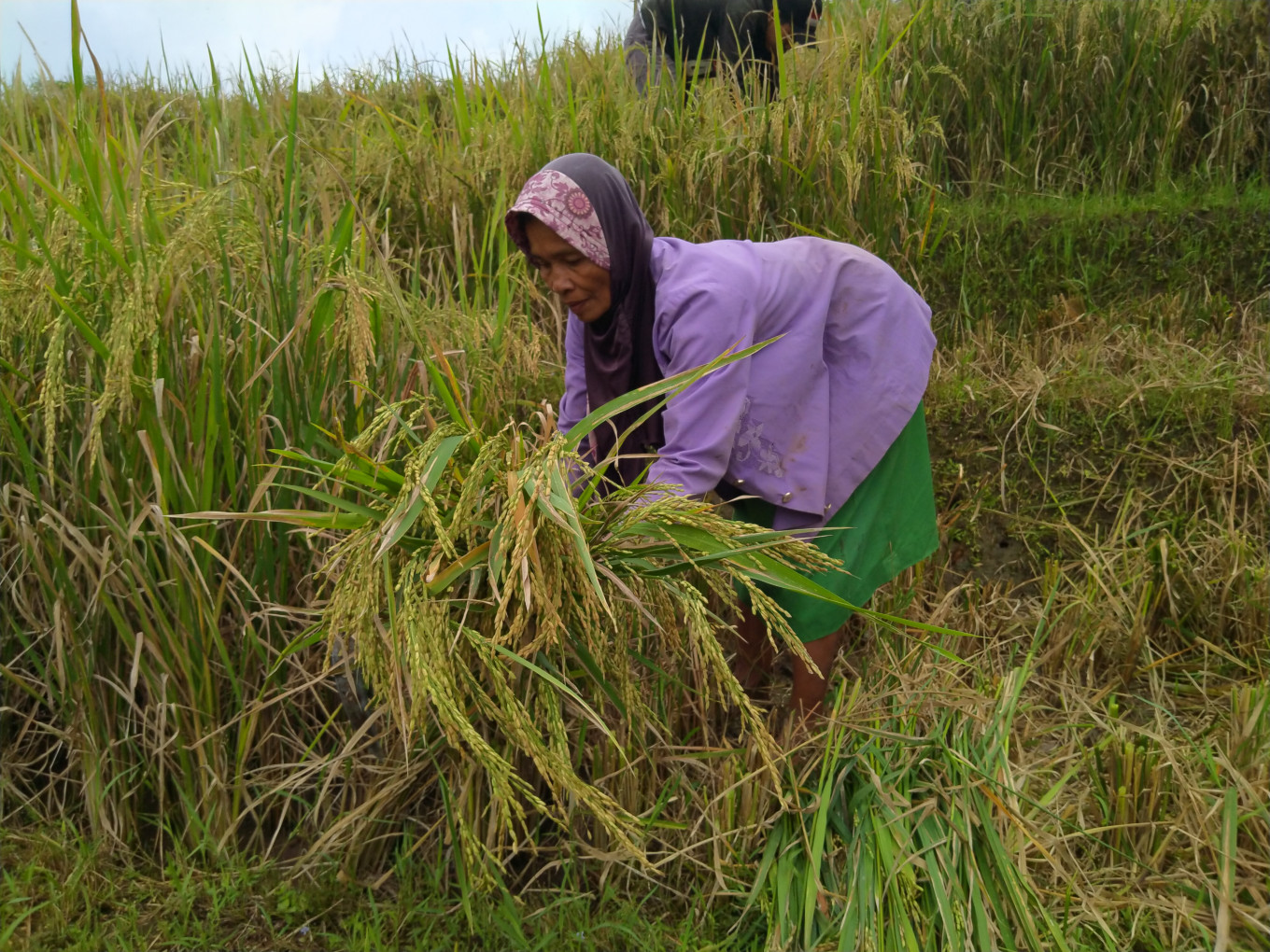
On average, women working in agriculture, forestry and fisheries earn Rp 1.44 million (US$101) per month, which is 33.75 percent less than their male counterparts.
Change text size
Gift Premium Articles
to Anyone
Share the best of The Jakarta Post with friends, family, or colleagues. As a subscriber, you can gift 3 to 5 articles each month that anyone can read—no subscription needed!
T
he International Day of Rural Women on Oct. 15 was observed by many agricultural and women organizations across the world. In Indonesia, however, it was a rather “silent celebration”. Does this reflect the ignorance of the role of women in agriculture in Indonesia?
This year’s rural women’s day took the theme of “Rural Women Cultivating Good Food for All”. Initiated by the United Nations General Assembly in its resolution 62/136 of Dec. 18, 2007, this international day acknowledges that the role of rural women is central in ensuring food and nutrition security for their children, households and communities. Rural women’s participation in economic activities also contributes to the development of rural economies, and therefore, local and global economies.
Yet, rural women and girls persistently face systemic challenges such as significant barriers to access resources and services, from access to land, farm assets, agricultural production inputs and technology, market information and healthcare, to education and training opportunities. Furthermore, during times of hardship, rural women and girls are often disproportionately hit. UN Women reported that in 2019 and 2020, women lost more 54 million jobs, representing a 4.2 percent decline in women’s employment compared to 3 percent decline in men’s employment.
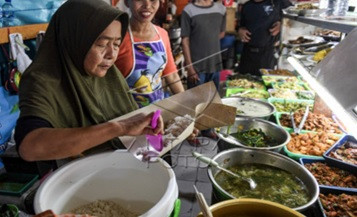
The gender discourse in agriculture is obviously applicable to Indonesia. According to the Women's Empowerment and Child Protection Ministry's Profile of Indonesian Women (PIW) 2020, 24.79 percent of women work in the agriculture sector, making it the biggest employment sector for women. Despite this high female participation, agriculture continues to be seen as a male-dominated industry. Furthermore, women earn less than men, a lot less. Referring to the PIW 2020, on average women working in agriculture, forestry and fisheries earn Rp 1.44 million (US$101) per month, which is 33.75 percent less than their male counterparts.
There have been efforts toward improving the role of women in Indonesian agriculture. The Agriculture Ministry was recently awarded the 2020 Anugerah Parahita Ekapraya award by the Women's Empowerment and Child Protection Ministry for its commitment to implementing gender mainstreaming to optimize agricultural development. The Agriculture Ministry has also worked closely with the Female Farmer chapter of the Indonesian Farmers Association (HKTI). Yet, more can and should be done.
Gender mainstreaming is a good start to acknowledge the different implications of policy and programs across genders. However, central to our resolve is the need to address leadership issues. We do not have enough female leaders in Indonesia. To address women's issues, women should not only be target recipients, but also take part and even lead decision-making processes.
We see too many webinars with all-male panels (manels) talking about issues such as (ironically) sustainable development in Indonesia. This definitely should stop. Solutions to gender issues need men’s contribution too, but women’s voices should be well-represented.
So the next issue is how to translate the above recognition of women’s roles into more concrete action. First is to invite relevant institutions to make a pledge to involve women in the pivotal discussions on agriculture. For instance, UN Indonesia’s “no more manels” pledge is a good start. But it requires the participation of more institutions, and, again, men’s contribution. We already have an issue with only 21 percent of the House of Representatives, responsible for many aspects with strong implications for agriculture, being female.
We should at least have more female representatives in public fora talking about women and agriculture issues. Male colleagues should be the ones to check with the organizing committee whether any female speakers are involved, and refuse to participate if there is no justification provided to address gender balance issues.
A deeper commitment can be made through supporting women in leadership ranks. Australia’s National Farmers Federation’s (NFF) Diversity in Agriculture Leadership program is a good example that organizations such as the HKTI should follow.
Supported by 27 government, business and representative organizations, the program drives these organizations to change the way they attract, retain and promote women. It includes initiatives such as expanding paternity leave, reviews of salaries, and mentoring opportunities to assist women on the career ladder.
Critical to this program is monitoring and evaluation to ensure progress in addressing agriculture’s gender leadership challenge. The NFF itself has a goal to double the number of women in agriculture’s leadership ranks by 2030 based on a 2018 benchmark that reported only 18 percent and 2.3 percent of agriculture’s management positions and CEO positions, respectively, were held by women.
It is important to acknowledge that change in agriculture requires transformation not only in the farming sector but also other institutions and supporting sectors and services. Look at e-commerce growth as an example. E-commerce development provides opportunities for women to sell online from the comfort of their home.
With the gross merchandise value expected to reach $40 billion this year, digital marketing is here to stay. A future face of small farm businesses in Indonesia might be a husband who leads the operational farming side, while women are responsible for the marketing activities. Therefore, given the wide range of roles and potentials in agriculture, addressing the gender leadership gap should also include leadership roles in farmers associations, industry bodies, agriculture-related academic institutions, research institutions, professional bodies and many other organizations.
At this stage, apart from the national statistics presented above regarding female employment participation, little is known about the exact figures of agriculture management positions – both in the public and private sectors – held by women. Thus, this is where we should start: gender-sensitive mapping of where we are now. Subsequently, a combination of a women in agriculture-targeted national strategy and, at the organization level, monitoring of the salary gap and ensuring opportunities for women can be pursued.
This recovery period presents a timely opportunity to recalibrate our strategies toward a gender-just and sustainable future.
***
The writer is a senior lecturer in agribusiness at the Department of Economics, Deakin University and cofounder of AgLive Indonesia. The views expressed are her own.