TheJakartaPost
Please Update your browser
Your browser is out of date, and may not be compatible with our website. A list of the most popular web browsers can be found below.
Just click on the icons to get to the download page.


Popular Reads
Top Results
No results found. Please check your search term and try again
Can't find what you're looking for?
View all search results
Popular Reads
Top Results
No results found. Please check your search term and try again
Can't find what you're looking for?
View all search resultsBelanda Depok: Can the past be manipulated?
The truth of the matter is that the Depok city government has not only neglected historical sites in the city, it is also engaging in “the politics of memory.
Change text size
Gift Premium Articles
to Anyone
Share the best of The Jakarta Post with friends, family, or colleagues. As a subscriber, you can gift 3 to 5 articles each month that anyone can read—no subscription needed!
H
ave you ever had an argument with a spouse, sibling or friend about how things went – e.g. the sequence of events, who said or did what – in the distant or even in the recent past? I would be very surprised if you have not. Not only do people have different perceptions, memories (famously elusive!), but sometimes, events and facts can be deliberately negated, revised or distorted for personal, material or political gain.
So the answer to the question in the title of my column is, it most certainly can! In fact, all of history is about the “interpretation” (sic!) of the past to benefit those who are the winners, vanquishers, and conquerors and to maintain the power of those who rule.
Historical negationism, sometimes called denialism or revisionism, is basically lying about what actually happened. Examples abound: in the United States (e.g. Confederate revisionism, California genocide), war crimes (e.g. resulting from Japanese imperialism, Croatian war crimes during World War II, Serbian war crimes both during World War II and the Yugoslav wars, Turkey and the Armenian genocide), Iran against religious minorities, and many others.
As someone who lived through 32 years of the New Order (1966-1998) under then president Soeharto, I and the majority of the populace had to live under our authoritarian rulers’ version of events: of the communist coup (which was actually an internal military struggle), of the “brutality” of the communists (there wouldn’t be some projection going on here, would there?), and the fatal stigmatization of those branded PKI (communists) which affected not just them, but also their families for generations to come. In short, historical manipulation traumatizes, destroys lives and kills. Between 500,000 and 1 million were the initial estimates of the mass killings in 1965-1966, but more recent ones go as high as 2 to 3 million.
Recently I came across another example of historical manipulation in my own backyard, Depok, following the sudden death of Ferdy Jonathan, 66, an elder of the so-called Belanda Depok, on Nov. 22.
Belanda means Dutch, while Depok is the name of a city in West Java adjacent to Jakarta. It implies that these are Dutch people living in Depok, but it is a misnomer. They are actually a multiethnic group of Indonesians – from Java, Bali, Sulawesi and Maluku and other areas – who are the descendants of the 150-200 slaves owned by Cornelis Chastelein, a high-ranking official of the Dutch East India Company (VOC) who owned estates in the Batavian (the old name for Jakarta) hinterlands.
Chastelein dreamed of creating a self-sustaining Christian community in that area, which was predominantly a Muslim stronghold. When he died in 1714, “he freed most of his slaves, and bequeathed those who had embraced Christianity, his 1,244-hectare Depok estate in ‘collective ownership’”. I read about this in a book published in August called The Christian Slaves of Depok: A Colonial Tale Unravels by Nonja Peters about the little known history of the Belanda Depok.
The name Depok is actually derived from Chastelein’s Christian organization, De Eerste Protestante Organisatie van Christenen (The First Protestant Christian Organization), also known as Depoc, through which he actively sought to spread Christianity. Depoc? Depok would not have been named after Chastelein’s organization, would it?
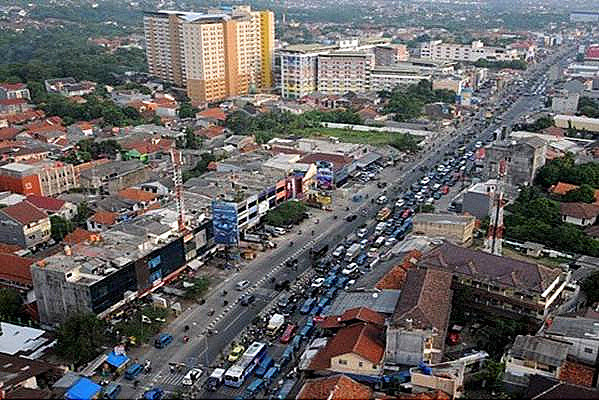
Currently, there are more than 7,000 descendants of Belanda Depok in Indonesia and abroad. The Lembaga Cornelis Chastelein (Cornelis Chastelein Foundation) was set up to protect their community assets and interests. Nowadays it is difficult to pinpoint where they used to live as they have been subsumed by Depok’s rapid urbanization and population of almost 2.5 million.
The Belanda Depok played a big role in developing Depok, in fact, according to Vence Turalakey, headmaster of Pemuda High School, a school maintained by the foundation, they were the first to build Depok. In 1871, they were granted autonomy by the Dutch to govern Depok independently. For this reason, Yano Jonathans, a sixth generation Belanda Depok and his wife Yulia, who actively campaign for Belanda Depok to be recognized in Indonesian history, wants to change Depok’s anniversary from April 22, 1999 to the date when the 12 clans of the original Belanda Depok were granted land ownership by Chastelein on June 28, 1713.
The notion of saving historical sites in Depok started emerging about 10 years ago. However, these sites are only designated as Objects of Suspected Cultural Conservation (what?), due to fact that the Depok city government only had a Cultural Conservation Expert Team in May 2019, they say.
Really? The truth of the matter is that the Depok city government has not only neglected historical sites in the city, it is also engaging in “the politics of memory” whereby "Depok’s symbolic identity as Dutch colonial and Christian, has shifted to become synonymous with Islam." Tri Wahyuning M. Irsyam explains this in her 2017 book The History of Depok 1950-1990. Not surprising really, considering that Depok is a Prosperous Justice Party (PKS) stronghold. The PKS is an Islamist party.
In the website The History of Jakarta, on 24 Nov, JJ Rizal, a well-known historian living in Depok, wrote a long and detailed essay, titled “Depok Heritage and the Politics of City Memory”. In the past 15 years, while Depok has been engaged in building up the city, historical sites from the 17th to the 19th centuries have been left in ruins, turning the city into a city without a memory, without a past, he says.
In short, what Rizal wanted to point out is that a process of historical manipulation is very much the basis of development in Depok, whereby they want to portray Depok as being Betawi-Muslim rather than Dutch-Christian.
The death of Ferdy has dealt a blow to attempts to reveal the true history of Depok. Much research should to be conducted to provide a solid foundation for the future development of Depok, not just for the sake of history. The Belanda Depok laid the foundation for pluralism, education and the environment, which is a critical issue worldwide.
Are the Belanda Depok going to be left to languish and fade into historical obscurity and even maligned as being traitors, like millions of suspected “communists”, or will they be given their true and proper place in Indonesian history?
This is not just about Depok, it is about how Indonesia wants to build itself as a nation. In order to be a strong nation, we have to develop ourselves based on the truth, not on historical manipulation and political opportunism.
***
The writer is the author of Julia’s Jihad.