TheJakartaPost
Please Update your browser
Your browser is out of date, and may not be compatible with our website. A list of the most popular web browsers can be found below.
Just click on the icons to get to the download page.


Popular Reads
Top Results
No results found. Please check your search term and try again
Can't find what you're looking for?
View all search results
Popular Reads
Top Results
No results found. Please check your search term and try again
Can't find what you're looking for?
View all search resultsUnderstanding China around Natuna and how Indonesia should respond
When Indonesia and China use UNCLOS to claim their maritime zones/entitlements, it is clear that there are no overlapping maritime areas.
Change text size
Gift Premium Articles
to Anyone
Share the best of The Jakarta Post with friends, family, or colleagues. As a subscriber, you can gift 3 to 5 articles each month that anyone can read—no subscription needed!
R
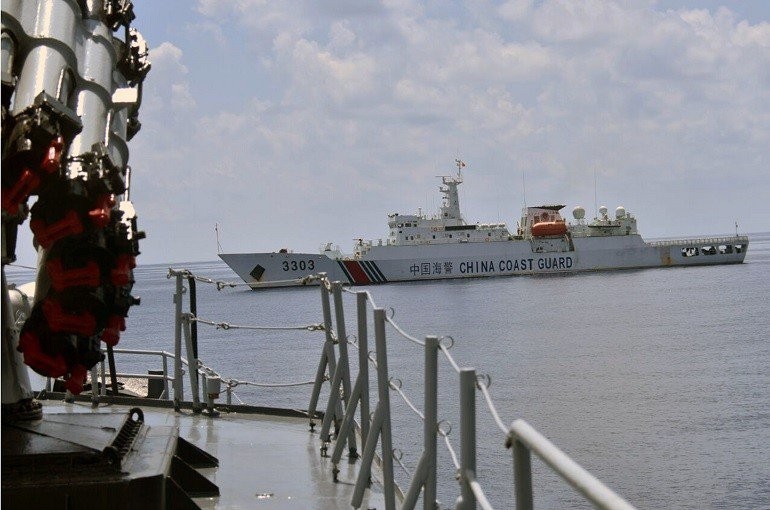
euters (Dec. 1) reported that China had told Indonesia to stop drilling for oil and natural resources in the maritime areas close to Natuna Islands, Riau Islands province. Apparently, both countries are sure that the concerned maritime areas fall within their respective jurisdiction.
Let us understand why and how Indonesia and China seem to have overlapping maritime areas around Natuna Islands. Both countries have ratified the United Nations Convention on the Law of the Sea (UNCLOS), the most widely accepted global regulation regarding ocean affairs and the law of the sea. UNCLOS is known as “the Constitution of the Ocean”. Hence, it is fair to start from provisions in UNCLOS to evaluate the legal position of Indonesia and China.
Every coastal state is entitled to maritime spaces/zones measured from its baselines/coastlines. Such zones are territorial seas (12 nautical miles), contiguous zones (24 NM), exclusive economic zones or EEZ (200 NM) and continental shelves or seabed that may extend beyond 200 NM. In accordance with UNCLOS provisions, a coastal state is entitled to large maritime areas and such entitlements can easily cause overlapping areas between neighboring countries when the distance between them is close enough.
When two countries have overlapping maritime areas, they will need to delimit maritime boundaries between them. It can be for territorial seas, an EEZ or continental shelf depending on the distance between them.
What about China and Indonesia? Robust measurements of maritime zones from baselines of both countries do not show any overlap. EEZ claims of 200 NM from the southern tip of China and the northern tip of Natuna in Indonesia do not cause any overlap, as the distance between the two is far enough. Legally speaking, Indonesia and China are not neighbors and they do not need to delimit maritime boundaries.
If any, Indonesia has overlapping maritime zones with Malaysia and Vietnam for both continental shelves (seabed) and EEZs (water column). In 1969, Indonesia and Malaysia agreed upon a continental shelf boundary between them. It was followed by another seabed boundary segment agreed upon by Indonesia and Vietnam in 2003.
These two agreements create boundary lines that enclose Indonesia’s seabed. Therefore, Indonesia’s seabed, where oil and gas exploration and exploitation may take place, has been made clear. No parties have expressed their rejection or protest to the arrangement. It came as a surprise, therefore, when China told Indonesia to stop drilling for oil and natural gas in the seabed.
We have clearly understood that based on UNCLOS, China’s maritime entitlement does not extend to maritime areas around Natuna Islands. Why does China come around the area and act as the owner of the maritime space?
China extends its claims based on a historical consideration instead of UNCLOS. With this, China claims almost the entire South China Sea, while, in fact, some other countries also have a similar entitlement in the areas. The claim is known as the nine-dash line (NDL) for it is depicted by nine segments of lines.
The NDL, while not robustly geographically positioned for unclear coordinates, geodetic datum and reference system, overlaps with Indonesia’s 200 NM EEZ measured from Natuna. To make things worse, the NDL also causes overlapping space with other parties in the region such as Malaysia, Brunei, the Philippines, Taiwan and Vietnam.
Legal action has been taken by the Philippines regarding this issue by bringing the case to the Arbitral Tribunal based on UNCLOS, and it was administered by the Permanent Court of Arbitration (PCA). The Tribunal concluded in 2016 that there was no legal basis for China to claim historic rights to resources within the sea areas falling within the nine-dash line.
It is clear, therefore, that China’s claim is unacceptable in the eyes of UNCLOS. Interestingly, China has yet to accept the decision and keeps maintaining its presence in the concerned region.
One might ask why China refuses a decision made based on UNCLOS, a legal basis that China ratified in 1996. China claims that maritime space close to Natuna is part of its “traditional fishing ground” (TFG) where Chinese ancestors had come for fishing and other activities. This is China’s reason for maintaining its presence up until the present day. UNCLOS, on the other hand, does not recognize TFGs. If anything, UNCLOS only recognizes traditional fishing rights (TFR) based on article 51.
It is important to understand the difference between TFGs and TFRs. Regarding location and areas, TFRs exist in a country’s archipelagic waters. In this case, if any, TFRs are located within Indonesia’s archipelagic waters, while the TFGs China has claimed is located outside of Indonesia’s archipelagic waters. This confirms that TFGs are certainly not the same as the TFRs that UNCLOS recognizes. In other words, China is holding on to something that does not exist within UNCLOS.
The last point to clarify: Do Indonesia and China need to discuss and negotiate on maritime boundary delimitation between them? We need to remember, maritime boundaries are needed when two or more countries have overlapping maritime entitlement based on existing, recognized and functioning international regulations, which in this case, is UNCLOS. When Indonesia and China use UNCLOS to claim their maritime zones/entitlements, it is clear that there are no overlapping maritime areas. Hence, no maritime boundaries are needed. No negotiations are required.
However, the fact that China keeps maintaining its presence and even has requested Indonesia to stop doing what Indonesia can rightly do shows the conclusion is not that easy.
***
The writer is a lecturer and researcher in geospatial aspects of the law of the sea at the Department of Geodetic Engineering, Gadjah Mada University. The views expressed are his own.