TheJakartaPost

Please Update your browser

Your browser is out of date, and may not be compatible with our website. A list of the most popular web browsers can be found below.
Just click on the icons to get to the download page.


Jakarta Post

Indonesia’s G20 presidency amid rising trade tensions

The benefit of the RCEP is that even though it doesn’t call for liberalization at the same level, scope or depth of commitment as the CTPP, its impacts on the economies of member countries, and indeed on the world economy, will be massive.

Lili Yan Ing (The Jakarta Post)
Jakarta
Wed, February 16, 2022 Published on Feb. 15, 2022 Published on 2022-02-15T16:41:19+07:00

Change text size

Gift Premium Articles
to Anyone

Share the best of The Jakarta Post with friends, family, or colleagues. As a subscriber, you can gift 3 to 5 articles each month that anyone can read—no subscription needed!
G20 Indonesia 2022

Indonesia’s Group of 20 presidency in 2022 is crucial for the global recovery from the health and economic crises wrought by COVID-19. With rising protectionism and increasing trade tensions around the world, how prepared is Indonesia to address these issues?

In February 2020, the United States and China signed the Economic and Trade Agreement – the so called “Phase One” trade deal – which many have predicted will only create further trade diversions in global trade. And indeed, the US-China trade (now including technology) tensions have been escalating instead of decreasing, putting pressure on smaller economies to choose between the two global powers.

Even after the agreement was signed, Beijing’s dual circulation plan promotes self-reliance, indigenous innovation and settling more trade deals in Renminbi. At the same time, the US strategy is equally (or more so) escalating tensions with its policies of realigning supply chains by “friend-shoring”, accompanied by policies mandating that key technologies must be produced at home or by designated US allies. The largest and most innovative US electric vehicle company has even started controlling its own supply chains.   

So, what solutions can Indonesia offer during its G20 presidency?

Let’s start by reviewing Indonesia’s foreign trade policy, where it stands, and what it can offer the G20. East Asia, including Southeast Asian countries grouped as ASEAN (including Indonesia), has been achieving high economic growth based on trade and investment. ASEAN has been very active in promoting trade and investment as well as forming trade agreements to facilitate this, including the ASEAN Free Trade Area (AFTA) in 1992 and the ASEAN+1 FTAs with its main trading partners, which was mostly concluded in 2010.

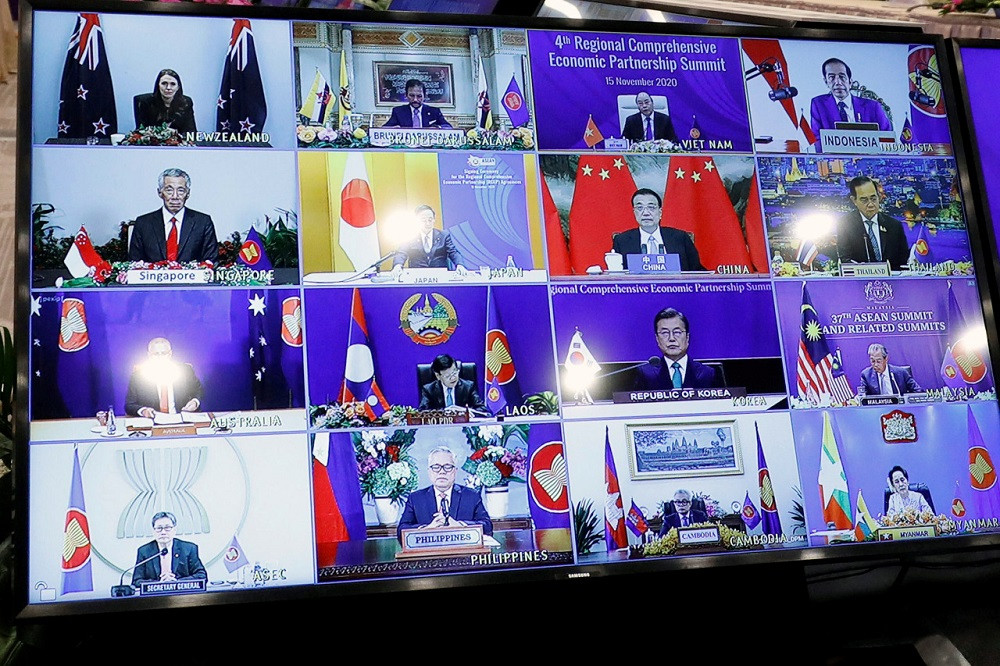
Recently, ASEAN and its five main trading partners concluded the Regional Comprehensive Economic Partnership (RCEP). The RCEP came into effect on Jan. 1 as it has already reached the quorum with ratification by 11 member countries:  Brunei, Cambodia, Laos, Thailand, Vietnam, Singapore, and all non-ASEAN signatories (Australia, China, Japan, Korea and New Zealand). Indonesia has not ratified the agreement yet.

The RCEP is the largest economic bloc in the world. Even without India, in 2021, the countries in the RCEP accounted for 31 percent of the world’s population, 31 percent of global gross domestic product, 27 percent of trade and 33 percent of foreign direct investment (FDI). 
By comparison, the Trans-Pacific Partnership (or TPP) without the US (now called the CPTPP) represents only 7 percent of the world’s population, 13 percent of global GDP, 15 percent of trade, and 20 percent of FDI.

While ASEAN joins the RCEP, will ASEAN (including Indonesia) join the CPTPP? Most ASEAN countries are less likely to join the CPTPP in the absence of the US due to at least three reasons.

First, economics: ASEAN countries would face high adjustment costs with relatively smaller benefits compared to joining the RCEP. Second, domestic political economy: the CPTPP contains more ambitious provisions that require broader, deeper and shorter time for adoption into domestic laws including state-owned enterprises, intellectual property rights, competition policy and labor and environmental standards.

Lastly, the benefit of the RCEP is that even though it doesn’t call for liberalization at the same level, scope or depth of commitment as the CTPP, its impacts on the economies of member countries, and indeed on the world economy, will be massive. At the same time, the RCEP will incentivize supply chains in the region while also being sensitive to political conditions and levels of development in member countries.

So, ASEAN’s current top priorities are the implementation of the RCEP and the ASEAN-EU trade agreement (either bilaterally or as a unified ASEAN).

Does this mean that ASEAN (Indonesia) stands for China over the US? Of course not. ASEAN will retain is neutrality and stand for neither of them. At this moment, neither the US nor China listens to trade economists as they keep creating trade diversions by any means. But at least they have learned that protectionism does not work. 

When the US decided to increase tariff rates on US$350 billion worth of imports from China, it was aiming to block imports from China. But less than two years later, the results are the other way around. In 2021, US exports to China were $179 billion and imports from China $576 billion resulting in a $397 billion trade deficit in goods with China – the largest in 30 years.  

The same result applied to Chinese’s efforts to ban Australia’s exports. China implicitly banned all imports from Australia, except iron ore, which is needed for China’s steel industry. China tried to source inputs from other countries thus creating trade diversions.

However, while Australia lost $4.4 billion in its trade with China, it has been able to access new markets worth $4 billion. Eventually, trade coercion China created vis-a-vis Australia resulted in increased iron ore prices, resulting in an increase of 10 percent of Australia’s total exports in 2021.

Ultimately, prolonged US-China trade and technology tensions will raise uncertainties that will be translated into costs for everyone, most of all, for the American and Chinese people. The US-China tensions further intensify the urgency of strengthening the rules-based multilateral trading system.

To address these issues, Indonesia’s G20 chairmanship should pursue trade and investment (Indonesia is now proposing trade, investment and industry) by emphasizing the following:

First, Indonesia should obtain G20 commitments to eliminate unnecessary regulations and customs clearances while at the same time increasing surveillance on specific health supplies, medicines and medical appliances. The pandemic has taught us how health and economy are strongly connected.   

Second, G20 countries should commit to strengthening the multilateral trading system to serve its three main functions: Trade rules, negotiations and dispute settlement. These need to be separate commitments – not tied to one another. One of the key functions of the WTO is the dispute settlement mechanism; it is a must to ensure that it is well functioning. 

Third, Indonesia should encourage G20 members to implement the Doha Development Agenda agreed back in 2001. At the same time, in response to new issues in trade, Indonesia can encourage members to pursue an open plurilateral agreement mechanism to move forward in the negotiation on difficult issues in the WTO.

In conclusion, while useful, forming mega-FTAs like the RCEP and the CPTPP with pro-trade middle powers is a stopgap solution, not a substitute for a well-functioning multilateral trading system. If the global powers keep exercising their powers, the markets and customers can too.

We can learn from the renewable energy market on how people-driven power can stir the whole policy and political landscape.

 ***

The writer is the lead advisor for the Southeast Asia Region at the Economic Research Institute for ASEAN and East Asia (ERIA). The views expressed are her own.

Your Opinion Matters

Share your experiences, suggestions, and any issues you've encountered on The Jakarta Post. We're here to listen.

Enter at least 30 characters
0 / 30

Thank You

Thank you for sharing your thoughts. We appreciate your feedback.

Share options

Quickly share this news with your network—keep everyone informed with just a single click!

Change text size options

Customize your reading experience by adjusting the text size to small, medium, or large—find what’s most comfortable for you.

Gift Premium Articles
to Anyone

Share the best of The Jakarta Post with friends, family, or colleagues. As a subscriber, you can gift 3 to 5 articles each month that anyone can read—no subscription needed!

Continue in the app

Get the best experience—faster access, exclusive features, and a seamless way to stay updated.