TheJakartaPost
Please Update your browser
Your browser is out of date, and may not be compatible with our website. A list of the most popular web browsers can be found below.
Just click on the icons to get to the download page.


Popular Reads
Top Results
No results found. Please check your search term and try again
Can't find what you're looking for?
View all search results
Popular Reads
Top Results
No results found. Please check your search term and try again
Can't find what you're looking for?
View all search resultsEducators question feasibility of new curriculum
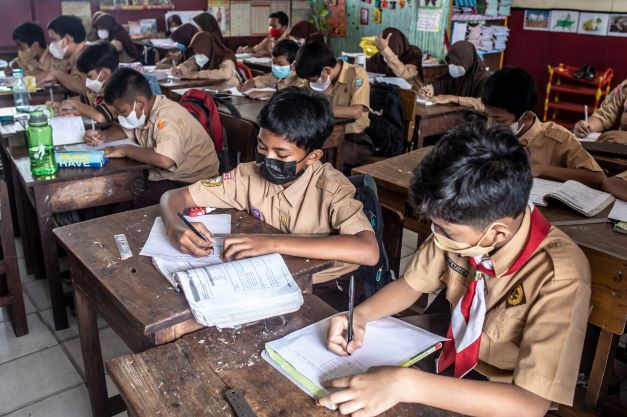
The Merdeka curriculum focuses on only the most essential learning materials for students.
Change text size
Gift Premium Articles
to Anyone
Share the best of The Jakarta Post with friends, family, or colleagues. As a subscriber, you can gift 3 to 5 articles each month that anyone can read—no subscription needed!
E
ducation, Culture, Research and Technology Minister Nadiem Makarim’s push to introduce a new curriculum, dubbed the Merdeka (Freedom) curriculum, has been met with skepticism from teachers, who are not convinced that it is compatible with schools nationwide, although the implementation remains optional.
The new curriculum, which will be applicable from this year for early childhood education institutions all the way up to senior high schools, has been touted by Nadiem as an answer to learning loss during the pandemic, particularly since previous curricula were deemed “too full of content”.
The Merdeka curriculum focuses on only the most essential learning materials for students. Unlike the previous curricula, which set out a certain amount of learning hours per week for each subject, the Merdeka curriculum sets out annual targets, in effect giving schools more flexibility to structure their teaching programs and learning timetables. The Merdeka curriculum also allows teachers to experiment with learning tools and for students to choose their preferred subjects, and emphasizes project-based learning, geared toward developing students’ soft skills and building character.
Schools now are given the freedom to implement one of three curricula: the tried-and-tested 2013 curriculum, the emergency curriculum, which simplifies the 2013 iteration, or the Merdeka curriculum.
Rushed process
While Nadiem appeared to wax lyrical on the benefits of the Merdeka curriculum, educator groups contend that the drafting of the Merdeka curriculum was too rushed and offered too little time to test it out on a nationwide scale.
The Merdeka curriculum has already been trialed by some 2,500 handpicked schools. These schools, dubbed sekolah penggerak (activator schools), began implementing the curriculum last year.
Read also: Explainer: Learning loss prompts government to introduce ‘Merdeka’ curriculum
Education ministry officials have lauded the success of the prototype curriculum in reducing learning loss – hence leading to the nationwide push for adoption of the new curriculum.
But Indonesian Teachers Association (PGRI) deputy secretary-general Dudung Abdul Qodir questioned the ministry’s findings, since most of the schools that took part in the trials were high quality schools.
“The education ministry said that everything is more simple now [with the Merdeka curriculum], but, as the people behind the curriculum, they should not be the ones making the judgment, it should be the users, who are us teachers,” Dudung said on Tuesday.
“The government should have tried the new curriculum on less fortunate schools, those with limited facilities and teachers, then they can find out whether or not the curriculum actually works.”
Fearing that the new curriculum will be difficult to implement on a national scale, he urged the government to retrace its steps and revise the 2013 curriculum, as opposed to suddenly introducing a new curriculum in the midst of a pandemic.
Exacerbate learning inequality
Nadiem’s reasoning behind why he made it optional was to let schools progress toward the new curriculum at their own pace. But United Federation of Indonesian Teachers (FSGI) secretary-general Heru Purnomo said it would instead result in confusion and exacerbate the nation’s education inequalities.
“If even the government considers one to be better than the other, that’s a problem, since, despite the multiple curriculum options available, there is only one standard for national assessment,” Heru said.
Read also: Amid lack of guidance, teachers chart own path to tackle online learning obstacles
The FSGI urged the government to make up its mind and choose between the 2013 curriculum or the Merdeka curriculum, since a difference in curricula might result in some students having a better learning experience than others.
Iman Zanatul Haeri of the Association for Education and Teachers (P2G) said that Nadiem’s decision to let schools choose their own curriculum, as opposed to making the Merdeka curriculum the only curriculum, was evidence that the new curriculum would not work well on a national level.
While the P2G has welcomed some aspects of the new curriculum, such as its project-based focus on education, Iman was wary that schools that were not ready to implement these changes to day-to-day learning would be overlooked by the government.
“In practice, once the government has made a new program, it will pay more attention to schools that are willing to implement the new program,” he said.