TheJakartaPost
Please Update your browser
Your browser is out of date, and may not be compatible with our website. A list of the most popular web browsers can be found below.
Just click on the icons to get to the download page.


Popular Reads
Top Results
No results found. Please check your search term and try again
Can't find what you're looking for?
View all search results
Popular Reads
Top Results
No results found. Please check your search term and try again
Can't find what you're looking for?
View all search resultsRethinking the soundness of our debt management: Should we be worried?
History has shown that the financial soundness of emerging markets are particularly vulnerable to external debts, both public and private.
Change text size
Gift Premium Articles
to Anyone
Share the best of The Jakarta Post with friends, family, or colleagues. As a subscriber, you can gift 3 to 5 articles each month that anyone can read—no subscription needed!
T
he COVID-19 pandemic has caused great social and economic disruptions with devastating consequences that we had never imagined before. In terms of policymaking, the virus has forced policymakers to override fiscal and monetary orthodoxy in order to save the economy from the brink of calamity. It has been two years, and we still have no clue when this pandemic will end. Fiscal discipline, however, needs to be undertaken to maintain macroeconomic stability, dampen vulnerabilities and improve the overall economic output.
On the one hand, the mounting level of debt caused by the pandemic should be reduced to a safer level in order to avoid more severe crisis and looming inflation. On the other hand, premature withdrawal of the fiscal stimulus to bring down the debt level could risk undermining recovery and cause double-dip recession.
Policymakers are determined to lower the budget deficit to pre-pandemic levels (below 3 percent) by 2023. But is this target realistic? Can we expect a “soft landing”, given the exit strategy policymakers have prepared?
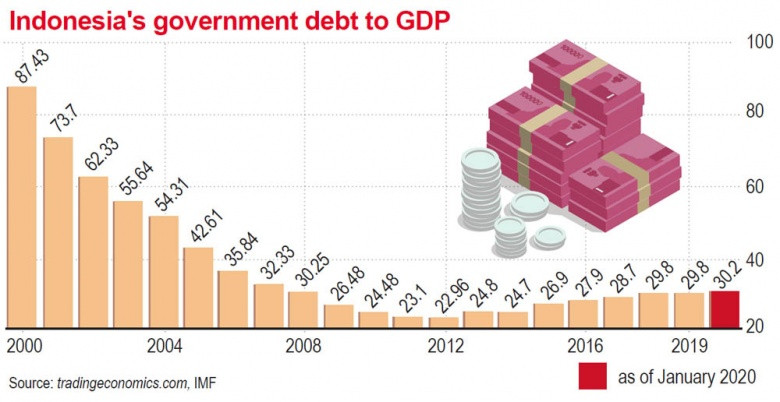
A well-designed exit strategy should take into account sound debt management as a potential solution if policymakers decide to extend fiscal consolidation to keep the expansionary stimulus programs on track. With government debt reaching 40 percent of gross domestic product (GDP) and deficit hovering between 4 and 5 percent, both public and private debts should be reexamined to make sure the payments can be fulfilled. Nonetheless, debt-to-GDP ratio should not be the only metric for assessing risks and vulnerabilities.
The biggest risk Indonesia faces as an emerging market is its current account deficit, which is financed by foreign capital flows to portfolio investment and leads to imbalance in the balance of payments. The imbalance results in capital flows that, when coupled with a lack of foreign direct investment, will result in mounting external debt. External debt exposes a bigger risk than domestic or “official” debt from multilateral institutions and the aid agencies of developed countries, since the creditors, or bondholders, can dump them on a whim, sparking currency depreciation and economic disruption.
Financial fragility as a consequence of overindebtedness in emerging markets, particularly from external debt, can be viewed from three dimensions.
First, countries with adequate foreign reserves or solid fundamentals only suffer very short-lived downturns in capital inflows. Thus, such countries are more resilient during market turmoil and can eventually avoid unexpected financial crisis. Aside from financing external debt payments and imports, foreign reserves can also be a means for central banks to conduct open market operations in order to stabilize financial markets from investor panic.
Second, countries with higher exposure to short-term debts (maturity within a year) deal with vulnerabilities to short-term financial shocks that could lead to outright default. Reinhart and Rogoff (2009) from Harvard University suggest that relying excessively on short-term borrowing to fund growth can provoke sudden and unexpected financial crises and undermine confidence in the market.
Third, outstanding debt held mostly by foreign investors is more vulnerable to dynamic and sudden capital flows. Dependence on foreign funds can be caused by insufficient loanable funds relative to investment needs, so the current account deficit must be financed by either foreign direct investments or portfolio investments.
Data from Bank Indonesia show that as of December 2021, Indonesia’s external debts, government and private combined, reached US$415 billion with $144.9 billion in foreign reserves, showing a year-on-year increase in the ratio of short-term external debt to reserves from 31.9 percent to 33.5 percent. This figure is higher than that of other peer markets such as India (17.5 percent), Thailand (29 percent), the Philippines (12.9 percent), Vietnam (28.1 percent) and Brazil (19.4 percent), but much lower than Turkey (148 percent), which recently suffered rapid currency depreciation and raging inflation.
Fortunately, in the context of debt composition, the ratio of Indonesia’s short-term external debts to outstanding external debts is 11.7 percent, still below that of India (18.4 percent), Thailand (36.6 percent), the Philippines (14.4 percent), Vietnam (21.3 percent), Turkey (31.8 percent) and Brazil (12.6 percent).
The government has relatively modest debts to multilateral institutions and development aid agencies, respectively accounting for 15.64 percent and 9.93 percent of Indonesia’s external debts. However, foreign reserves are in sore need of improvement, despite its all-time high in recent months, and the rising dependence on the dollar needs a solution. Policymakers need to take a more concerted effort in boosting exports in order to reduce the current account deficit and at the same time, attract more foreign direct investment.
Referring to the data above, it seems that Indonesia’s debt management in terms of debt composition is quite sound, because long-term external debts still comprise the biggest portion.
Relying solely on the debt-to-GDP metric will not give a comprehensive view of the underlying risks and vulnerabilities. We need to better understand the typical characteristics of emerging markets like Indonesia.
A number of studies suggest that emerging markets and developing economies face bigger risks in terms of external debt, particularly because of currency volatility. The currency crises followed by financial crises in Latin America in the 1980s, in Asia in 1997-1998 and in Russia in 1998 were triggered by high exposure to external debt and thus, could be a lesson for today’s policymakers.
***
The writer is chairman of the Center for Accounting and Public Finance Studies at STAN Polytechnic of State Finance. These views are personal.