TheJakartaPost
Please Update your browser
Your browser is out of date, and may not be compatible with our website. A list of the most popular web browsers can be found below.
Just click on the icons to get to the download page.


Popular Reads
Top Results
No results found. Please check your search term and try again
Can't find what you're looking for?
View all search results
Popular Reads
Top Results
No results found. Please check your search term and try again
Can't find what you're looking for?
View all search resultsFirm policies needed to retain pandemic traffic respite
As mobility returns to pre-pandemic levels in response to plummeting COVID-19 cases and easing restrictions, experts say that major efforts are needed to keep Jakarta's roads gridlock-free.
Change text size
Gift Premium Articles
to Anyone
Share the best of The Jakarta Post with friends, family, or colleagues. As a subscriber, you can gift 3 to 5 articles each month that anyone can read—no subscription needed!
T
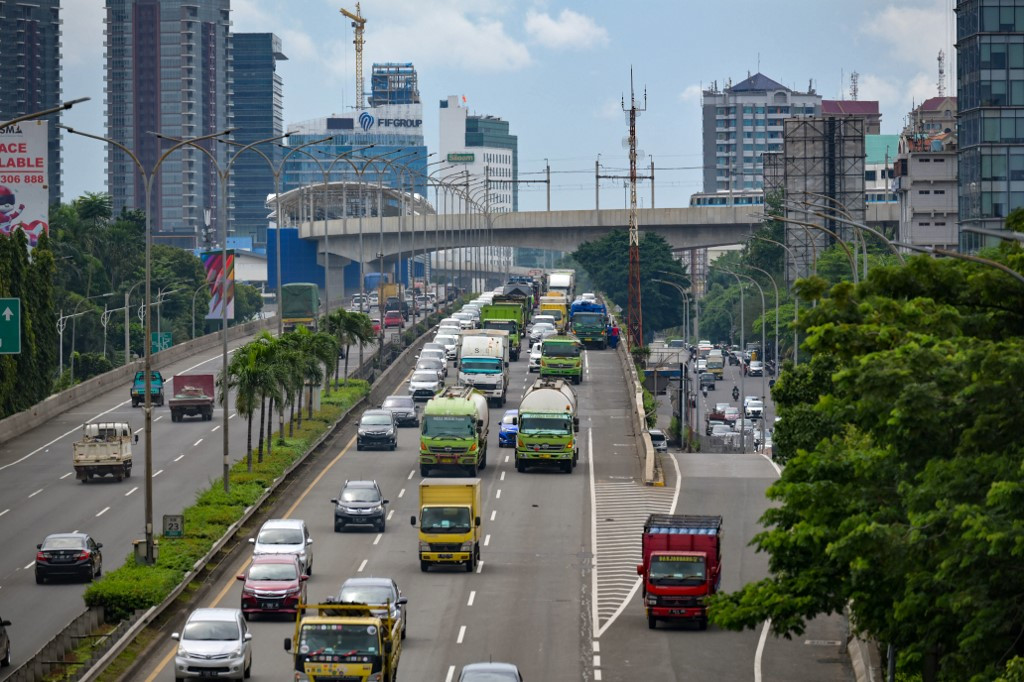
he two years of the COVID-19 pandemic have come with a small silver lining for Jakarta. The city, which was once ranked among the most congested in the world, has experienced a reprieve in its chronic traffic woes.
Roadway congestion levels improved significantly after the outbreak, as schools were closed and people were forced to work from home to curb the spread of the virus.
But as mobility slowly returns to pre-pandemic levels in response to plummeting COVID-19 cases and easing restrictions, experts say that major efforts are needed to keep Jakarta's roads gridlock-free.
A recent report by Dutch location technology company TomTom ranked Jakarta the 46th most congested city in the world last year. The city had been ranked 37th in 2020 and 10th in 2019.
According to the 2021 TomTom Traffic Index, the average congestion level in Jakarta was 34 percent in 2021, down 2 percent from 2020 and down 19 percent from 2019 – before the pandemic swept the globe.
Traffic during rush hours had also improved, the report said, with congestion levels during the morning rush down 25 percent from 2019 and congestion levels during the evening rush hour decreasing by 22 percent.
The report also found that in 2021, Jakartans spent an average of 2 days and 3 hours less time driving in rush hours than in 2019.
Pandemic working habits
Congestion began to return to Jakarta's streets as the recent third wave of COVID-19 infections receded and the government lowered public activity restrictions (PPKM) in the capital to level 2, the second-lowest in the four-tiered system.
The new curbs allow 75 percent of the workforce to return to the office and schools to fully reopen for limited periods, among other relaxations.
Transportation expert Leksmono Suryo Putranto of Tarumanegara University said maintaining some remote work would be vital to keeping Jakarta’s traffic from returning its pre-pandemic levels.
"With two years of remote working, many companies have now realized that they don't need their employees to come into the office to get their work done," Leksmono said on Monday. "If they continue to embrace remote or hybrid work even after the pandemic, I believe we could maintain and even improve traffic in the capital."
Before the pandemic, about 11 percent of Greater Jakarta’s inhabitants over the age of 5 were commuters, with seven out of 10 these commuters belonging to the working-age population, according to the 2019 Greater Jakarta Commuter Survey by Statistics Indonesia (BPS).
About 80 percent of the city’s 3.2 million commuters were office workers, and some 72 percent of commuters used private vehicles – either cars or motorcycles – to get to their workplaces.
Improving public transportation
Besides encouraging offices to continue remote work after the pandemic, Indonesian Transportation Society (MTI) secretary-general Harya Setyaka Dillon said that the Jakarta administration needed to continue improving public transportation in the capital.
"Besides teleworking, public transportation plays a big role in reducing traffic in Jakarta. Even before the pandemic, Jakarta's ranking in the TomTom traffic index was gradually improving as the number of public transportation passengers increased," Harya said on Monday.
In 2017, Jakarta was the fourth-most congested city in the world, according to the index. It ranked seventh in 2018 and 10th the following year.
Over the same period, the number of passengers on the city-owned TransJakarta bus service nearly doubled from 144.7 million in 2017 to 264.6 million in 2019.
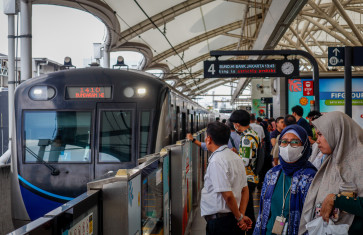
In 2019, the city also launched the Jakarta MRT, a rapid rail service, which managed to gain more than 20 million passengers in less than a year.
Harya said the city administration needed to ensure that public transportation remained safe during the pandemic, as studies had suggested that many people preferred to use private vehicles to get to work for fear of COVID-19 transmission.
"Make sure that all public transportation drivers are fully vaccinated and regularly tested, enforce mask wearing even after COVID-19 becomes endemic and put better ventilation systems inside the vehicles," Harya said.
The extra mile
Southeast Asia Institute for Transportation and Development (ITDP) director Faela Sufa suggested that the Jakarta administration introduce tougher policies to deter people from using private vehicles after the pandemic.
"No matter how good Jakarta public transit is, it will never beat the comfort and convenience of driving private vehicles," she said. "So there should be a policy in place to discourage people from using private vehicles, such as by implementing electronic road pricing and increasing parking fees in downtown areas."
The Jakarta administration has been seeking to implement an electronic road pricing policy since 2006, but progress has stalled, reportedly because of paperwork and financing issues. It had also been planning to significantly increase both on-street and off-street parking fees, but no changes have yet been made.