Can't find what you're looking for?
View all search resultsCan't find what you're looking for?

View all search resultsSaving Jakarta has become politicized, leading to a never-ending debate over how this should be done.
ore people are living in cities than ever before, with much of the rapid urbanization occurring in the Global South, particularly in Southeast Asia.
Indonesia is the fourth most populous country in the world, and in 1950 only about 12 percent of its population resided in urban areas, which has risen to around 58 percent in 2022 and is expected to rise to 73 percent by 2050. Asian cities are struggling under the weight of this rapid urbanization, as exemplified by Jakarta, which is literally sinking.
In response, a number of grand mega-infrastructure plans have been proposed to protect Jakarta’s coastline and flood-proof the city, primarily revolving around upgrading existing flood protections and building new Dutch-style seawalls.
The building of the “Giant Sea wall” has been included in the Jakarta 2030 Master Plan, described as a three-layered sea wall, with the outer layer acting as a causeway and breakwater. The dam created by the wall will serve as a water catchment basin for the 13 rivers that run through the city, and a water treatment plant will ensure water quality.
The project, developed with the government of the Netherlands, has gone through multiple iterations, with the most recent, including reclaimed land in the shape of a Garuda, the country’s national emblem, symbolizing the Garuda as the savior of the nation, a bold and courageous figure that can bring prosperity to Indonesia.
Despite progress in planning the Giant Seawall, the project has been postponed due to the high costs, problems with reclamation, and public criticism. Saving Jakarta has become politicized, leading to a never-ending debate over how this should be done.
Partly in response to this, in 2019, President Joko “Jokowi” Widodo decided to move the capital city to Kalimantan. The new capital is officially named Nusantara and is set to be inaugurated in 2024. Building is expected to start in 2023, and the first 2 million people are expected to live there by 2039.
There has been quite a lot of debate amongst journalists, environmentalists, and academics in the media about the plan to move the new capital due to Kalimantan's importance for the environment. Kalimantan is home to one of the last remaining large intact contiguous tropical forested landscapes and a globally important carbon sink. It is a major evolutionary hotspot for fauna and flora, with species found not anywhere else in the world.
The central region of Kalimantan is home to the Heart of Borneo, a transboundary conservation zone slightly smaller than the land area of the United Kingdom. While its oceans are home to the coral reef triangle, sometimes referred to as the Amazon of the ocean.
To many, moving the capital is seen as advocating responsibility for addressing the current environmental and social problems associated with Jakarta and potentially creating another environmental crisis is arguably one of the most important locations globally for biodiversity and carbon.
This concern has primarily been around the nature of urbanization in the new capital. While initial announcements around the design of the new capital suggest it would be designed around environmental principles, as a forest city or biocity, they have always been treated with some degree of skepticism.
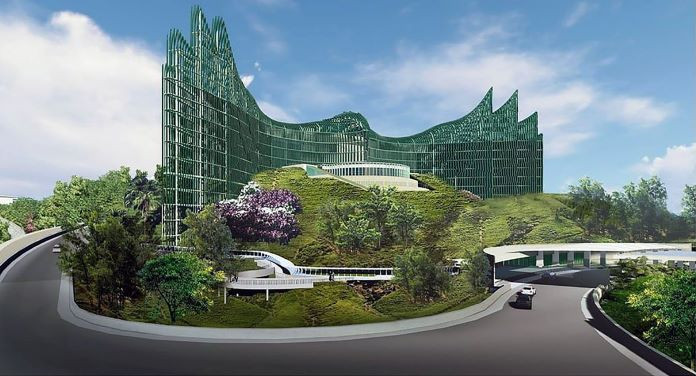
However, the shroud of secrecy on exactly what the design of the new capital has only recently been lifted, which has included the unveiling of the new capital website (IKN), and more details around the design and location has emerged. The website describes eight principles and provides a glimpse around the kind of city the new capital aspires to be. There is no shortage of great ideas, and lofty ambitions, as fleshed out in a more detailed manner by these principles (see https://ikn.go.id). For example, 80 percent of the trips within the IKN are set to be completed using transit and or combinations with walking and cycling – for comparison, 67 percent of residents of New York City, long considered as a champion of sustainable transportation, use a combination of transit, bike, and walk.
Another principle, outlines that the IKN would emit zero emissions by 2045, all while cementing its status as the region that has the highest regional domestic product and the lowest poverty level compared to more than 500 districts in the country. Finally, 75 percent of the new capital will be made up of green areas.
What has been outlined in the 8 IKN principles, on paper, appears to be unmatched by any existing city in the country and around the world, in both the Global North and Global South. If the city is indeed built based on these principles it has the potential to provide a blueprint for “the world’s most sustainable city”.
Furthermore, more details have come out around the existing land cover in the immediate area of the initial city boundary – it is primarily non-indigenous Eucalypt plantation forestry. Therefore, biodiversity impacts directly associated with the city’s footprint may be positive if converted to natural ecosystems.
In fact, the new capital may be one of the most ambitious urban restoration programs ever. Which is fitting given that it is the UN decade of restoration.
However, there are two major challenges for the new capital if it is to become a shining example of sustainable urbanization. Firstly, the implementation and construction will need to live up to the expectations around sustainable urban design; but in Southeast Asia this is often not the case, as seen in other cities and urban developments, where green credentials just amount to greenwashing.
Secondly, and perhaps most concerning is how the city impacts the natural environment outside of its boundaries. Megacities and capital cities usually outpace the growth of other cities and have a ripple effect, promoting growth in nearby cities in the surrounding region. It is important that urban design regulations outside of the capital be equally sustainable otherwise the spillover effects on Kalimantan’s natural landscape may be far greater than the positive impacts within the city boundaries.
Along with urban growth, any transport infrastructure which connects the new capital to other parts of Borneo, including Sarawak, Sabah, and Brunei, will promote deforestation as previously inaccessible parts of the island are developed. There are already plans to build a number of new highways which crisscross Kalimantan and will connect the new capital.
While the designs and plans for the new capital are promising, whether it becomes a model for sustainable urban transformation in Southeast Asia or an impending environmental disaster will depend on its implementation and how the government regulates sustainable development across the whole island.
The concern is that a failure here will have global repercussions for addressing the twin challenges of climate change and biodiversity.
***
Alex Lechner is a landscape ecologist and associate professor, teaching on the Master of Urban Design at Monash University Indonesia. Sofian Sibarani is the founder and director of URBAN+ and a lecturer at Monash university Indonesia on the Master in Urban Design. URBAN+ is in charge of designing the new capital.
Share your experiences, suggestions, and any issues you've encountered on The Jakarta Post. We're here to listen.
Thank you for sharing your thoughts. We appreciate your feedback.
Quickly share this news with your network—keep everyone informed with just a single click!
Share the best of The Jakarta Post with friends, family, or colleagues. As a subscriber, you can gift 3 to 5 articles each month that anyone can read—no subscription needed!
Get the best experience—faster access, exclusive features, and a seamless way to stay updated.