TheJakartaPost
Please Update your browser
Your browser is out of date, and may not be compatible with our website. A list of the most popular web browsers can be found below.
Just click on the icons to get to the download page.


Popular Reads
Top Results
No results found. Please check your search term and try again
Can't find what you're looking for?
View all search results
Popular Reads
Top Results
No results found. Please check your search term and try again
Can't find what you're looking for?
View all search resultsCould solar punk be our hope against climate apocalypse?
It is no wonder that millennials’ movement to not have children owing to fears about climate crisis is on the rise.
Change text size
Gift Premium Articles
to Anyone
Share the best of The Jakarta Post with friends, family, or colleagues. As a subscriber, you can gift 3 to 5 articles each month that anyone can read—no subscription needed!
A white furry beast is floating on a thin chunk of ice. In all its confusion the mammal stares blankly into the water and wonders where all the seal have gone.
We are already familiar with this image. Your next-door environmental activist may have posted it, or you stumbled upon the animal on a meme site a few years back. But who could have cared for a creature stranded thousands of kilometers away?
The issue was just too far-fetched, and it became even more so when you were told it was because you bought the wrong brands. Yet disheartening scientific discoveries have finally surged, and everyone has begun losing their minds.
Research-based predictions on land desertification, crop failures, famines and societal collapses almost seemed like fear-mongering attempts advertised by doomsday merchants. In 2019 the Intergovernmental Panel on Climate Change (IPCC) reported that prolonged heat-wave projections indicate a decrease in crop yields and disastrous effects on Central Asian population health.
By 2030, without proper inclusive progress, climate change could increase the number of paupers by between 35 million and 122 million globally. Additionally, a related study showed that changes in climate drylands may promote rapid mortality of foundational species on the soil surface.
It is no wonder that millennials’ movement to forego having children owing to fears over climate crisis is on the rise. They believe that doing so will amplify global warming or are concerned about severe situations their progeny may have to endure. In less extreme responses, people might contract stress disorders that hinder their day-to-day activities.
These phenomena are being termed as eco-anxiety, which is a result of receiving too much information on environmental emergencies pushed by mass media. Those of us who are highly empathetic or possess immense affinity toward Gaia are the ones most prone to the syndrome.
While such large information streams are a good sign of concern and care, it also says a lot about the lack of optimism and actionable plans to mitigate further declines.
Until recently, what cult-classic science fictionists offered a hope-deprived world, were portrayals of dystopian earth, in a genre coined as “cyber punk”.
Remind yourselves of Blade Runner, a movie characterized by a countercultural antihero, trapped in a dehumanized high-tech future. A skyline of densely packed skyscrapers and holographic femme fatale commercials blended into a haze of smog. Standing 300-stories tall, the abode of the god-like creator of last-gen clones exudes its overbearing control over the filthy streets below. Against the urban fortress, a once-fertile biome has degraded into a lifeless scenery, childbearing herds exchanged with hollow bones. Brutal tides of a risen sea stalk beyond the city walls.
This is the kind of future we are unfolding. Call this a daydream, but we are already living in an Orwellian nightmare, and without amendments there is only a slight chance we will not slumber into another one.
But without Goliath, David’s bravery would not have manifested -- analogous to a group of insurgents proposing an antithesis minted as “solar punk”. The word “solar” refers to tech-enabled renewable-energy humanity can adopt to preserve the planet, while “punk” bears upon an anti-establishment view, where each constituent contributes to society’s welfare.
What makes this genre interesting is the idea that pursues a mix of indigeneity and modernity -- a coexistence between man, technology and nature -- which means accomplishing future developments and technological advancements with cultural values and ancestral wisdom in mind.
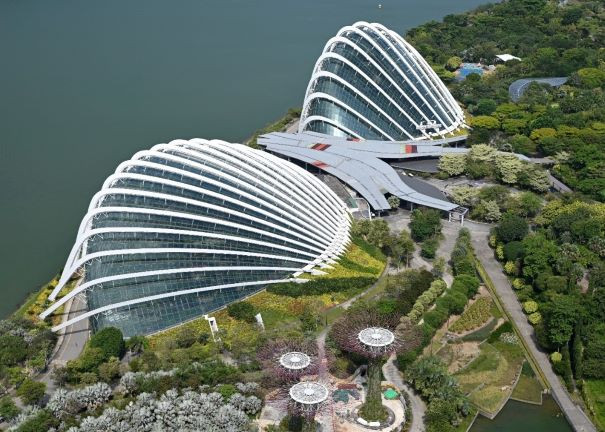
One fictional example would be Black Panther’s Wakanda, an affluent sanctuary of civilized sapiens immersed in wilderness and futuristic machines. We can almost find a real world parallel in Changi Airport, Singapore, or their Gardens by the Bay. Inside, breezes carrying fresh scent of greeneries pass through a circular water curtain that falls down the center of a dome-like structure, upheld by steel beams reminiscent of sacred geometry.
With numerous ethnicities and natural abundances, Indonesia is also susceptible to the concept, and may serve as a perfect ground to encase solar punk and its practical dream of regenerative developments. The genre will function as a launchpad that catalyzes change in science and society. Having internalized this, the next step is to understand that the emerging creative industry acts as the infantry-laying groundwork for the war against the climate apocalypse.
We need entrepreneurs, artists, film-makers, innovators and scientists who are willing to take extensive risks in creating originals that are not only good to be used right now, but also good for the future outlook. Future endeavors will demand more innovation capital, consequently more green investments are required. Hence, financiers will not only need to shift their expense priorities, but to also shift from profit-oriented to inclusive growth.
Moreover, brands may use solar punk as a device to boost equity. Both as a large idea that encapsulates the whole marketing campaign, or as an additional element -- just like Marvel did with Earth-838’s landscape. To be effectively accepted, populous communities are needed.
Though instead of becoming passive recipients of brand messages, these populaces should rather operate as active agents that will not only discuss, but produce outputs ranging from whimsical fiction works to complex engineering feats.
Solar punk is just one idea in an ocean of many. Whatever shape developments may take, what is noticeably important is the notion that we should all reflect on the ways we have lived and how we will continue on living.
After all, earth is the only place where we make a stand, there is no hint that help will come from elsewhere to save us from ourselves (Carl Sagan, 1997). We live in a sunset world; is there any hope that we will ever get to see the dawn of tomorrow?
***
The writers are lecturers at Prasetiya Mulya University and cofounders of TANARE-A Place to Regenerate. The views expressed are their own.