TheJakartaPost
Please Update your browser
Your browser is out of date, and may not be compatible with our website. A list of the most popular web browsers can be found below.
Just click on the icons to get to the download page.


Popular Reads
Top Results
No results found. Please check your search term and try again
Can't find what you're looking for?
View all search results
Popular Reads
Top Results
No results found. Please check your search term and try again
Can't find what you're looking for?
View all search resultsGovt eyes ratification of UN convention ahead of UPR
A senior Cabinet minister has said the government would press for the swift ratification of the International Convention for the Protection of All Persons from Enforced Disappearance (ICPPED).
Change text size
Gift Premium Articles
to Anyone
Share the best of The Jakarta Post with friends, family, or colleagues. As a subscriber, you can gift 3 to 5 articles each month that anyone can read—no subscription needed!
T
he government would ask lawmakers to fast-track the ratification of a United Nations legal instrument on forced disappearance, a senior Cabinet minister has said, ahead of a global peer review of Indonesia’s human rights record.
Indonesia will face its next Universal Periodic Review later in September, when members of the UN Human Rights Council will probe the nation’s treatment of human rights issues. Jakarta itself has focused its efforts on upholding various civil rights, which has been called out as a distraction from the more contentious human rights issues.
Most recently, senior Coordinating Political, Legal and Security Affairs Minister Mahfud MD has vowed to have Indonesia complete its responsibility to ratify all core international human rights instruments, by ensuring that lawmakers ratify the International Convention for the Protection of All Persons from Enforced Disappearance (ICPPED).
During his speech at the 50th session of the UNHRC in Geneva, Switzerland last week, Mahfud said that Indonesia was in the process of ratifying the ICPPED. He claims that UN High Commissioner for Human Rights Michelle Bachelet welcomed the move.
The minister later told a press conference upon his return that he would press lawmakers to fast-track the process. "We will talk again [with lawmakers to say] the bill has caught the attention of the Human Rights Council, so it must be passed immediately," he said in a statement.
However, the House has yet to schedule a meeting to further process the ratification of the instrument.
Abdul Kharis Almasyhari, deputy chairman of House of Representatives Commission I, overseeing defense, foreign affairs, information and intelligence, told The Jakarta Post on Thursday that legislators were still focused on the deliberation of the Data Protection Bill, and that no other item would be considered until the commission finishes it.
President Joko “Jokowi” Widodo had given the go-ahead to ratify the ICPPED in a presidential letter dated April 27 two weeks before the House began its current sitting term. When asked, House Deputy Speaker Sufmi Dasco Ahmad was unable to confirm plans for its ratification.
The ICPPED is the last core international human rights convention that Indonesia has yet to ratify. The House had passed eight others legal instruments, which cover racial discrimination (ICERD), discrimination against women (CEDAW), torture and inhuman treatment (CAT), disability rights (CRPD), political rights (ICCPR), socio-economic and cultural rights (ICESCR), children’s rights (CRC) and migrant worker protections (ICMW).
The ICPPED has been languishing in the pipeline since Indonesia signed the convention in September 2010, about three months before it came into effect that year.
A plan to ratify the convention in 2013 fell through after political parties opposed its adoption. Last August, the government had promised to restart the deliberation process to coincide with Human Rights Day on Dec. 10, but it was delayed yet again.
In December 2021, the Law and Human Rights Ministry’s then-director for human rights instruments, Timbul Sinaga, submitted the draft ratification bill to the Executive Office of the President (KSP). The bill had to be signed off by four ministers -- Mahfud, Law and Human Rights Minister Yasonna Laoly, Foreign Minister Retno LP Marsudi and Defense Minister Prabowo Subianto -- before it was presented to the President.
Timbul, who retired in early March, was quoted by Tempo.co as saying that Prabowo was the last to sign off on the bill before it was sent to Jokowi for consideration.
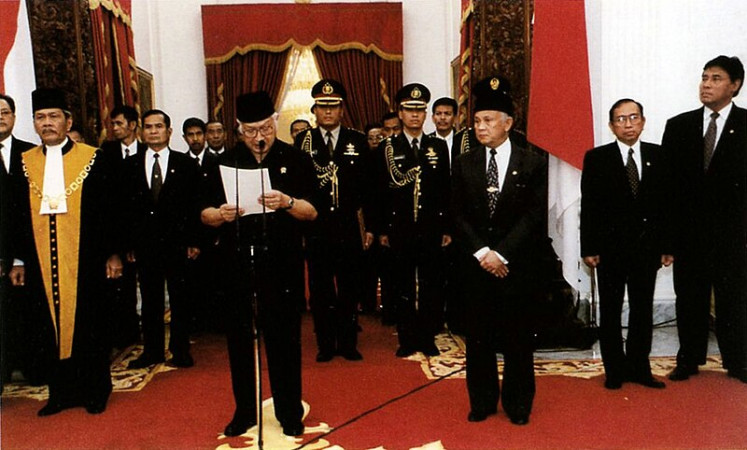
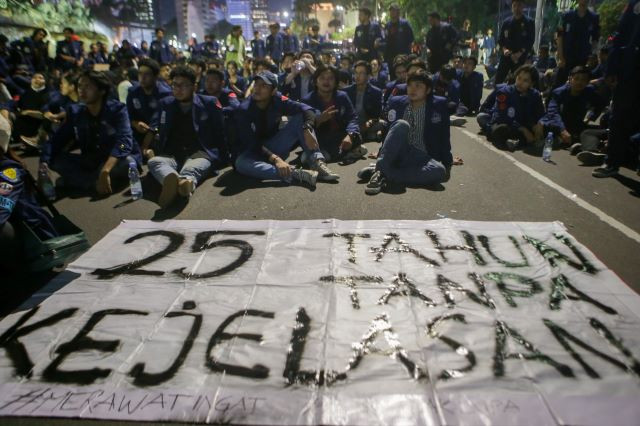
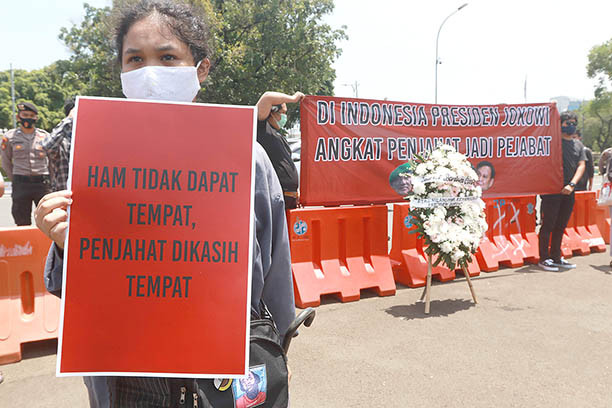
The issue of forced disappearances casts a long shadow over Indonesia’s democratic reforms. A raft of figures in the current government and the legislature are linked to forced disappearances in the last years of the New Order regime.
The ICPPED requires its state signatories to pass a law that criminalizes forced disappearance and requires them to ascertain the whereabouts of disappeared persons.