TheJakartaPost
Please Update your browser
Your browser is out of date, and may not be compatible with our website. A list of the most popular web browsers can be found below.
Just click on the icons to get to the download page.


Popular Reads
Top Results
No results found. Please check your search term and try again
Can't find what you're looking for?
View all search results
Popular Reads
Top Results
No results found. Please check your search term and try again
Can't find what you're looking for?
View all search resultsPancasila must be more than just ‘lip service’, Muslim thinkers say
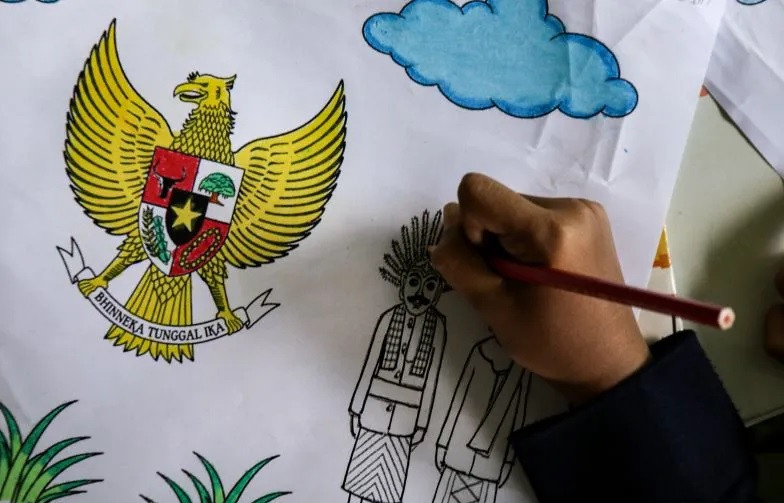
The Jakarta-based Centre for Strategic and International Studies (CSIS) recently hosted a webinar on Pancasila commemorating the late Muslim intellectual Syafii Maarif, who died in May of this year.
Change text size
Gift Premium Articles
to Anyone
Share the best of The Jakarta Post with friends, family, or colleagues. As a subscriber, you can gift 3 to 5 articles each month that anyone can read—no subscription needed!
M
ore needs to be done to promote tolerance and preserve the national ideology Pancasila, prominent Muslim thinkers have said, as the country prepares to face another potentially polarizing general election in 2024.
During a seminar hosted by the Jakarta-based Centre for Strategic and International Studies (CSIS) on Wednesday, Muslim intellectual Azyumardi Azra said that while he remained optimistic that most Indonesians would firmly hold on to the national ideology, he also noted recent “challenges”, particularly in what he saw as the weakening of certain Pancasila values.
“For the most part, aspects of Pancasila right now are just lip service. If we can compare the current situation to how it was practiced during the time of Buya Syafii, there’s a big difference,” Azyumardi said.
He was referring to Ahmad Syafii Maarif, an icon of pluralism and an intellectual force of nature for a generation of progressive Indonesian Muslims, who passed away in late May.
Read also: Indonesia’s pluralism icon Ahmad Syafii Maarif dies at 86
The online seminar was held to commemorate Syafii. It was also attended by Catholic scholar and Jesuit priest Franz Magnis-Suseno, Muslim scholar Ulil Abshar Abdalla and presidential expert staffer Siti Ruhaini Dzuhayatin.
During the seminar, Azyumardi offered several examples of how respect for Pancasila had grown weaker. He scrutinized its first principle, Belief in one God, and how recent instances of religious intolerance, particularly from and among Indonesian Muslims, was degrading it.
“With instances of intolerance from Indonesian Muslims toward non-Muslims, any bit of difference will be followed [by an altercation]. That is what Buya would have called ‘thugs in sheep’s clothing,’” said the current Press Council head.
He also said the fourth principle of Pancasila – democracy guided by the wisdom of consensus-based deliberation among representatives – faced further setbacks, citing a string of interim regional leaders that had been appointed directly by the government rather than through democratic processes.
So far, the government has installed five senior officials to replace governors whose terms in office have expired before the next regional elections, which are to be held in November 2024, a process critics have accused as being opaque.
“It has taken power away from the people,” he said.
Read also: Observers decry non-transparent interim leader selection
Meanwhile, Ulil said democracy in the wake of the fall of the New Order in 1998 had been characterized by the increasing prominence of identity politics, which posed another threat to Pancasila.
“This era has been marked by a type of politics that puts people in groups, [a sort of] tribalism, with religion being a contributing factor. This stands in stark contrast to the principles of Buya Syafii,” he said at the seminar.
Part of the problem, the scholar contended, was that Indonesian Muslims, particularly those who interpreted the Quran in a more literal fashion, were now more easily offended.
“In following the spirit of Buya, while it is true that he wants us to go back to the roots of Islam that is the Quran, it should not be seen as a tool for identity politics. Instead, values should be applied in a more modern context,” he added.
Indonesian identity politics has tended to deploy religious feeling to mobilize support for political ends, such as winning elections.
Read also: Election stakeholders take firm stance against identity politics in 2024
Law enforcement agencies, politicians and experts have weighed in on, and taken steps against, identity politics, while also expressing their hope that the 2024 elections can be remain free of campaign strategies that sow unproductive division.