TheJakartaPost
Please Update your browser
Your browser is out of date, and may not be compatible with our website. A list of the most popular web browsers can be found below.
Just click on the icons to get to the download page.


Popular Reads
Top Results
No results found. Please check your search term and try again
Can't find what you're looking for?
View all search results
Popular Reads
Top Results
No results found. Please check your search term and try again
Can't find what you're looking for?
View all search resultsCitayam in Sudirman: Blurring the lines of sociospatial divide in Jakarta
A well-planned and appropriately priced mode of public transportation is also a meeting place, a melting pot and usually a good representation of the city’s diversity.
Change text size
Gift Premium Articles
to Anyone
Share the best of The Jakarta Post with friends, family, or colleagues. As a subscriber, you can gift 3 to 5 articles each month that anyone can read—no subscription needed!
A
s it appears to be a daily occurrence these days in Indonesia, video footage went viral on social media platforms and became the talk of the town. By “town” of course I mean Jakarta, a megalopolitan with 30 million people.
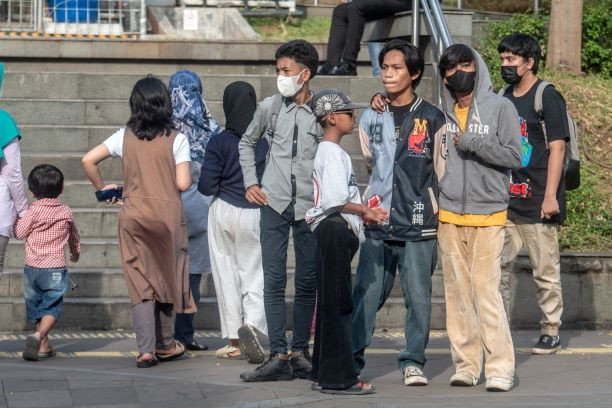
The video in question shows a 360-tour around Dukuh Atas MRT station, situated right at the heart of Jakarta. The unique design of the area, however, does not take the spotlight of the video. Instead, it highlights a seemingly recent phenomenon of adolescents from the outskirts of the Jakarta metropolitan region who flock to hang out in the area in groups, be it on the benches or the curbs.
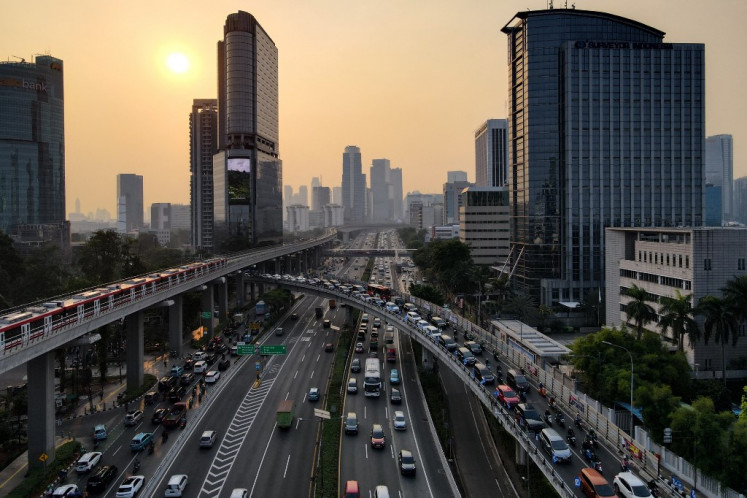
Popularly known now as the "SCBD phenomenon", it is meant as a tongue-in-cheek contrast with a whiff of condescension between the actual Sudirman Central Business District (SCBD) and an acronym of Sudirman-Citayam-Bojong Gede-Depok – areas in the outskirts of the capital city. The former hosts Jakarta’s young executives sitting on the umpteenth floor of the city’s modern skyscrapers, while the latter hosts these young adults coming from much more humble areas and, dare I say, from a lower step of the socioeconomic ladder.
Public discourse was then born out of these viral videos, mainly asking the question of whether or not it’s appropriate for the latter to hang out in public spaces in one of Jakarta’s most elite areas – which I would argue is not only a socioeconomic question but also a sociospatial one.
As we all know, Jakarta is a city of many, many faces – for better or worse. Amid all the glass-draped skyscrapers and the Louis Vuitton-flaunting shopping malls, there is always a dense semiformal settlement with metal roofs revealed to be percussive whenever it rains.
While the majikan (masters) are having pasta for lunch in an alfresco setting, their drivers are also outdoors eating a bowl of noodles probably at a 10th of the price. This is not meant to be a dig at people’s lifestyle differences, by the way. It is just the reality that we are all facing in Jakarta and, in fact, in all major cities around the globe.
Jakarta, therefore, should be no stranger to socioeconomic heterogeneity, if not divide. But this recent phenomenon and the discourse it triggers seem to suggest otherwise.
The chosen location at Dukuh Atas MRT station is in itself a revealing clue. As part of the city’s attempt to improve mass transportation, Dukuh Atas is being designed as an integrated hub connecting the MRT line, Jakarta Commuter Rail, the airport train and the upcoming LRT. With the Dukuh Atas MRT station connected to the Sudirman Commuter Rail Station, people living in Jakarta’s peri-urban areas now have direct and affordable access to the newly built public spaces built as part of the MRT development.
With the shortage of quality public spaces in and around Jakarta, it is not a surprise that these well-designed transit nodes become attractive to people who seek places to socialize without having to pay the almost mandatory hidden cost of sitting comfortably in Jakarta: a Rp 50,000 (US$3.33) cup of coffee. This, therefore, looks to be a classic case of what is known as Not In My Back Yard (NIMBY)-ism in urban planning discourse.
If Jakartans are asked whether or not everybody has a right to good quality and accessible public spaces, the majority would probably agree. However, some will surely insist on the condition that it is NIMBY– basically a highbrow utopia of social justice without social cohesion.
Public transportation, as you must have observed in the world’s greatest cities, is not only a pragmatic vehicle that brings you from A to B. A well-planned and appropriately priced mode of public transportation is also a meeting place, a melting pot, and usually a good representation of the city’s diversity – barring the most marginalized groups, of course.
It is a great social, economic and cultural equalizer where you can meet with people from all different kinds of backgrounds, or at least see them from a distance close enough to offer your arm for a handshake.
With the relatively new MRT line, Jakarta looks to just be starting a similar journey toward this outcome. To some extent, public transport may help break the false security of your tinted car window and make all of us face societal differences merely as a harmless daily occurrence.
I, for one, am looking forward to that day to come when sociospatial lines are becoming blurred by an increasingly penetrative mass transportation network. Anyone from any background is – and should be – welcome in any of the city’s public spaces without any cloud of judgment from society and, even worse, from the authorities who – based on recent reports – seem to maintain the institutional clairvoyance that a congregation of lower-middle class adolescents automatically mean a guaranteed impending criminal offense.
It is about time Jakartans face the reality of living in a multicultural, heterogeneous megalopolitan. This time without the horse blinkers on.
***
The writer is a program officer at an international development cooperation agency, specializing in sustainable urban development.