TheJakartaPost
Please Update your browser
Your browser is out of date, and may not be compatible with our website. A list of the most popular web browsers can be found below.
Just click on the icons to get to the download page.


Popular Reads
Top Results
No results found. Please check your search term and try again
Can't find what you're looking for?
View all search results
Popular Reads
Top Results
No results found. Please check your search term and try again
Can't find what you're looking for?
View all search resultsTrade barriers intensify as global food crisis looms
Change text size
Gift Premium Articles
to Anyone
Share the best of The Jakarta Post with friends, family, or colleagues. As a subscriber, you can gift 3 to 5 articles each month that anyone can read—no subscription needed!
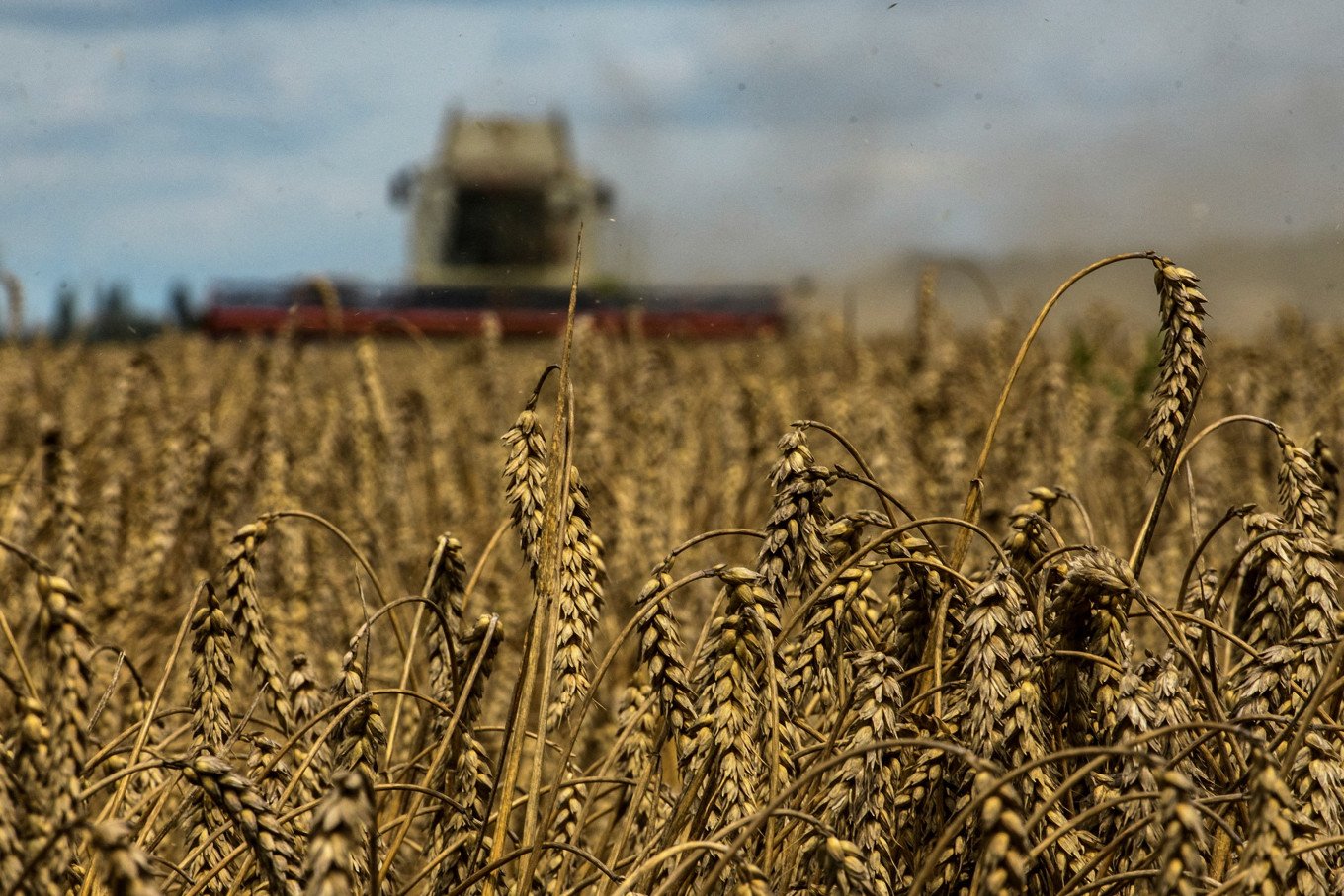

Neither Russia nor the West are willing to back down in their argument over what is causing disruption in food supply, meanwhile completely disregarding its impact on global food insecurity that might creep up on the world in 2023.
United Nations experts have revealed there are no severe shortages of wheat seeing as how the Food and Agriculture Organization (FAO) has raised this year’s forecast on world wheat production by 6.7 million tonnes, and the global wheat inventories are predicted to rise marginally above their opening levels by the end of the 2023 season.
“However, most of the anticipated year-on-year increase is concentrated in China and the Russian Federation,” Economic Development Deputy Minister of the Russian Federation Vladimir Ilichev told The Jakarta Post on Saturday, complicating the forecast, remembering how China consumes most of their supplies domestically while Russia’s are claimed to be shackled by the sanctions.
It is true that food was exempted from the West’s sanctions on Russia, but as per Bloomberg, bankers and insurers are “cautious about doing business with Russia and shipping lines are wary of sending their vessels into a war zone”, which Ilichev argued was the cause of global supply chain interference.
“The sanctions, including threats of mass arrests of dry-cargo ships and SWIFT cut-off for Russian financial institutions, refusal to insure ships and cargoes and restrictions by international transport companies have significantly disrupted the supply chains and money transfers involving Russian economic operators,” Ilichev said.
“Direct and indirect restrictions have also affected goods necessary for the production of agricultural products and fertilizers -- equipment and components for agricultural machinery, seeds, planting and incubation material, etc.,” he added.
Meanwhile, the West stood steady on their sanctions, going even toward the direction of tying with potential allies to make Russia’s foodstuff-supply irrelevant.
“I’ve been at the Group of Twenty [G20] Trade, Investment and Industry Ministerial Meeting [TIIMM] in Indonesia [last week] where I have been working with allies to use trade as a force for good and pressing on United Kingdom priorities, including supply chain resilience to help withstand future disruption and reduce the G20’s reliance on countries like Russia,” said UK’s Minister of State at the Department for International Trade James Duddridge.
“Russia’s illegal war on Ukraine has prevented them from exporting and harvesting future produce. Russia has not only majorly disrupted the production of key foodstuffs in Ukraine, but also supply routes through the Black Sea, accounting for a third of the world’s exports,” he added.
The United States Trade Representative (USTR) was unavailable for comment on the matter and recommended the Post to quote US President Joe Biden’s remarks before the 77th Session of the United Nations General Assembly (UNGA), which called on all countries to refrain from banning food exports or hoarding grain.
“Russia, in the meantime, is pumping out lies, trying to pin the blame for the food crisis onto sanctions imposed by many in the world for the aggression against Ukraine,” said Biden.
“So, let me be perfectly clear about something; our sanctions explicitly allow Russia the ability to export food and fertilizer. No limitation. It’s Russia’s war that is worsening food insecurity, and only Russia can end it,” he added.
Read also: Indonesia warns of global food insecurity
Unilateral trade restrictions
Meanwhile, Ilichev also told the Post that withdrawal of unilateral trade restrictions is important to ensure unimpeded access to world markets for food products and fertilizers from Russia whose obstructions have brought food insecurity to life.
“Russia is one of the largest food exporters. […] We are well aware of the importance of the supply of socially significant goods, including food, for the socio-economic development of the States in Asia, Africa, Latin America and the Middle East, achievement of food security targets and implementation of SDGs,” Ilichev said.
“The unilateral sanctions of the ‘collective West’ against our country have provoked negative trends in the global food market, energy sector and industry. Restrictions affected all economic operators, including agricultural companies.”
Furthermore, Ilichev revealed that Russian companies are interested in the Indonesian market, saying, “If the Indonesian side is interested in Russian wheat, we are open to discuss the details.”
Indonesia’s Coordinating Economic Minister Airlangga Hartarto addressed the issue of food insecurity in his opening remarks for the TIIMM, saying that the ripple effect of the Ukraine invasion would push the number of severely food insecure people to 323 million, which is more than double the amount of 135 million people prior to the pandemic.
“If the global food and energy crises are unattended, they can lead to a backsliding in global growth in the future and may become a source of even more significant structural problems. […] People would be impoverished, cutting the productivity rate in half,” said Airlangga on Sept. 22.
Read also: In Bali, G20 countries agree on need to fix global trade
At the end of the UNGA summit, global leaders issued a declaration calling for urgent efforts to address global food insecurity, laying out seven specific lines of action.
Among them is an acknowledgment of the need to “keep food, fertilizer and agricultural markets open and avoid unjustified restrictive measures, such as export bans on food and fertilizer, which increase market volatility and threaten food security and nutrition at a global scale”.