Can't find what you're looking for?
View all search resultsCan't find what you're looking for?

View all search resultsAs most of the investments were aimed to tap windfall from the commodity sector, with its short business cycle, they would not be sustainable in the long term.

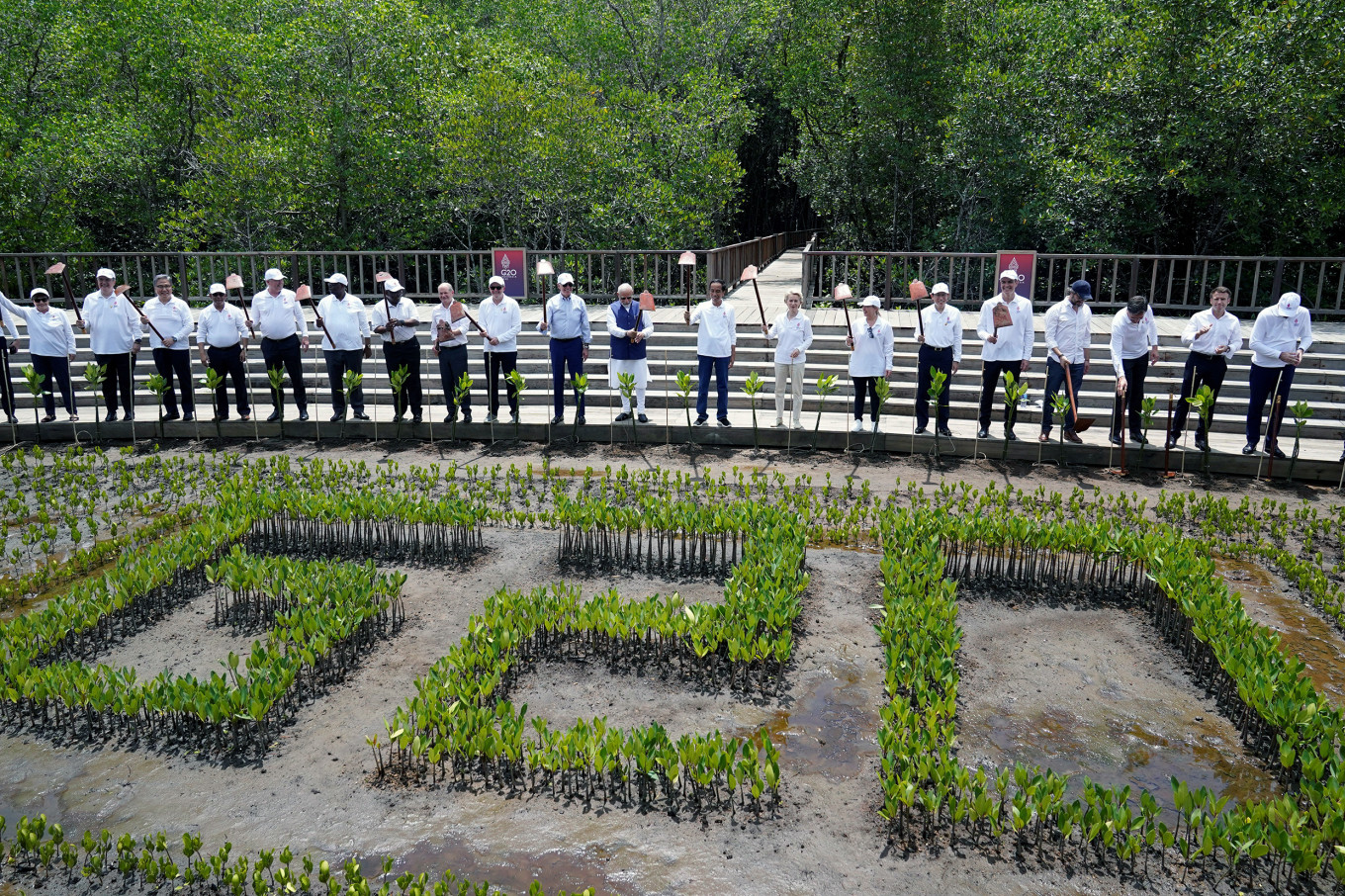
Bali has every reason to celebrate, not only because it was at the center of the world attention when it successfully hosted the Group of 20 Summit early last week, but also because its economy, notably its tourism industry, received a big boost from the series of international conferences.
But the joy of the Balinese is overshadowed by economic headwinds that have been slowly blowing to other provinces. Reports have emerged of the increasing worker layoffs in some parts of Java. Labor-intensive manufacturing -- textile, footwear, electronics -- have been shedding hundreds of thousands of workers, as orders from overseas are shrinking. And more layoffs may be imminent.
It seems that the country is not immune to the bleak global economy, still reeling from the pandemic, which is now battered by high inflation, rising interest rates and energy and food insecurity caused by the war in Ukraine.
But amid these gloomy world prospects, the Indonesian economy still showed strong recovery in the nine months to October, with 5.4-percent growth year-on-year (yoy), after growing 3.7 percent in 2021.
Government consumption shrank by 4.7 percent and remained a drag on growth, as it is winding down the pandemic-related expenditure. But private consumption, export and gross fixed-capital investment more than offset the slack in government expenditure.
Gross fixed-capital formation rose 5 percent in 2022 compared with 3.8 percent in 2021. These are in line with the figures published by the Investment Coordinating Board (BKPM). Realized domestic and foreign investment in the first half rose by 32 percent to Rp 585 trillion (US$39 billion). But most of the investments were put into mining and mineral-processing industries.
In response to the commodity boom, investment in the mining sector almost tripled from Rp 6.5 trillion in the first quarter to Rp 18.4 trillion in the second quarter. This trend raised questions about the quality of investment, as most of the investments were channeled to the commodity sector, which usually has short-term business cycles.
As most of the investments were aimed to tap windfall from the commodity sector with its short business cycles, they would not be sustainable in the long term, especially taking into account Indonesia’s commitment to the higher climate-action target. Pouring investments into the exploitation of natural resources also would adversely affect the flow of investments to a more productive and more technologically driven manufacturing base.
Whether such strong growth could be sustained in the next quarters is uncertain. What is clear, however, is that on a quarter-to-quarter basis, the growth in the third quarter was only 1.8 percent, a steep fall from 3.8-percent growth in the second quarter.
That the growth is losing steam is also apparent in the country’s trade. Total exports were up 33 percent in October yoy, and imports were up 28 percent. But exports and imports have declined by 10 percent since August.
Imports of raw materials and capital goods, which are directly related to output growth, were down by 15 percent and 14 percent respectively between August and October.
The global financial condition will be getting tighter as the United States Federal Reserve will continue its hawkish policies to tame inflation. Bank Indonesia (BI) last week also raised its benchmark rate -- for the fourth consecutive time this year -- by 50 basis points to 5.25 percent.
The dilemma for BI is that the policy-rate rise should not be too high as to hurt the economy, but also should not be too little to have an impact on curbing inflation.
The fiscal position is currently solid, with a surplus at 0.3 percent GDP in September, as revenues were up by 46 percent and expenditure rose by 6 percent yoy.
Although government foreign debts have declined, total debts outstanding rose from Rp 7.1 quadrillion in the second quarter to Rp 7.4 quadrillion in the third quarter. Accordingly, the interest cost of the government debts rose to Rp 279 trillion. The government-debt interests will continue to increase along with the rising interest rates globally.
The Indonesian banking system is in good shape after a series of restructurings during the pandemic. Bank loans grew strongly by 10.3 percent in June. Non-performing loans (NPL) declined to 2.86 percent from 3.0 percent in June 2021. Their capital adequacy ratio (CAR) was 24.7 percent, well above the Basel (BIS)-mandated regulatory minimum of 8 percent.
While strong bank capital is a buffer and the first line of defense against economic shocks, rising interest rates would bring headwinds for the banking sector as a higher interest rate tends to compress net interest margin (NIM) in the short to medium term.
There is also concern over the continuing decline in foreign-exchange reserves that have dropped by US$6 billion to $130 billion in the September quarter. This indicated that the increasing interest rate in the US has triggered capital outflows and has forced Bank Indonesia (BI) to intervene in the market in order to stem rupiah depreciation. It would be difficult for BI to maintain foreign exchange reserves, which are quite important in the face of looming recession and uncertainties.
The government should continue its prudent macroeconomic policies since they are the best defense in the face of global economic turmoil. Just like a ship that needs robust hull and engine power to weather the storm, so does the economy. It needs strong fundamentals to ride out the economic headwinds.
***
The writer is an economist and a commissioner at a publicly listed company.
Share your experiences, suggestions, and any issues you've encountered on The Jakarta Post. We're here to listen.
Thank you for sharing your thoughts. We appreciate your feedback.
Quickly share this news with your network—keep everyone informed with just a single click!
Share the best of The Jakarta Post with friends, family, or colleagues. As a subscriber, you can gift 3 to 5 articles each month that anyone can read—no subscription needed!
Get the best experience—faster access, exclusive features, and a seamless way to stay updated.