TheJakartaPost

Please Update your browser

Your browser is out of date, and may not be compatible with our website. A list of the most popular web browsers can be found below.
Just click on the icons to get to the download page.


Jakarta Post

Factory output hit by falling demand

November’s PMI of 50.3 scrapes expansion threshold.

Fadhil Haidar Sulaeman (The Jakarta Post)
Jakarta
Fri, December 2, 2022 Published on Dec. 1, 2022 Published on 2022-12-01T17:54:04+07:00

Change text size

Gift Premium Articles
to Anyone

Share the best of The Jakarta Post with friends, family, or colleagues. As a subscriber, you can gift 3 to 5 articles each month that anyone can read—no subscription needed!
P

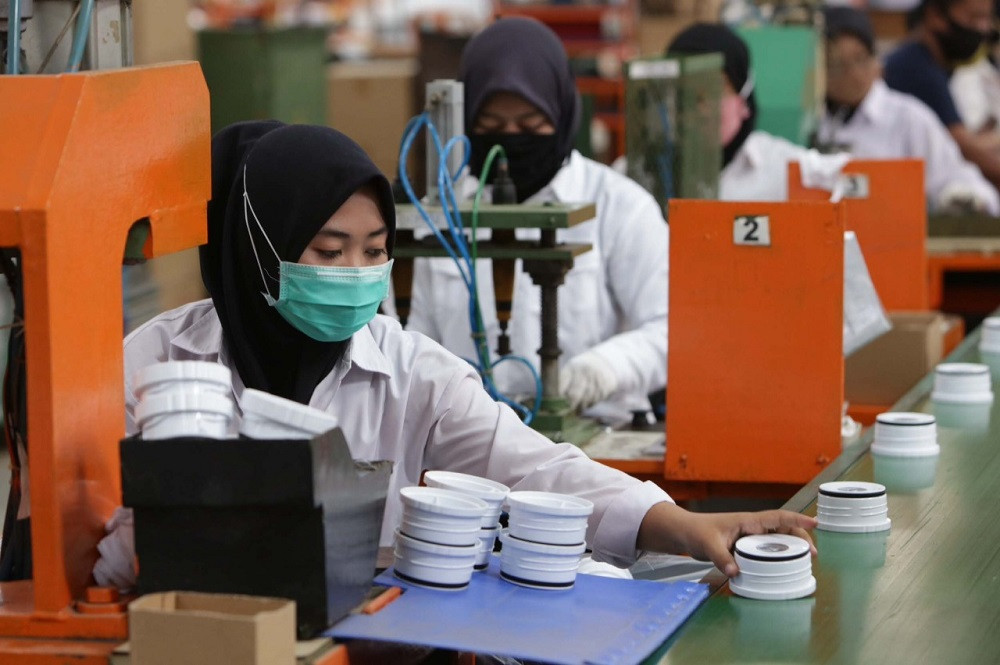
ersisting sluggish global and domestic demand means Indonesia’s manufacturing sector faced worsening downward pressure in November, while inflationary pressure began to ease as consumption continued to weaken. 

Citing the latest report from financial research firm IHS Markit, a subsidiary of S&P Global, Indonesia’s purchasing managers’ index (PMI) contracted two-month straight to 50.3 points in November, the slowest in five months, and just slightly above the expansion threshold of 50.

Down 1.5 points from October, the latest figure is just 0.10 points higher than the lowest point this year in June, whereas in September, Indonesia’s PMI was at an eight-month high of 53.7 points.

The PMI is a survey of purchasing executives from around 400 different firms on whether business conditions have expanded, remained the same or contracted.

“November’s PMI data revealed growth slowing across the Indonesian manufacturing sector midway through the fourth quarter. A slower improvement in overall demand conditions, amid a notable fall in foreign sales, had been one of the main culprits underpinning the loss of growth momentum,” S&P Global Market Intelligence director Jingyi Pan said on Thursday.

The market intelligence firm assessed that demand for Indonesian manufactured products had skidded due to economic conditions and supply-side issues, in particular foreign sales that fell “at the quickest rate” in the last 15 months.

“Central to the slowdown in demand had been the persistent upturn in cost, although input price inflation slowed again in November, which provided some relief for manufacturers,” explained Pan. 

Overall business confidence also plummeted in November, further underlining the risk that Indonesia’s manufacturing sector could dive deeper into the contraction zone unless there is a meaningful recovery in demand.

“Selling prices continued to rise as firms passed on additional costs to clients, which may warrant continued monetary policy attention in the near term,” Pan continued.

Read also: Local industries cut staff, spending as global slowdown begins to hurt

As the manufacturing performance slumped due to weakening demand, inflation volatility also became more restrained. 

Main contributors

According to a Statistics Indonesia (BPS) press briefing on Thursday, the consumer price index (CPI) increased by 5.42 percent year-on-year (yoy) and 0.09 percent month-to-month (mtm) due to the higher price of transportation fuel, household fuel and air freight rates.

The November figure was lower than the estimates made by state-owned Bank Mandiri and financial research firm Moody's Analytics of 5.5 and 5.6 percent yoy, respectively. Bank Mandiri expects monthly inflation to rise by 0.17 percent.

November’s figure was a two-month continuation of falling inflationary pressure that peaked in September, which posted 5.95 percent yoy due to a fuel price hike by around 30 percent.

"From trends in previous years, inflation is always highest [in the months] after a fuel price hike," BPS deputy head Setianto told reporters.

Core prices, the main indicator for the central bank to assess aggregated demand in the domestic economy and thus interest rates policy, increased by 3.30 percent yoy in November, which slipped by a marginal 0.01 percentage points (ppt) from the previous month.

Administered prices rose by 13.01 percent yoy due to the fuel price hike, but the figure was lower 0.27 ppt from October. Volatile prices, meanwhile, increased by 5.70 percent yoy, down from 11.47 percent yoy posted in July.

"I see that the target [of year-to-date or ytd inflation below 6 percent] is achievable," Setianto continued.

Bank Indonesia (BI) Governor Perry Warjiyo projected that the “now-high inflation” will return to the 3 to 4 percent range in the first semester of 2023, faster than previous estimates of the second half, and in 2024 the range would hit lower to 1.5 to 3.5 percent.

To achieve this target, the central bank is committed to a monetary policy of “pro-stability” next year as a means to rein in inflation and strengthen the rupiah.

For the other four policies, however, the central bank prefers to utilize a “pro-growth” approach. These others are macroprudential, digital payment systems, financial markets deepening and Islamic micro, small and medium enterprises (MSMEs).

According to state-owned Bank Mandiri recapitulation, the rupiah depreciated by 10.4 percent ytd to Rp 15,732 per United States dollar on Nov. 30.

“The world is still in turmoil,” Perry said on Wednesday, “We have yet to know when the war between Russia and Ukraine will be over, [while] the trade war between China and the United States is heating up again.”

Read also: Global chaos could get in way of 2023 recovery, Jokowi warns

Fixing supply chain

Bank Mandiri economist Faisal Rachman said that the easing of inflationary pressures in November was mainly due to the government's efforts to fix the food supply chain, with measures ranging from direct fuel subsidies for farmers to raw materials subsidies for MSMEs.

As a result, the state lender revised its inflation estimate for the end of 2022 to be within the range of 5.4 to 5.6 percent, much lower than the 6.27 percent previously projected.

An inflation range of around 5 to 6 percent is expected to continue in the first half of 2023, Faisal said, due to the continued effect of the fuel price hike.

In regards to the PMI, Faisal noted that the bleak global outlook compelled foreign markets to reduce demand for Indonesian products, which battered export-oriented industries.

"We anticipate reduced economic growth in the fourth quarter of 2022 and the whole of 2023," Faisal told The Jakarta Post on Thursday.

Your Opinion Matters

Share your experiences, suggestions, and any issues you've encountered on The Jakarta Post. We're here to listen.

Enter at least 30 characters
0 / 30

Thank You

Thank you for sharing your thoughts. We appreciate your feedback.

Share options

Quickly share this news with your network—keep everyone informed with just a single click!

Change text size options

Customize your reading experience by adjusting the text size to small, medium, or large—find what’s most comfortable for you.

Gift Premium Articles
to Anyone

Share the best of The Jakarta Post with friends, family, or colleagues. As a subscriber, you can gift 3 to 5 articles each month that anyone can read—no subscription needed!

Continue in the app

Get the best experience—faster access, exclusive features, and a seamless way to stay updated.