TheJakartaPost
Please Update your browser
Your browser is out of date, and may not be compatible with our website. A list of the most popular web browsers can be found below.
Just click on the icons to get to the download page.


Popular Reads
Top Results
No results found. Please check your search term and try again
Can't find what you're looking for?
View all search results
Popular Reads
Top Results
No results found. Please check your search term and try again
Can't find what you're looking for?
View all search resultsIn 2022, G20 presidency a paragon of Indonesian leadership
When Indonesia assumed the Group of 20 presidency late last year, it was faced with the tall order of mediating a forum polarized by war, but exposed the world to Indonesian-style global leadership.
Change text size
Gift Premium Articles
to Anyone
Share the best of The Jakarta Post with friends, family, or colleagues. As a subscriber, you can gift 3 to 5 articles each month that anyone can read—no subscription needed!
When Indonesia assumed the Group of 20 presidency at the end of last year amid global efforts to devise a post-pandemic economic recovery agenda, there were few reasons to expect the situation to turn from bad to worse.
Three months later, Vladimir Putin, the president of G20 member Russia, authorized the invasion of Ukraine.
By that point, Jakarta had asserted that it would be the voice of developing nations at the forum of the world’s biggest economies. But when the faraway conflict erupted, Indonesia was suddenly faced with a new, taller order: to facilitate negotiations between nations polarized by the war, all the while pursuing its three broad G20 priorities of improving global health architecture, digitalizing economies and pushing the brief for sustainable energy transition.
For Indonesia’s insistence of keeping pariah state Russia from getting kicked out of the group, Western countries and their allies threatened to boycott the whole G20 affair.
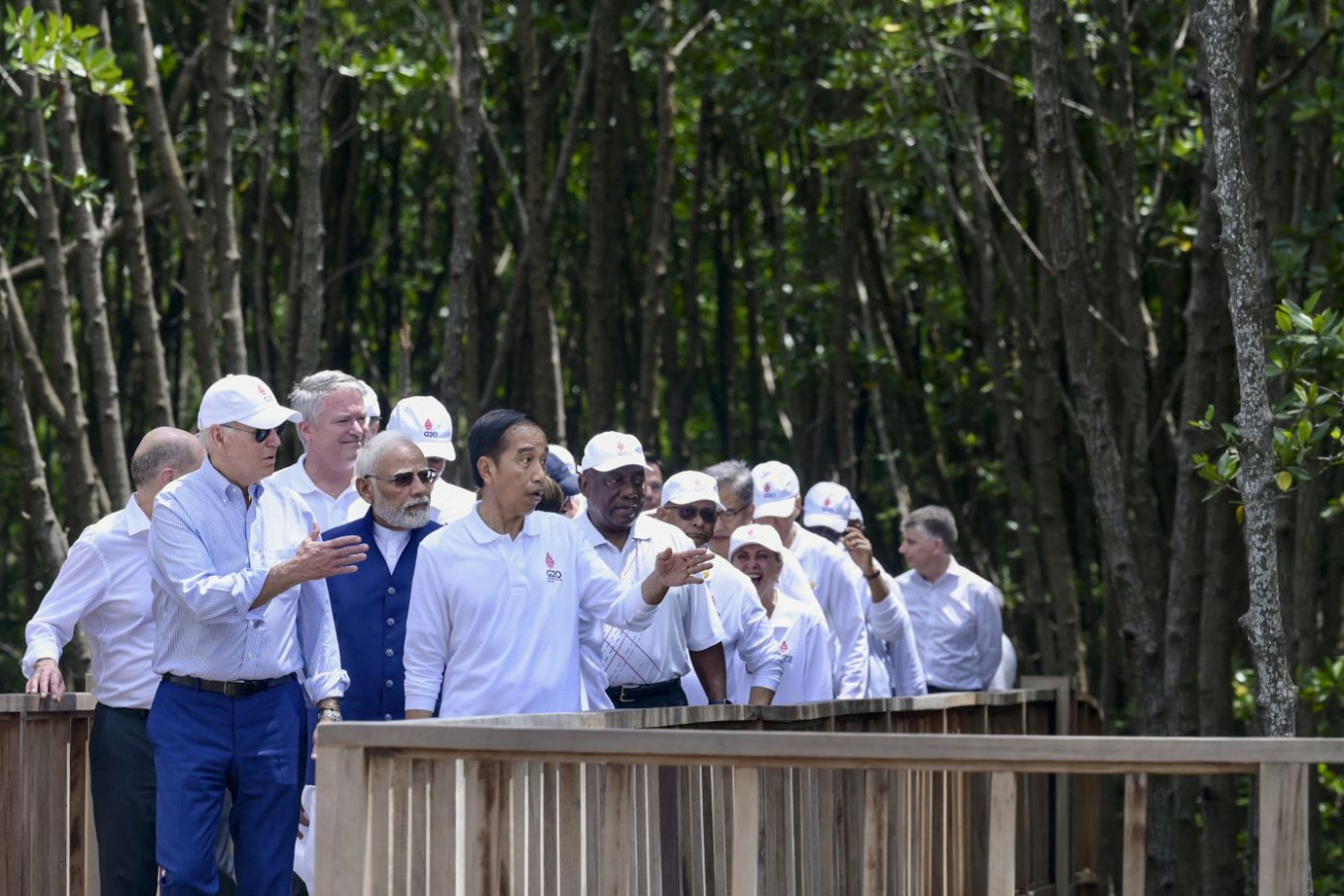
Eight months of intensive diplomacy and communication later, 17 heads of state, including from the United States and China, descended onto Bali, while the absent three, Russia, Mexico and Brazil, were represented by their ministers. The hundreds of concrete deliverables promised at the outset were accomplished, in one way or another.
This most challenging of G20 presidencies, experts say, was evidence that middle powers like Indonesia are not helpless amid the turmoil of great geopolitical rivalries and that there is merit to pursuing a non-aligned approach.
“The G20 Summit seemed to answer those questioning the relevance of ‘independent and active politics’,” said senior international relations expert Dewi Fortuna Anwar, in reference to Indonesia’s foreign policy approach.
“Simply put, the event would have failed if Indonesia was neither free nor active,” the National Research and Innovation Agency (BRIN) researcher told The Jakarta Post in a recent interview.
The independent and active foreign policy is one where the country proactively pursues diplomatic cooperation that is not beholden to the interests of others.
As a middle power, Indonesia had two options in leading the top 20 economies, Dewi explained. One was to take the normative approach, which meant finding common ground and getting all parties to engage with each other. The other, the functional approach, was to exert its influence as G20 president to push for tangible results.
“Indonesia is very adept at the normative approach, but there were initial concerns that it might fail, so both approaches were taken. If there was not to be any joint statements, then at the very least there would be deliverables,” Dewi said.
“In both aspects, Jakarta was relatively successful.”
The past few weeks have seen Indonesia receiving nods of approval for its G20 contributions from observers around the world. Global actors, including the US, Russia, Japan and the World Economic Forum (WEF), tipped their hats to Jakarta’s success. Indonesia had returned to the world map, said a piece in The Economist.
“The leaders’ summit in Bali last month saw Indonesia’s active and engaged leadership. It was successful. There were productive side meetings [and] the long communiqué touched on central issues,” said Gareth Evans, president emeritus of the International Crisis Group and former Australian foreign minister, at an early December conference.
In keeping with the Indonesian diplomatic tradition, Jakarta also took its leadership role as an opportunity to advocate for the interests of small, developing nations in the Global South. During her speech at the G20 Foreign Ministers’ Meeting (FMM), Foreign Minister Retno LP Marsudi made a special mention of the “brothers and sisters” from the Pacific Island Forum (PIF), the Caribbean Community (CARICOM) and the African Union who joined in on the G20 proceedings this year.
Unending task
Yet, in treading on the prudent side, Gadjah Mada University (UGM) international expert Dafri Agussalim said that the G20’s true success could only be truly celebrated when the pledged projects come to fruition. It is also noteworthy, he said, that much of the summit’s focus revolved around an agreement to condemn the war in Ukraine, far from Jakarta’s intentions.
“Let us not over-glorify our achievements. [...] In diplomacy, statements and pledges are simply that. It will take some time until we can see if we have, in fact, succeeded substantively,” Dafri said to the Post.
“But of course, one could safely say that Indonesia was at least successful in terms of guiding the processes that led to the summit.”
BRIN’s Dewi said while she thought Indonesia had done exceptionally well at leading the global event, the jury was still out on whether it could recreate this next year for the ASEAN chairmanship. The challenges, she said, differed greatly from the G20.
“Indonesia was an outstanding mediator in Bali. But in ASEAN, it has to really take the lead. It will not be enough to reconcile opinions; it cannot avoid tough decisions under the pretext of being a middle power,” she warned.
This year’s ASEAN Summit, convened two days before the G20 Summit, saw Indonesia take over the 10-nation bloc from Cambodia. With the aggravated political crisis in Myanmar, however, there is not much optimism that ASEAN will overcome the challenge. While its debut as G20 leader was a pleasant surprise for many, Jakarta’s dominance at the regional level has been long-established and more critically scrutinized.
“People would expect Indonesia to do miracles at ASEAN. Clearly, miracles do not exist. So managing expectations will be just as important as being a leader next year,” said Dewi.