TheJakartaPost
Please Update your browser
Your browser is out of date, and may not be compatible with our website. A list of the most popular web browsers can be found below.
Just click on the icons to get to the download page.


Popular Reads
Top Results
No results found. Please check your search term and try again
Can't find what you're looking for?
View all search results
Popular Reads
Top Results
No results found. Please check your search term and try again
Can't find what you're looking for?
View all search resultsFloating Pertamax prices may increase competition in unsubsidized fuel market
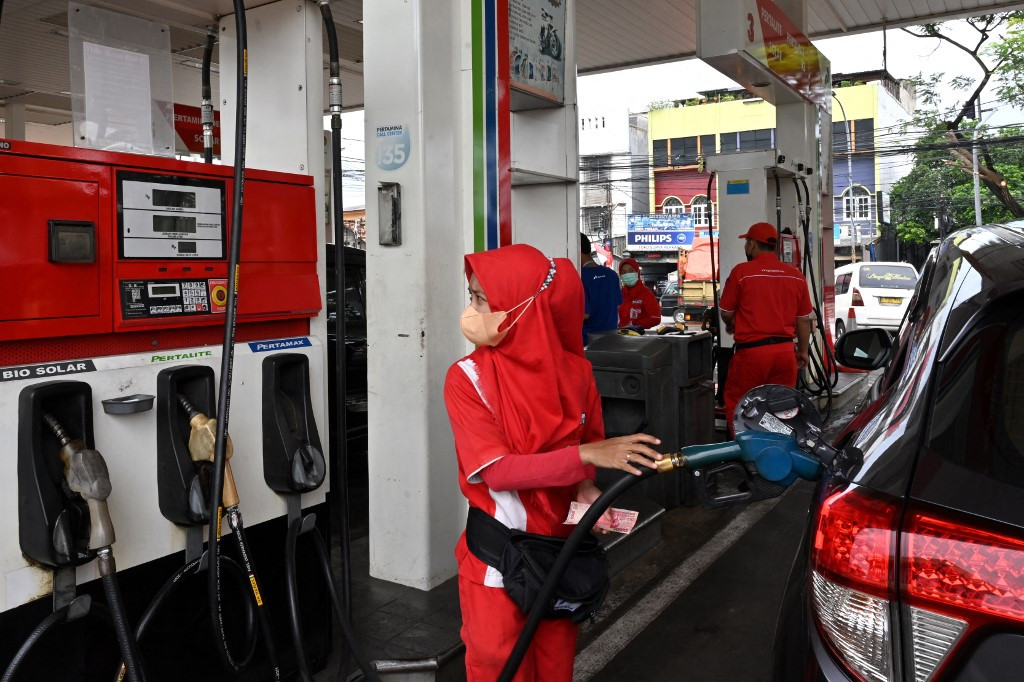
Now that the product’s retail price will follow the contours of global oil prices, Pertamina is expected to sell Pertamax at rates closer to other brands.
Change text size
Gift Premium Articles
to Anyone
Share the best of The Jakarta Post with friends, family, or colleagues. As a subscriber, you can gift 3 to 5 articles each month that anyone can read—no subscription needed!
T
he government’s recent decision to sell “unsubsidized” Pertamax fuel at market prices will create a more level playing field with other brands, analysts say, as state oil and gas giant Pertamina will no longer be effectively subsidizing the product by selling it at an administered, often below-market price.
Now that the product’s retail price will follow the contours of global oil prices, Pertamina is expected to sell Pertamax at rates closer to other brands.
Ahmad Zuhdi Dwi Kusuma, an industry and area analyst at state-owned Bank Mandiri, said allowing the price of Pertamax to float would permit other brands to compete with it.
“Since the prices are not so different now, every brand can implement a marketing strategy to [compete with] Pertamax,” he said.
Indonesia’s largest fuel retailer cut the prices of its unsubsidized Pertamax and Pertamax Turbo gasoline brands on Tuesday to adjust to lower global crude prices. The change was called for under Energy and Mineral Resources Ministerial Regulation No. 11/2022 on the calculation of the retail price of fuel oil, which requires the government to make at least monthly adjustments to fuel prices to align with market movements.
Previously, the government had maintained an ambiguous price policy for its Pertamax brand. While the fuels sold under the brand did not receive direct subsidies from the government, Pertamina had been required to sell the fuels for much less than other products of the same octane level.
The government had tried to float the price of Pertamina’s fuel products in 2002 but later abandoned the policy amid skyrocketing global prices.
Since the Tuesday announcement, retail prices have varied by region because of differing fuel taxes. In Jakarta, Banten and West Java, the price of Pertamax was reduced from Rp 13,900 (89 US cents) per liter to Rp 12,800 per liter while Pertamax Turbo was reduced from Rp 15,200 per liter to Rp 14,050 per liter.
In comparison, RON-92 gasoline at Shell, Vivo and BP was being sold for Rp 14,180, Rp 12,800 and Rp 13,030 per liter, respectively.
State-owned Enterprises (SOEs) Minister Erick Thohir said lowering the fuel prices was “in line with government evaluation considering trends and market mechanisms”.
Citing the same reasons, Pertamina also lowered the prices of its Pertamina Dex fuel brand, which in Jakarta was lowered from Rp 18,800 to Rp 16,150 per liter.
Prices of subsidized Pertalite gasoline and Solar diesel remained unchanged at Rp 10,000 and Rp 6,800, respectively.
Ahmad said Pertamax prices now depended on several factors, including the price of imported fuel oil and the flexibility of crude oil contracts.
“The more flexible the contracts, the more likely it is to have [unsubsidized] fuel oil prices updated weekly,” he said.
Oil prices held in a narrow range on Tuesday, though the outlook for demand was clouded by news of weak manufacturing activity from China and a warning from the head of the International Monetary Fund that the global economy faced a tough year ahead.
US benchmark West Texas Intermediate futures rose toward $81 a barrel after closing at a modest annual gain last week.
Komaidi Notonegoro, executive director of the Jakarta-based research group ReforMiner Institute, said the policy would not “change much” because Indonesia had already been using the average selling prices in Singapore, as measured by the Mean of Platts Singapore (MOPS), as a basis to set its prices.
The recent price adjustment, for example, was determined by calculating the average benchmark price from Nov. 25 to Dec. 24, he explained. Komaidi was referring to Energy and Mineral Resources Ministerial Decree No. 245/2022 issued on Oct. 11 of last year, which stipulated a formula to calculate retail prices based on MOPS.
“The more [fuel prices] follow the [volatile] international benchmark prices, the more they reflect the fluctuations. But in terms of prices, eventually, it’ll depend on the companies’ decisions,” said Center of Reform on Economics (CORE) director Mohammad Faisal.