TheJakartaPost
Please Update your browser
Your browser is out of date, and may not be compatible with our website. A list of the most popular web browsers can be found below.
Just click on the icons to get to the download page.


Popular Reads
Top Results
No results found. Please check your search term and try again
Can't find what you're looking for?
View all search results
Popular Reads
Top Results
No results found. Please check your search term and try again
Can't find what you're looking for?
View all search resultsAward-winning author Norman Erikson Pasaribu discusses 'Happy Stories, Mostly'
Change text size
Gift Premium Articles
to Anyone
Share the best of The Jakarta Post with friends, family, or colleagues. As a subscriber, you can gift 3 to 5 articles each month that anyone can read—no subscription needed!
W
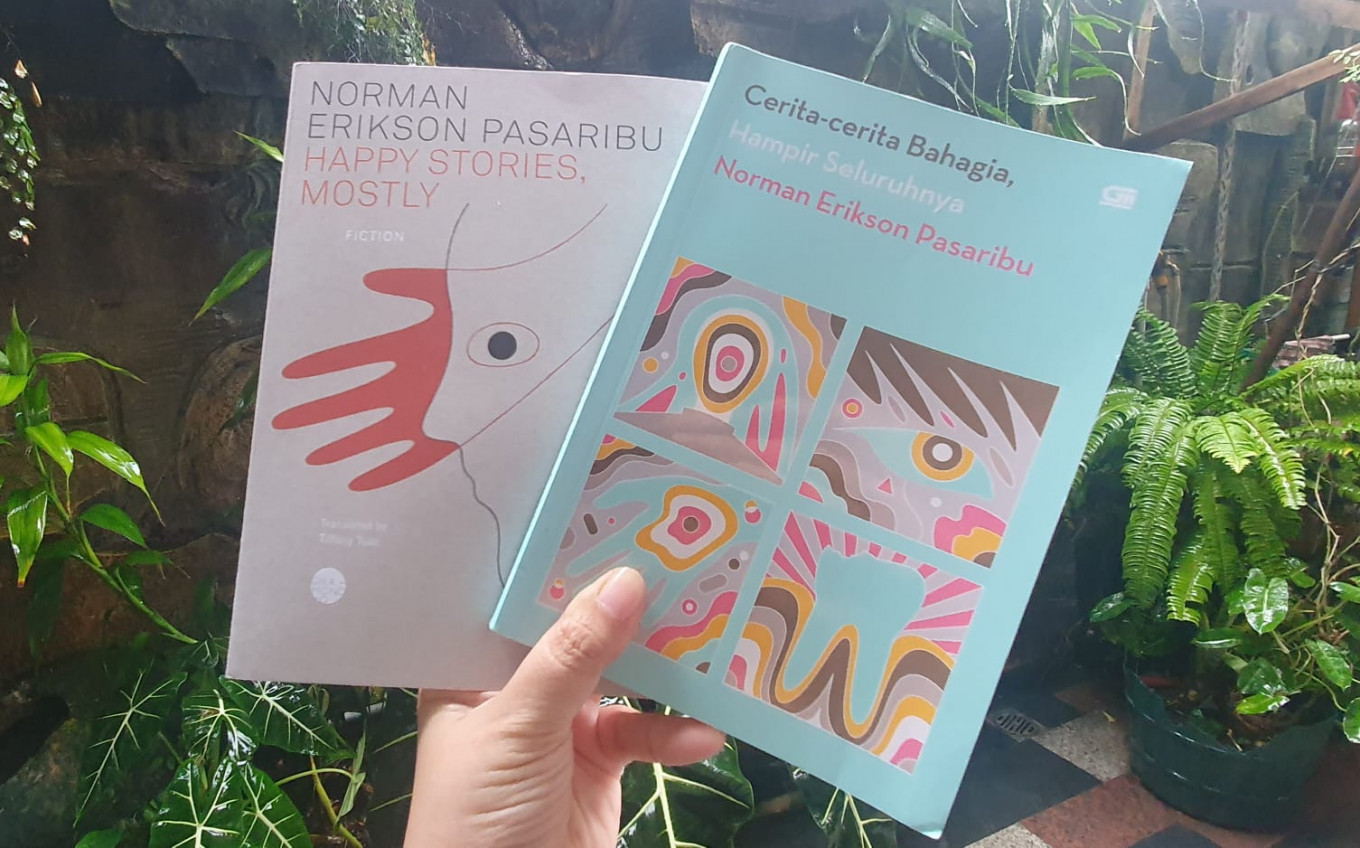
inning the 2015 Jakarta Arts Council (DKJ) Poetry Book Competition, the author rocketed in 2022 with a short story collection, Cerita-cerita Bahagia, Hampir Seluruhnya (Happy Stories, Mostly). However, all that glitters might not be gold.
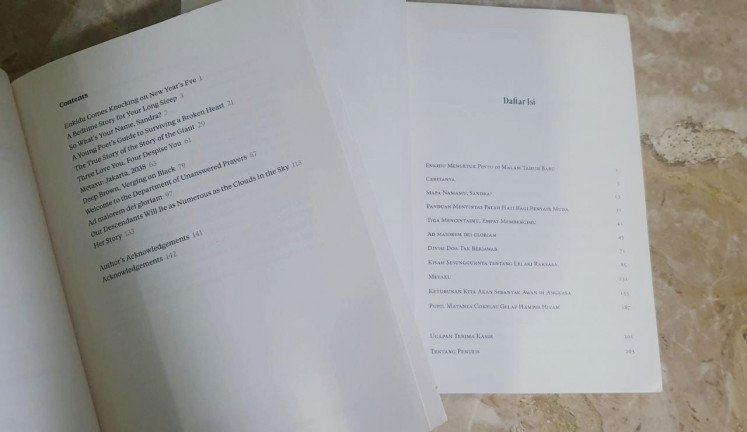
Author Norman Erikso Pasaribu garnered quite the accolades throughout 2022 with a short story collection titled Cerita-cerita Bahagia, Hampir Seluruhnya (CCB). The book has been translated into English, with the title Happy Stories, Mostly, by renowned translator and writer Tiffany Tsao. It also won the Republic of Consciousness Prize, an annual British literary prize, and was long-listed for the prestigious International Booker Prize.
With multiple international awards attaching to the book, readers might think that CCB is a heavy read. However, according to Norman, that is not exactly the case.
"To be honest, most of the stories in CCB were meant to be playful when written. They were fun experiments. It's like a linguistic 'what if' game," said Norman, who was in the middle of his three-month residency at the Centre for Stories in Perth, Western Australia, at the time of the interview. It was part of his prize that he won with the inaugural Patricia Kailis International Writing Fellowship.
"All the stories talk about the lives of queer people because those are the things that are important to me, [that] I see every day [and] worry me at night when I can't sleep."
Norman also let his impulse to experiment with the linguistic aspects of the Indonesian language run amok this time.
"[The initial idea was something like] what if I make sentences with circling syntax like Gertrude Stein? Or, how fun would it be to make up stories that generate stories that give birth to [even more] stories?"
The book also consists of many Bataknese conversations with jargon and slang that would be very familiar to most Indonesians. However, this would have been a challenge for Tsao.
"Missing nuances is unavoidable. Not because the translation work is thorough or anything, but because [the two languages have stark differences]. In Indonesian, for me, for example, the tone and rhythm can create the mood, and the mood clarifies the predicate. In English, everything must be clear. The logic between these two languages is already different," he said.
"For me, Tiffany is the best translator [for my works]. Besides being brilliant and diligent, she was also even willing to see my life first-hand [to capture the mood]."
A looking glass
Norman refuses to describe CCB as a reflection of himself or an autobiography even though all the stories represent significant points in his life.
"After all, CCB is fiction. It portrays my perception of the world and humanity, which will definitely change over time, and that change is visible in the story," he said. "It could be mentally draining [to write] because sometimes what [it is about triggers me] in real life. But on the other hand, there is relief in exposing that vulnerability."
Tito Nusantara, a 30-year-old civil servant in Bogor, West Java, said that the simplicity of the narratives was one of the main appeals of CCB. Tito has been following Norman's career as a writer closely but said that CCB was the first to make him both laugh and cry.
"[The way Norman delivers] the stories is very simple, and I'm sure that for some, it can be very relatable. I especially like how he infuses the Bataknese cultural nuances into it. It's really good, but it might not be that appealing for some," Tito acknowledged.
"If [you're not queer or] you don't have queer friends or relatives, it would be hard to imagine [the feelings of the subjects in the story], and I believe you'll somewhat think, 'What is this?', especially when it comes to the last two stories — ‘Keturunan Kita Akan Sebanyak Awan di Angkasa’ [Our Descendants will be as Numerous as the Clouds in the Sky] and ‘Pupil Matanya Cokelat Gelap Hampir Hitam’ [Deep Brown, Verging on Black]."
Norman admits that there will be obstacles to relating to his stories. Some would force their way in by comparing it to familiar settings.
"[You cannot] read the work of queer authors through a heterocentric lens. [Read that way, the story won’t] really make sense," he explained. "It's hard for us to talk about liberation and equality when the way we perceive the world has to be filtered by the heterocentric lens."
Despite being heavily associated with the gay community, describing the actual gay community was not the main purpose for Norman writing the book. According to the Bataknese author, he mostly aimed to just tell of what he thinks and feels.
"The queer community is huge, and I'm just one person. I write what I know," Norman explained. "However, the queer community will always be the most important thing for me. It will always be [my] focus because [the members of the queer community] are also humans, just like straight people, but our basic rights are denied, and we are forced to step back into the background.”
"It's okay if most people don't understand what it really means to be queer. But can they learn if there is no engagement? Queers are often just a myth for hetero people, even though there are many of us everywhere."
Silent activism
Through his works, Norman also aims to taunt the Indonesian literary scene and all its boundaries. There is a particular complex when it comes to gayness and literature, as people, according to Norman, can be "weirdly sensitive when a queer is seen as successful".
"Someone once said I took advantage of my gayness to get international recognition. That's hilarious. Because if it's that easy to get published internationally by only using sexuality, why don't we see a long line of well-known queer writers?"
In addition to the necessity of having some sort of justifiable background story, there is this unhealthy expectation that gay people need to be accomplished in some sort to be accepted. The same expectation, however, is not burdened upon the heterosexual community.
“Juxtaposing acceptance with achievement is also a form of discrimination," he lamented, adding that there were many accomplished gay people that have yet to come out of the closet if people want to start tallying virtue. “Everyone should be socially accepted for who they are even when they are ordinary.”
There were days when Norman took all the discrimination from fellow litterateurs, both discreet and blatant, bitterly. However, Norman decided not to linger in the dark and responded in a witty way that only he could.
"For example, when I was told that [my writing] was too autobiographical, I responded by writing a poem titled Curriculum Vitae. [Then] I was told that the short stories in my first book [Hanya Kamu yang Tahu Berapa Lama Lagi Aku Harus Menunggu [Only You Know How Long I Should Wait] were too sad, so I titled [this] book Happy Stories."
ohmg