TheJakartaPost
Please Update your browser
Your browser is out of date, and may not be compatible with our website. A list of the most popular web browsers can be found below.
Just click on the icons to get to the download page.


Popular Reads
Top Results
No results found. Please check your search term and try again
Can't find what you're looking for?
View all search results
Popular Reads
Top Results
No results found. Please check your search term and try again
Can't find what you're looking for?
View all search resultsRethinking authenticity in tourism in Yogyakarta
Economic and political changes in Indonesia have an influence on the rise of tourism in Yogyakarta.
Change text size
Gift Premium Articles
to Anyone
Share the best of The Jakarta Post with friends, family, or colleagues. As a subscriber, you can gift 3 to 5 articles each month that anyone can read—no subscription needed!
T
ourism and Creative Economy Minister Sandiaga Uno’s recent remarks at the Private Equity and Venture Capital Summit 2023 about tourism in Yogyakarta have drawn criticism on social media.
After examining tourists’ wants and needs based on the data he had, Uno said that what tourists wanted from Yogyakarta was water parks, not nature- or culture-based experiences or temples. Many found that this observation belittled the image of Yogyakarta as a center of art and culture in Java. The data, according to him, also revealed that sushi, particularly salmon mentai, was in strong demand. He encouraged more investment in water parks and the fulfilment of the increased demand for salmon mentai.
Apparently, many were angered by the promotion of a food that did not adequately reflect the characteristics of Yogyakarta and that was far from being an authentic Javanese dish.
Authenticity in tourism has been a complex subject to which there is no straightforward interpretation. The notion of authenticity is particularly relevant to some types of tourism, such as cultural tourism, which allows tourists to embrace, learn and experience a particular culture, and historical tourism, which represents the past. Cultural and historical tourism remain the most-popular kinds of tourism in Yogyakarta despite the efforts made by the local government to promote other types of tourism.
The attributes of being authentic or inauthentic have commonly been bound to various tourism products such as cultural performances, festivals, works of art, cuisine and so on. In this sense, something is authentic if it is an accurate representation of the original and in accordance with the traditional culture. This also implies that subsequent changes, transformation and creativity can be inauthentic.
However, this reasoning may oversimplify the complex interaction between tourism and authenticity. To clarify the meaning of authenticity it is important to analyze various forces engaged in the process of cultural reproduction and consumption within a wider historical, political, economic and touristic context.
Economic and political changes in Indonesia have an influence on the rise of tourism in Yogyakarta. The development of tourism in Yogyakarta is part of a larger international tourism-development plan made by the government to promote Indonesian natural and cultural resources to the world and to restore the country’s economic and political stability. In the 1960s, besides building tourist accommodations, expanding and modernizing communications and transportation facilities, the government also made efforts to restore historic relics and to preserve traditional Javanese arts and artefacts in Yogyakarta.
The main attractions for travelers visiting Yogyakarta are the nearby Borobudur and Prambanan temples (both UNESCO World Heritage Sites), the Sultan’s Palace and Jl. Malioboro, the main street of Yogyakarta, which features many shops and cultural activities.
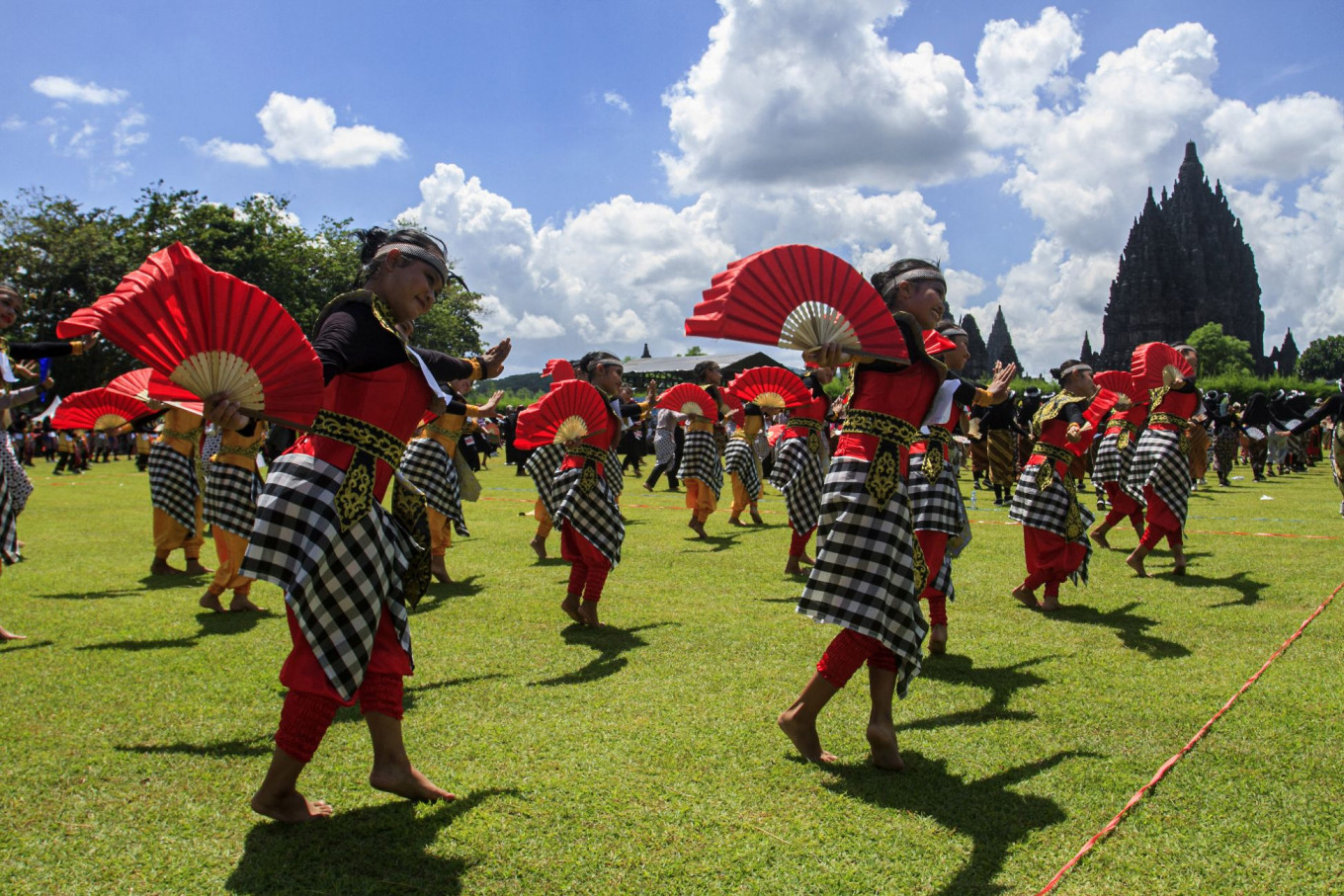
Yogyakarta is also famous for its culinary delights, batiks and cultural attractions, including traditional Javanese court dances, gamelan-music performances and shadow-puppet theaters. In the global-tourism market, these assets embody the national image of Indonesia, which may show that Yogyakarta is central to Indonesian identity.
These assets also have another significant role in tourism; they function as commodities packaged and promoted to domestic and international tourists. This role, however, has been a matter of debate.
Tourism has become a significant source of income for the local people and an important development agent. Tourists also provide economic and aesthetic reinforcement to the culture, tradition and the arts of Yogyakarta; that is to say, by attaching economic value to culture, the money can help preserve traditional cultural forms.
On the other hand, because of the commodification of culture and the incorporation of culture into the global economy through tourism, many cultural forms and other social practices of the locals are disparaged for not being authentic.
However, it is the “tourist gaze”, to borrow John Urry’s term, which has also encouraged creativity in arts and crafts and various cultural forms in many communities.
Many destinations in Southeast Asia, including Yogyakarta, are magnets for tourists to acquire local handicrafts and arts. Although they have intrinsic value, their creation partly corresponds to the demand of tourists and collecting them could presuppose the process of objectification that extends to culture itself. This may obscure the authenticity of the cultural products and their relationship with the originals.
The tourists, with their gaze, are active actors in tourism and engage in a coproduction with the host society. Within this tourist gaze, the locals find a point of reference to reconstruct their identity. They willingly accept the idealized identities tourists come to expect and imagine that they offer the tourists an authentic image.
The tourist gaze may give the locals a distorted mirror for viewing their culture and lives, and therefore, has consequences for how the locals see themselves and the role they play in tourism.
The tourist gaze has also stimulated the creation of some Javanese performances, which appear to be traditional, but are in fact created specifically for tourists.
The Ramayana ballet, created in 1961, is one such performance. Ballet is not a Javanese genre and compared with other Javanese dances, the Ramayana is simplified and reduced to fit the Western system of meaning. Instead of using dialogues, the Ramayana ballet uses gestures to make it easier to communicate the story of Ramayana across different cultures.
Thus, when culture is packaged and sold as a tourist attraction, tourism may have a transformative effect on the concepts of the local identity or the locals’ self-definition. Although the performances do not cut the tie with tradition, they are created within a completely different context.
Authenticity may be germane to understanding tourist experiences and cultural products, including food deemed as a cultural icon, but there is a need to move beyond the binaries, such as authentic-inauthentic, real-show and others.
The Ramayana ballet and other cultural and artistic expressions are cultural products born within the local cultural matrix and must be understood within the particular Indonesian political and touristic context.
This context, along with time and audience are in fact never fixed, but always in constant change. Even cultural forms and their meanings are continuously being reworked, which can be illustrated by the example of “repackaging culture” being done by the Yogyakarta palace.
With these everchanging conditions, it is virtually impossible to get an absolute point of origin, because origin can be moving and changing. It remains to be seen whether authenticity could be achieved. Thus, authenticity always remains contested.
***
The writer is a researcher at the International Center of Language and Cultural Studies, Indonesian Islamic University, Yogyakarta.