Can't find what you're looking for?
View all search resultsCan't find what you're looking for?

View all search resultstatistics Indonesia (BPS) released forecast-beating first-quarter Indonesian economic performance data on Friday. The economy grew at a rate of 5.03 percent year-on-year (yoy), higher than the previous quarter, suggesting continued economic recovery and resilience.
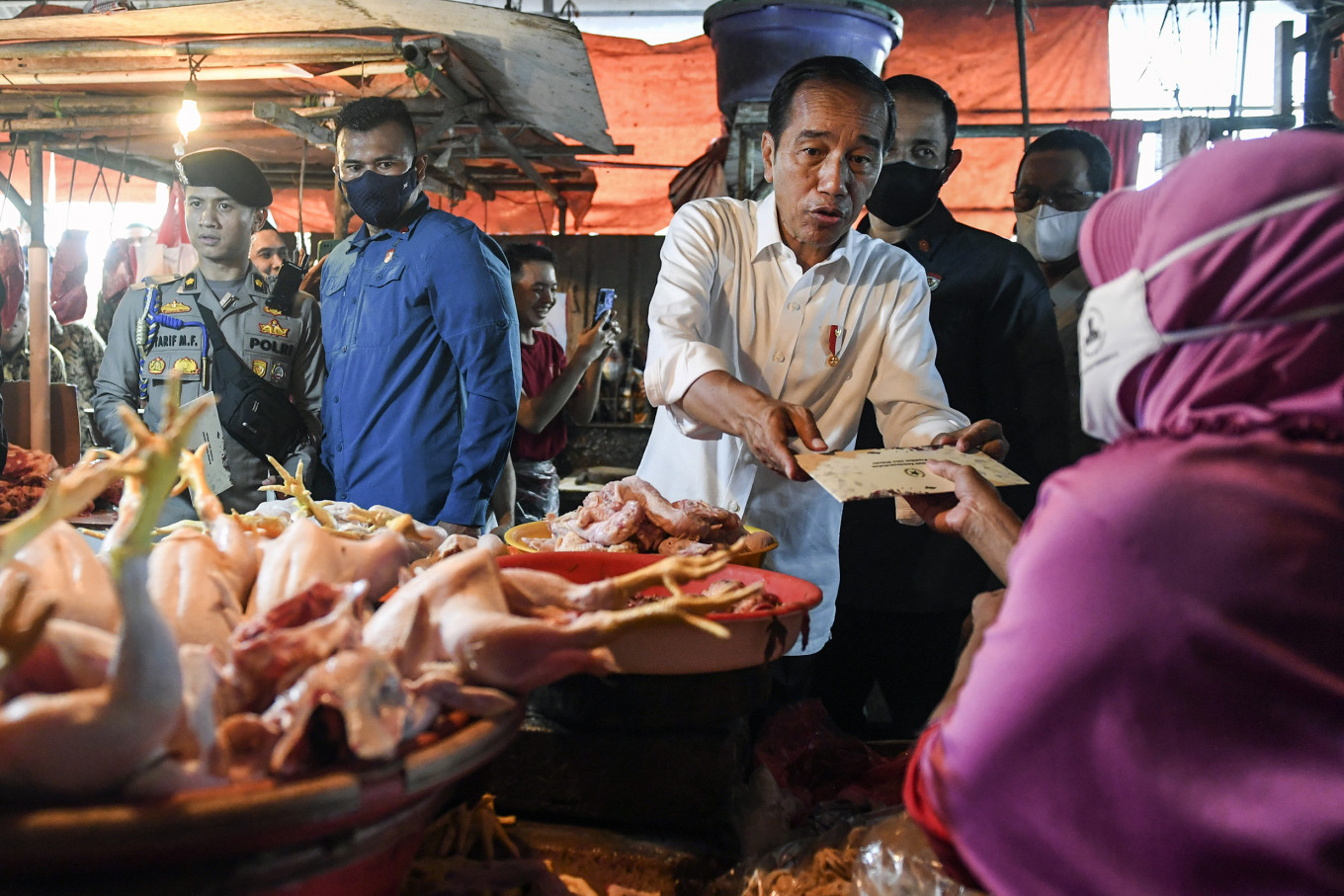
As the major contributor to GDP, household spending is worth discussing and has been highly correlated with the consumer spending behavior in the last three years, especially during the pandemic.
The first quarter number, once again, confirmed our view that ensuring domestic mobility and accelerating government spending would play an important role in economic recovery. Last quarter, the rebound in government spending supported consumption after the subsidized fuel price hike. This indicated a shift of the source of growth from the external sector (commodity-related exports) to the domestic sector.
In terms of consumer spending, performance was quite resilient in the first quarter as it managed to expand by 4.54 percent yoy, versus 4.48 percent yoy in the fourth quarter of last year.
The fasting month of Ramadan, which started in the last week of March, also had a positive impact on spending.
In fact, the current consumption resilience has been seen since 2022. It has laid a solid groundwork, and reliable indicators hint at an optimistic future. Despite the Omicron explosion in early 2022, consumer spending continued its upward trend.
Indeed, when the government reduced the fuel subsidy, which led to rising prices, consumer spending was remarkably stable for at least six weeks, as indicated by the Mandiri Spending Index (MSI). With mobility restrictions lifted, we see consumer spending in 2023 being at least as robust as in 2022.
Now, how do we see the Indonesian consumer pattern in the past and future? In general, the trend of higher spending occurs only twice a year: during Ramadan-Idul Fitri and near year-end.
Spending is generally stable outside these two periods. This can be seen by comparing spending patterns in 2019, as represented by Bank Indonesia’s Real Sales Index (RSI) as an illustration of spending before the pandemic, to the MSI levels in 2022 and 2023.
Historically, spending fell in the first two months, recovered in March, and remained stable throughout the year, with the exception of Ramadan-Idul Fitri and the year-end.
In terms of baskets of commodities, both food and non-food consumption trended upward, whereas food consumption recovered faster with 8.8 percent growth. Overall, this trajectory followed the average national data, wherein consumers still prioritized food over non-food consumption because of the uncertain economic future.
However, we see some back-to-basic consumption activities that affect food spending categories. Households in the middle-income class tend to lower their allocation for ready-to-serve food while maintaining other types of food consumption.
Reducing spending and expenses for utilities, household needs, leisure and travel seem to be the main strategy of the middle-income class during the pandemic. Leisure and travel were the hardest hit, as their spending allocation declined by 31.5 percent in 2021.
In 2022, the middle-income class started traveling or allocating some money for leisure activities, although still below the pre-pandemic level. Allocations for those activities went up by 16.7 percent in 2022.
In line with the GDP figure, the MSI reached 134.1 in the third week of March, a week before Ramadan, marking the third consecutive week of improvement since late February. This was 6.2 percent higher than in the same period last year (126.3) and 6.8 percent higher than the lowest spending in 2023 at the end of February (125.6).
Despite rising ahead of Ramadan, spending in the past 3 weeks was only slightly higher than in 2022, growing by an average of 4 percent over the same period last year.
This contrasts with last year, when the average spending was higher than in Ramadan 2021 by 15 percent. Despite higher prices than in 2022, the lower value growth in 2023 might indicate a slowing in the current spending volume. To provide context, the average annual inflation in the first two months of 2023 (2M23) was 5.38 percent, which was more than double the rate in 2M22 of 2.12 percent.
After the beginning of the war between Russia and Ukraine in February 2022, annual inflation rose steadily and peaked in September 2022. Although inflation is currently falling at a slower rate, it is expected to remain higher than 5 percent in 2M23, compared to 2 percent in early 2022.
Consumers may become more prudent because of rising inflation, especially on food. Consumers who are wary of spending too much may either cut back on their usual purchases or look for cheaper alternatives.
The recent consumer spending patterns reinforce our view about the cautious consumer phenomenon. As shown by the MSI, spending volume in all categories (durable, non-durable and services) dropped in 2M23 compared to last year, especially durable (-6.9 percent) and services (-6.6 percent).
Although the current prices are relatively higher, the spending value (a function of price and volume) will eventually fall when spending volume falls at a greater magnitude. In comparison, spending volume increased in 2M22 and 2M21 when inflation was lower, thus boosting the growth in spending value.
After a relatively stable first quarter this year, consumer spending rose in March. This trend is likely to sustain through the end of Ramadan and the beginning of Idul Fitri in early May. However, this spending momentum must be maintained by keeping the inflation rate stable, especially in staple goods and transportation, which have the potential to grow quickly ahead of Idul Fitri and the massive homecoming season.
Sustaining spending momentum in April and early May will lay a solid foundation for strong household consumption growth in the second quarter. If not, inflation might stifle the accelerated recovery of consumer spending this year. Thus, at this point, we strongly suggest that the government should maintain low inflation throughout the year to keep people consuming at current levels.
Although the overall picture indicates that consumers are resilient, economic shocks and volatility could jeopardize the livelihoods of the vulnerable and poor. As a result, the government’s assistance to these groups through social assistance is critical. Past lessons showed that some welfare policies worked well in assisting the poor in mitigating economic shocks. So, twin policies to keep inflation low and accelerating social assistance distribution will ensure that Indonesia’s economic growth will remain in line with our forecast of 5.04 percent this year.
*****
The writer is the chief economist at Bank Mandiri.
Share your experiences, suggestions, and any issues you've encountered on The Jakarta Post. We're here to listen.
Thank you for sharing your thoughts. We appreciate your feedback.
Quickly share this news with your network—keep everyone informed with just a single click!
Share the best of The Jakarta Post with friends, family, or colleagues. As a subscriber, you can gift 3 to 5 articles each month that anyone can read—no subscription needed!
Get the best experience—faster access, exclusive features, and a seamless way to stay updated.