TheJakartaPost
Please Update your browser
Your browser is out of date, and may not be compatible with our website. A list of the most popular web browsers can be found below.
Just click on the icons to get to the download page.


Popular Reads
Top Results
No results found. Please check your search term and try again
Can't find what you're looking for?
View all search results
Popular Reads
Top Results
No results found. Please check your search term and try again
Can't find what you're looking for?
View all search resultsThe US Embassy’s sidewalk
Many Jakartans were annoyed because the city looked like it was at war given the barbwire fence and moveable concrete barriers that stretched 170 meters outside the embassy compound on Jl. Medan Merdeka Selatan.
Change text size
Gift Premium Articles
to Anyone
Share the best of The Jakarta Post with friends, family, or colleagues. As a subscriber, you can gift 3 to 5 articles each month that anyone can read—no subscription needed!
T
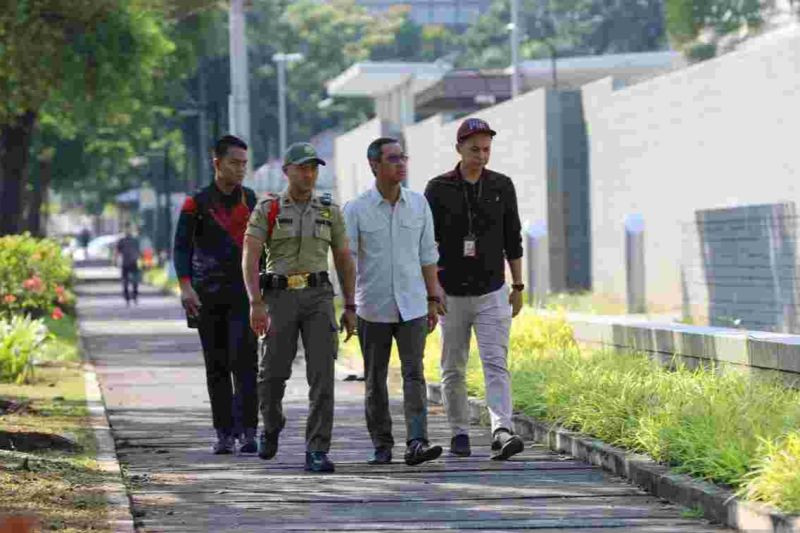
he 1961 Vienna Convention on Diplomatic Relations was the legal basis for the Jakarta administration to allow the United States Embassy in the capital to close the sidewalk in front of the premises in 2002. And after more than 20 years, the US Embassy has agreed to reopen the pavement for public pedestrians on June 9. It is too late, but still laudable.
According to Article 22 of the Vienna Convention, the receiving state is under a special duty to take all appropriate steps to protect the premises of the mission against any intrusion or damage and to prevent any disturbance of the peace of the mission or impairment of its dignity.
Article 30 states that the private residence of a diplomatic agent shall enjoy the same inviolability and protection as the premises of the mission. Indonesia has ratified the convention and, consequently, has to abide by the international treaty.
The decision to reopen the sidewalk, after public outcry, is a big relief for both the US Embassy and the Indonesian government. The 21-year closure was seen by the public as more serious than just the loss of people’s right to access public spaces. Many Jakartans were annoyed because the city looked like it was at war given the barbwire fence and moveable concrete barriers that stretched 170 meters outside the embassy compound on Jl. Medan Merdeka Selatan. The problem was there were hardly any public relations efforts to explain why the security measures were in place for so long.
Many, if not most, people are not familiar with the Vienna Convention. For security reasons, a number of other embassies of major countries in Jakarta have also received the same treatment, but only temporarily.
Before removing the barriers from the sidewalk outside the US Embassy, the city administration had received the green light from the Foreign Ministry and the National Police Headquarters.
US Ambassador to Indonesia Sung Kim said the embassy was willing to reopen the sidewalk to the public. “Accessibility, safety, and walkability are all important considerations for a major city like Jakarta. We have informed the Indonesian government that the U.S. would welcome the reopening of the sidewalk in front of the Embassy,” the envoy said on his Twitter account recently.
A spokesperson for the US Embassy told Kompas the sidewalk was closed for the first time in 2002 for security reasons, just after the Bali bombings. Less than one year later, terrorists attacked JW Marriott, a US hotel chain, in Kuningan, South Jakarta and in 2004 suicide bombers hit the Australian Embassy also in Kuningan.
American interests in Jakarta continued to fall prey to terrorist attacks when suicide bombers once again attacked the JW Marriott Hotel and neighboring US hotel chain Ritz Carlton in 2009.
This is why the US Embassy had very strong grounds for the restrictive measures it adopted in and nearby its premises, just to protect its national interests. Apart from the terrorist threats, numerous demonstrations took place in front of the embassy and Indonesian security authorities were often overwhelmed to ensure the safety of the embassy’s staff and all the people inside
Indonesia has managed to significantly enhance security and stability, thanks in part to the counterterrorism squad that has arrested many terror suspects to preempt new attacks, and there is no longer convincing justification for the closure of public space outside the US Embassy. Many had perceived the closure as an expression of American arrogance.
According to the Pedestrian Coalition that there are 10 sidewalks that should be free from restrictions. Some of them are related to VVIP and foreign diplomatic missions, including those in front of the US Embassy and in Suropati Park in Menteng, Central Jakarta.
While welcoming the US Embassy sidewalk reopening, we need to learn from the prolonged closure for better public policy-making in the future. After all, one of the characteristics of a civilized city is the respect of the local government and population for the rights of pedestrians.