TheJakartaPost
Please Update your browser
Your browser is out of date, and may not be compatible with our website. A list of the most popular web browsers can be found below.
Just click on the icons to get to the download page.


Popular Reads
Top Results
No results found. Please check your search term and try again
Can't find what you're looking for?
View all search results
Popular Reads
Top Results
No results found. Please check your search term and try again
Can't find what you're looking for?
View all search resultsFlooded rivers, cities test China's disaster response systems
Change text size
Gift Premium Articles
to Anyone
Share the best of The Jakarta Post with friends, family, or colleagues. As a subscriber, you can gift 3 to 5 articles each month that anyone can read—no subscription needed!
F
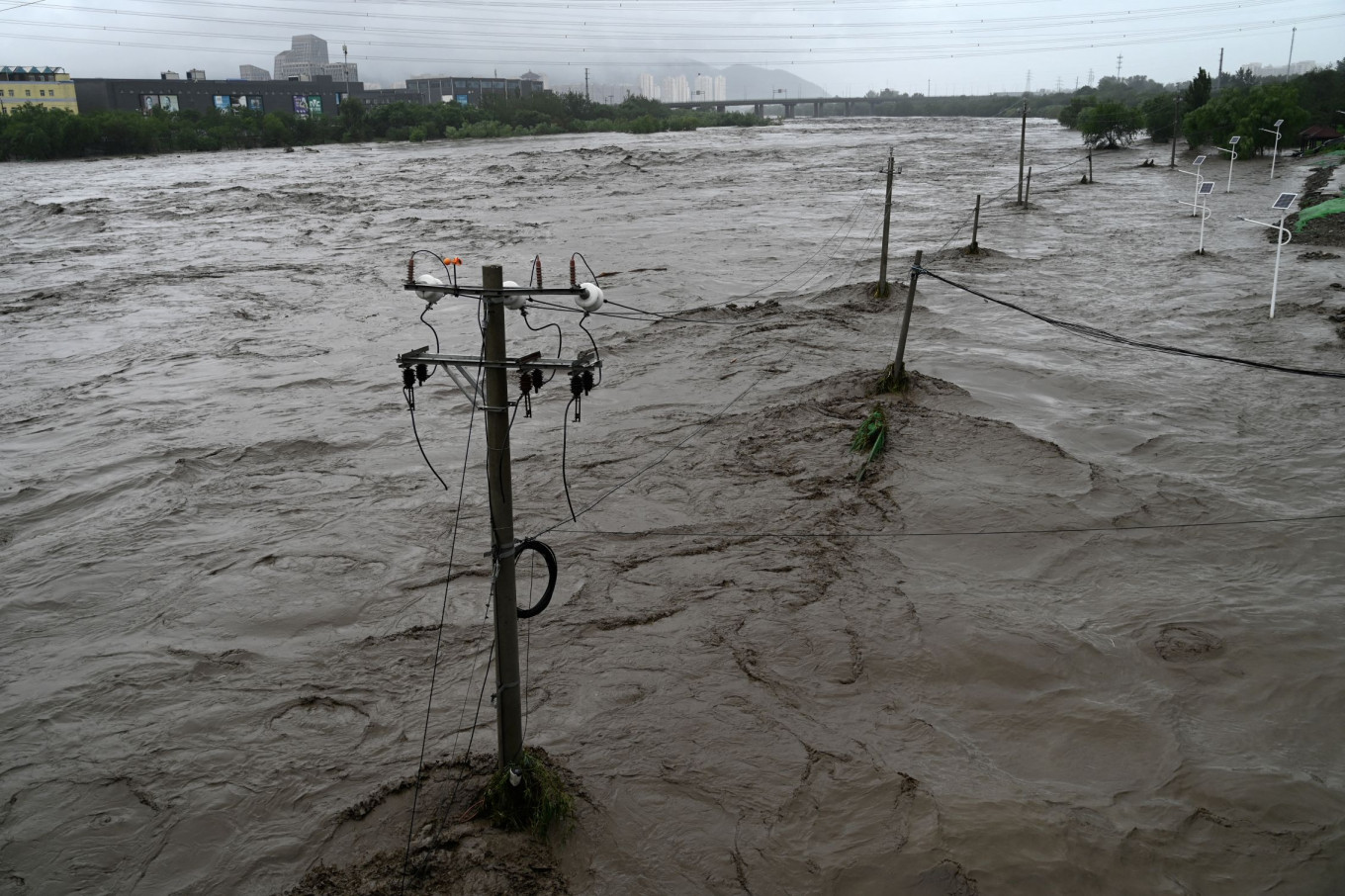
rom dangerous discharge by swollen rivers to residents trapped in waterlogged cities, China's disaster-response systems are being put to the test, with record rainfall potentially taking weeks to recede following one of the strongest storms in years.
In the wake of Typhoon Doksuri, which landed in southern China on Friday, extreme rain has battered the north, breaking a 140-year rainfall record in Beijing and dumping more than a year's rain in Hebei, a populous province.
As the remnants of the typhoon drift to China's northeastern border provinces and rains start to taper off, a region the size of the United Kingdom is grappling with the logistics of safely discharging waterways and reservoirs and rescuing tens of thousands trapped in their homes.
The Hai river basin, where five rivers converge in northern China, is going through a "flood evolution process" and flood-control engineering systems are experiencing the "most severe test" since inundations in 1996, state media reported on Thursday.
In the summer of 1996, large-scale flooding in the Yangtze river basin in central China killed about 2,800 people, damaged millions of homes and inundated swathes of cropland.
Authorities in Hebei raised the natural disaster emergency response level to II from III, while Beijing kept a warning in place for landslides on its outskirts.
Floodwaters could take up to a month to recede in Hebei, where Zhuozhou is the hardest hit city, a water resources department official told state media on Thursday. So far, about 100,000 people in the city southwest of Beijing had been evacuated, or a sixth of its population.
China has long been aware of urban waterlogging risks, with rapid urbanization in recent years creating metropolitan sprawls that covered floodplains with concrete. Extreme weather driven by global warming is making it worse.
Official data show that about 98 percent of China's 654 major cities are prone to flooding and waterlogging. Rainfall in the northeastern provinces could increase as much as 50 percent in August, China's national forecaster said on Thursday.
"Is there no way to discharge the water now? The water is not receding and the rescue efficiency is too low," said a netizen on China's popular microblog Weibo, alarmed that some places in Zhuozhou are 6 meters under water.
"The six meters of water is not a problem of heavy rains at all, but a problem of flood discharge."
Logistics nightmare
One severely affected area in Zhuozhou was the township of Matou, where roads had turned into rivers, supply of power and drinking water had been cut, mobile phone signals were lost and residents were trapped in their homes.
In their rubber rafts and boats, rescuers plied the waterlogged streets of Matou, belaying down residents trapped in high-rise buildings. Where the water was just knee-high, residents were transported away to safety by large forklifts, according to China's state broadcaster.
But rescue efforts have been difficult.
Local government and emergency management officials have stopped accepting new rescue teams from elsewhere, state-backed media reported, citing blocked pathways and a lack of unified coordination as adding to safety concerns.
State media said rescuers from around China have been applying to assist in Zhuozhou's flood relief, but some have not received approval from local officials – a prerequisite for their operations on the ground.
China is facing more stormy weather with Typhoon Khanun currently swirling over the East China Sea towards Japan, and forecast to approach China's Zhejiang and Fujian provinces by Friday.