TheJakartaPost
Please Update your browser
Your browser is out of date, and may not be compatible with our website. A list of the most popular web browsers can be found below.
Just click on the icons to get to the download page.


Popular Reads
Top Results
No results found. Please check your search term and try again
Can't find what you're looking for?
View all search results
Popular Reads
Top Results
No results found. Please check your search term and try again
Can't find what you're looking for?
View all search resultsClosely watching the macroprudential incentives
When demand for loans is sluggish, relaxation from the supply side will not stimulate the growth of bank loans.
Change text size
Gift Premium Articles
to Anyone
Share the best of The Jakarta Post with friends, family, or colleagues. As a subscriber, you can gift 3 to 5 articles each month that anyone can read—no subscription needed!
T
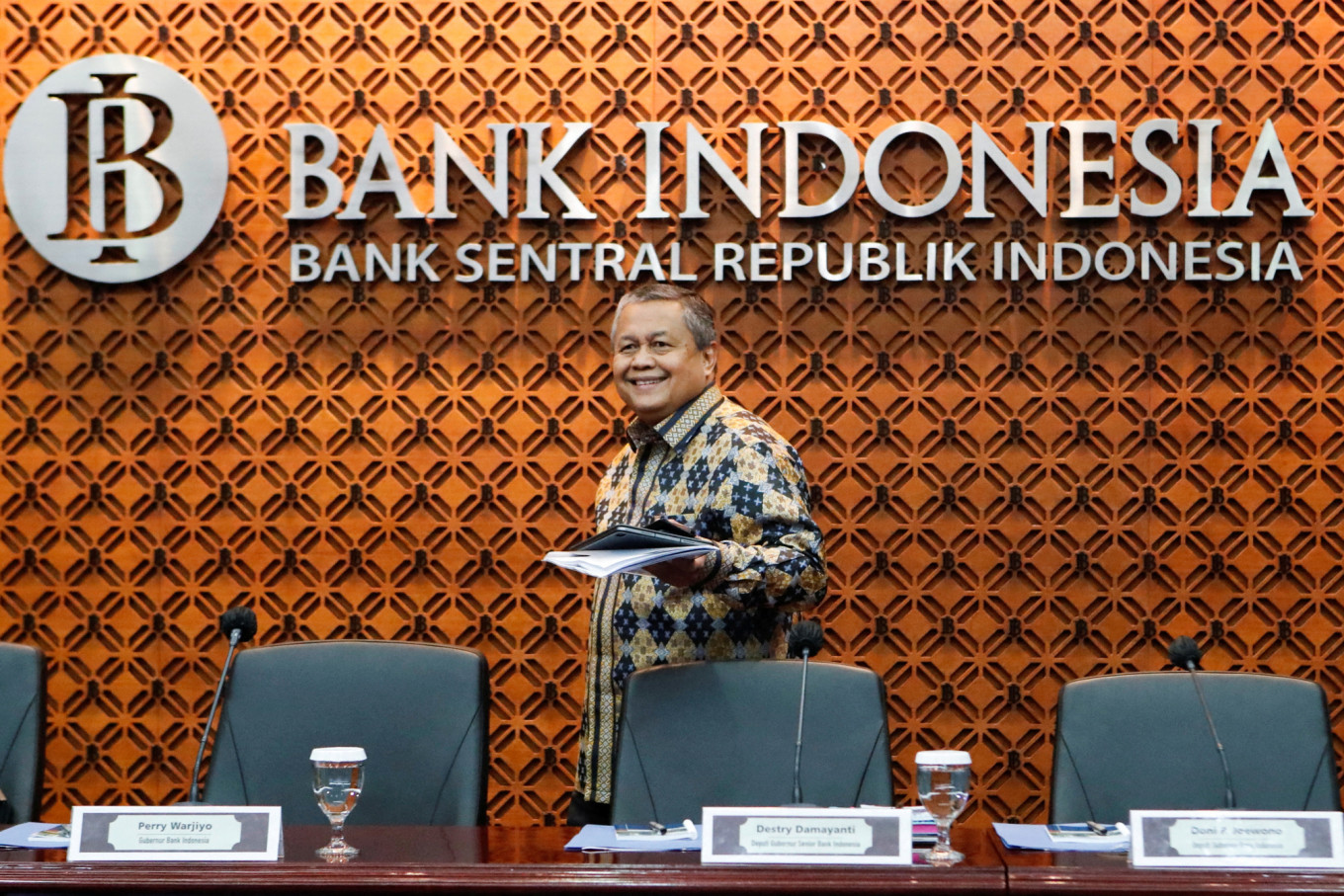
he limited space for monetary policy has prompted Bank Indonesia (BI) to relax its macroprudential realm. In line with the spirit of the policy mix, BI has released a Macroprudential Liquidity Incentive Policy (KLM) for banks, which will take effect on Oct. 1.
Banks that extend financing to priority sectors will be given incentives of up to 4 percent in the form of a reduction in the minimum reserve requirement (GWM). The implementation of KLM will add liquidity of at least Rp 47 trillion (US$3.1 billion) to the domestic financial market. The funds can be utilized by the bank receiving the incentives to provide more loans, or purchase securities or other financial assets in accordance with the needs of the national economic recovery.
At this point, KLM can be seen as a response to BI's policy on the recent trend of slowing loan growth. Last year total bank loans grew by 11.35 percent on an annual basis, then growth fell to 9.39 percent in May 2023, and to 7.76 percent in the following month.
The slowdown in loan growth is not due to a shortage of supply, as banking liquidity is ample. Third party funds and the loan to deposit ratio indicate a large potential for lending. The increase in the share of bank holdings of government securities (SBN) is an additional justification.
On the other hand, the businesses tend to be more careful in taking new loans. The results of a BI survey show that businesses are delaying the disbursement of approved loans. In many cases, corporations pay off their loans and prefer to use internal funds to finance their business activities.
Many factors could be behind the loan slowdown. Commodity prices are normalizing on the global market, which slows down business expansion. Additionally, ahead of the 2024 elections, businesses seem to prefer a “wait and see” approach.
As a result, KLM's effectiveness is in question. Textbook thinking directs KLM's arguments based on the inherently contradictory character of macroprudential policies. When loan disbursement weakens, macroprudential policies, in this case KLM, are relaxed.
In contrast, practical considerations may refute the textbook thinking through redundancy arguments. When the demand for loans is sluggish, relaxation on the supply side will not stimulate the growth of bank loans.
Even if the redundancies can be completely resolved by demand side manipulations, the problems do not stop there. Additional bank liquidity can spread to various financial markets outside the money market.
Effects arising from bank purchases of securities, for example, also need to be anticipated. According to market laws, this will cause stock and bond prices to decrease. When bond prices fall, yields will rise.
The conditions above are not too worrying, however. The liquidity flows are still circulating within the national financial system but move from the banking sector to other financial sectors. The problem becomes much more complex if the additional banking liquidity is used to purchase foreign currency. An increase in banking demand for foreign currency without being matched by a commensurate supply can lead to a depreciation of the exchange rate without any sign of substantial advance.
The above theoretical situation is not far-fetched as the high yields offered by securities denominated in foreign currencies attract banks to buy them. The chain of problems that ensues ranges from withdrawing funds, buying foreign exchange, decreasing foreign exchange reserves and fluctuating exchange rates.
This is very counterproductive to the recently issued Government Regulation (PP) No. 36/2023. Following the PP, 30 percent of natural resource export receipts (DHE) must be placed in domestic banks for at least three months to maintain the availability of foreign exchange reserves for the stabilization of the rupiah exchange rate.
When various ammunitions are launched to secure the availability of foreign exchange, the exchange usually migrates abroad. It is ironic that the perpetrators are the DHE collector banks, who are also provided with incentives in the form of higher interest rate spreads from BI.
This reminds us of what led to the 1997-1998 financial crises. At that time, the corporate sector had a large stock of foreign debt. When the debt matured, the monetary authorities had a hard time dampening exchange rate volatility as there was no official record of private sector external debt.
Under the above problematic configuration, KLM must be followed by a monitoring mechanism as a complementary policy. Eventually, the destabilizing effect of additional banking liquidity triggered by KLM must be minimized so that the main goal can optimally be achieved.
***
The writer is professor of economics at the School of Economics, Jakarta State University and research director at the Socio-Economic & Educational Business Institute (SEEBI) Jakarta. The views in this article are personal.