TheJakartaPost
Please Update your browser
Your browser is out of date, and may not be compatible with our website. A list of the most popular web browsers can be found below.
Just click on the icons to get to the download page.


Popular Reads
Top Results
No results found. Please check your search term and try again
Can't find what you're looking for?
View all search results
Popular Reads
Top Results
No results found. Please check your search term and try again
Can't find what you're looking for?
View all search resultsThousands flee wildfires in Canada’s far north
Thousands were fleeing wildfires advancing on one of the largest cities in Canada’s far north on Thursday, as convoys snaked south to safety on the only open highway and evacuation flights took off from the airport.
Change text size
Gift Premium Articles
to Anyone
Share the best of The Jakarta Post with friends, family, or colleagues. As a subscriber, you can gift 3 to 5 articles each month that anyone can read—no subscription needed!
T
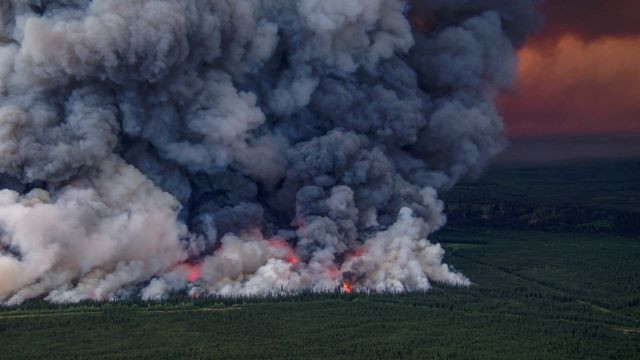
housands were fleeing wildfires advancing on one of the largest cities in Canada’s far north on Thursday, as convoys snaked south to safety on the only open highway and evacuation flights took off from the airport.
The order to evacuate Yellowknife in the Northwest Territories marks the latest chapter in a terrible summer for wildfires in Canada. More than 20,000 residents of the regional capital have been given until noon on Friday to leave.
Emergency responders were constructing firebreaks, installing sprinkler lines and water cannons, and laying fire retardant in an effort to prevent the blaze from reaching the city, which remained a real possibility in coming days, officials said.
Northwest winds over the next two days would send the fire “in directions we don’t want”, said Mike Westwick, Northwest Territories’ fire information officer.
Heeding Wednesday’s evacuation order, Tiffany Champagne was one of many who crammed into the airport in Yellowknife awaiting flights, the first departing at 1 p.m. local time.
“I have asthma and the wildfire smoke was making it increasingly difficult to do anything,” Champagne, wearing a face mask, told public broadcaster CBC.
Carriers WestJet and Air Canada announced they were increasing flights out of the city.
As of Thursday, more than 1,000 wildfires were burning in Canada, including around 230 in the Northwest Territories, where more than 21,000 square kilometers have been set ablaze.
In British Columbia in western Canada, an evacuation order was put in place for the city of West Kelowna, which was under threat of a different fire.
In addition to those traveling by car, some 5,000 had been evacuated on emergency flights as of Thursday night.
Yellowknife Mayor Rebecca Alty warned drivers being led out in kilometers-long convoys that the flames were skirting the edges of highways and they would encounter limited visibility as thick smoke turned the sky orange.
Crews scrambled to erect fire barriers as one blaze got to within 16 km of Yellowknife. Water bombers were seen flying low over the city and swooping in to fill up at a nearby lake.
Resident Sylvia Webster said, “a lot of trees were cut down and sprinkler lines were set up around the city” to bolster its defenses.
“We might still lose everything, but that’s OK,” she told AFP. “As long as our loved ones are safe, we can move on from there.”
Prime Minister Justin Trudeau interrupted his summer vacation on Thursday to convene an incident response group.
Several military aircraft have already been dispatched, along with more than 120 soldiers to help beat back the flames.
In what has already been declared the Northwest Territories’ largest-ever evacuation, the emptying of Yellowknife now means half the population of the near-Arctic territory will soon be displaced.
Several towns and indigenous communities are already under evacuation orders.
On Monday, the Canadian military started airlifting to safety residents of smaller, far-flung communities in the region after roads were engulfed in flames.
For many, it was the second time in recent months that they were forced to evacuate.
Images shared on social media and on Canadian television showed large swaths of blackened forests. Evacuees reported seeing abandoned vehicles and burned carcasses of wildlife, including bears, on roadsides.
Cars and trucks arrived at evacuation centers in Alberta, at least 1,150 km away, with melted headlights and peeling paint.
Nadia Byrne, 24, considered turning back but worried she might run out of gas and become stranded.
“I don’t really know where to go. [...] Everyone’s just kind of scrambling right now,” she told AFP.
Evacuee Julie Downes, reached by telephone, described big plumes of smoke along a “gridlocked highway”.
“It’s scary to say, but myself and other northerners are now climate change refugees,” she said.
Scientists say human-caused global warming is exacerbating natural hazards, making them both more frequent and more deadly.
The evacuation of Yellowknife is the second time a sizeable Canadian city has been cleared due to wildfires since 2016, when 100,000 residents of Fort McMurray in Alberta’s oil and gas producing heartland were forced out.
Earlier this year, suburbs of Halifax on the Atlantic coast were also evacuated.
Fires this season have spread across Canada with remarkable intensity, scorching 13.7 million hectares, according to the Canadian Interagency Forest Fire Centre. Four people have died so far.