TheJakartaPost
Please Update your browser
Your browser is out of date, and may not be compatible with our website. A list of the most popular web browsers can be found below.
Just click on the icons to get to the download page.


Popular Reads
Top Results
No results found. Please check your search term and try again
Can't find what you're looking for?
View all search results
Popular Reads
Top Results
No results found. Please check your search term and try again
Can't find what you're looking for?
View all search resultsChallenges abound ahead of 43rd ASEAN Summit
As the days count down toward the ASEAN Summit, current chair Indonesia is taking the bull by the horns in tackling several overarching issues toward issuing the fourth edition of the so-called Bali Concords.
Change text size
Gift Premium Articles
to Anyone
Share the best of The Jakarta Post with friends, family, or colleagues. As a subscriber, you can gift 3 to 5 articles each month that anyone can read—no subscription needed!
D
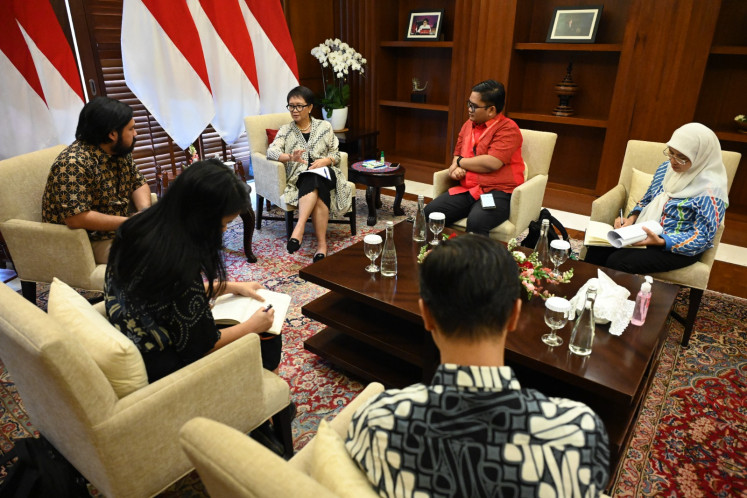
iscussions on fresh internal and external challenges awaited ASEAN’s current chair Indonesia, Foreign Minister Retno LP Marsudi said in an interview on Wednesday, as the region’s leaders prepare to convene next week in hopes of streamlining the bloc’s decision-making process over the coming year.
Indonesia’s 2023 chairmanship of the regional bloc, which the minister suggested had been fraught with efforts to contain “crisis after crisis”, culminates in the 43rd ASEAN Summit and related meetings from Sept. 5 to 7 in Jakarta.
The summit promises a flurry of meetings and outcome documents, more than 60 by Retno’s count, and expects to welcome the leaders of at least nine ASEAN member states and prospective member Timor-Leste, as well as top representatives of the bloc’s nine dialogue partners.
Further, the leaders of Bangladesh and the Cook Islands, respectively the current chairs of the Indian Ocean Rim Association (IORA) and the Pacific Islands Forum (PIF), are also slated to attend, underscoring Indonesia’s inclusive approach to developing the Indo-Pacific region.
Among the hot-button issues is the ongoing negotiation on the code of conduct (COC) in the South China Sea amid rising tensions between China and the Philippines over the latter’s grounded naval vessel on the Second Thomas Shoal.
Complicating things further, Beijing has also revealed a new official map on Monday, which includes the controversial nine-dashed line outlining its claim to the busy sea route that was invalidated in a 2016 international court ruling.
China has overlapping claims in the South China Sea with several ASEAN countries as well as Taiwan, which it sees as a breakaway province.
While declining to comment on the matter, Retno acknowledged that some countries were certain to raise the latest developments in the disputed sea during next week’s summit.
“I wouldn’t be surprised if that issue comes up during the AMM [ASEAN Foreign Ministers’ Meeting] or at the summit. It’s not a new issue for us,” Retno told The Jakarta Post at her office in Jakarta.
At the previous ministerial-level meeting in July, ASEAN and China had agreed on “guidelines for accelerating the early conclusion” of the COC negotiations, as laid out in the AMM joint communiqué.
Read also: China’s behavior in South China Sea must be challenged: US NavyMyanmar in mind
The summit’s agenda also includes a plan to review the implementation of the Five-Point Consensus (5PC) in resolving the Myanmar crisis. It has been roundly criticized for its slow progress, which has in turn attracted the ire of many, including President Joko “Jokowi” Widodo.
Retno admitted that expectations to resolve the crisis during Indonesia’s chairmanship was simply “too much”, but she also insisted that ASEAN would retain the 5PC as the guiding principles for addressing the issue.
“The Five-Point Consensus itself will not be reviewed. We will be reviewing its implementation: whether it has made any progress; if not, why; whether we will continue to push for its implementation and how far,” the minister said.
“This will be discussed at the AMM and will surely be discussed by the [ASEAN] leaders,” she added.
Retno also explained why neither the President nor she herself had traveled to Myanmar to provide mediation.
“It’s very easy to head up there. But we have to ask what it means to go, and what will be achieved by it. We can’t afford to do something counterproductive,” she said.
To improve collective efforts, guarantee continuity and sustain the progress made thus far, the minister suggests forming a troika of ASEAN chairs and empowering its envoys and the secretariat to bolster the current special envoy mechanism.
The Feb. 1, 2021 coup in Myanmar plunged the country into violence, with at least 4,000 civilians killed in the 1,000 days since the military junta took power from the democratically elected government.
But Daw Zin Mar Aung, the foreign minister of Myanmar’s civilian National Unity Government (NUG), heaped praise on Indonesia for its active role in the crisis.
“The military council has not respected ASEAN’s Five-Point Consensus and it does not listen to anyone or anybody,” she said, as quoted by local online news outlet The Irrawaddy.
“We urge ASEAN to keep up its progress and maintain institutional relations with the NUG as well.”
The latest victim of Myanmar’s junta was Timor-Leste, whose top diplomat in Yangon was expelled on Sunday.
Dili is currently in the prolonged process of becoming ASEAN’s 11th member, which began in earnest after last year’s ASEAN summit hosted by Cambodia.
Retno declined to comment when asked if the recent diplomatic expulsion would complicate Timor-Leste’s bid, saying only that she had yet to meet with her Timorese counterpart and others to discuss the matter, and that the topic would be broached next week.
Read also: Envisioning ASEAN’s comprehensive response to regional dynamics‘ASEAN matters’
Indonesia has employed a two-pronged approach through its chairmanship summarized by the slogan, “ASEAN Matters: Epicentrum of Growth”.
Underpinning this phrase are efforts to push for greater economic integration and to maintain ASEAN’s relevance by improving its decision-making process. This is to culminate in the Concord IV document that, according to Retno, will serve as the foundation for the bloc’s long-term vision until 2045.
The first three ASEAN concords, known as the “Bali Concords”, were produced in 1976, 2003 and 2011, all during Indonesia’s chairmanship.
Concord I laid out the foundations of ASEAN, while Concord II introduced the concept of building the ASEAN community around the political-security, economic and socio-cultural pillars. Concord III covered ASEAN’s role in “a global community of nations”.
ASEAN needed to be able to respond to crises quickly, Retno said, likening the bloc to a ship sailing into a storm. “If decision-making takes too long, then we will surely be hit by the storm,” she said of Concord IV.
Dewi Fortuna Anwar, an international relations expert from the National Research and Innovation Agency (BRIN), said separately on Wednesday that she welcomed the initiative to speed up ASEAN’s decision-making process, noting that the bloc’s adherence to its policy of consensus had often impeded progress.
And while addressing timely issues such as the Myanmar crisis or the South China Sea dispute were important, Dewi said it was just as crucial to strengthen the three pillars of the ASEAN community.
“We shouldn’t become too busy solving problems and lose sight of the main agenda,” she said. (tjs)