TheJakartaPost
Please Update your browser
Your browser is out of date, and may not be compatible with our website. A list of the most popular web browsers can be found below.
Just click on the icons to get to the download page.


Popular Reads
No popular reads data found
Top Results
No results found. Please check your search term and try again
Can't find what you're looking for?
View all search results
Popular Reads
No popular reads data found
Top Results
No results found. Please check your search term and try again
Can't find what you're looking for?
View all search resultsBPJS-Kesehatan

Society 1 year ago
PREMIUM
Single inpatient class raises concerns of reduced hospital beds
The government acknowledges that the new single-class inpatient system for the National Health Insurance (JKN) program may reduce the number of the country's hospital beds by more than 23,000, but gave an assurance that it will not disrupt treatment or hospital admission for patients.

Society 1 year ago
PREMIUM
Ombudsman calls for better service as BPJS transitions to single-class hospital care
The Indonesian Ombudsman has called on the government to ensure better hospital facilities and fair premiums once standardized inpatient care for National Health Insurance (JKN) policyholders goes into full effect next year.

Companies 1 year ago
PREMIUM
Implementation of JKN standard inpatient class: Opportunities and challenges
The implementation of KRIS is expected to improve the quality of service for JKN patients, especially existing class 3 patients. However, this policy also raises several issues for future practice.

Front Row 1 year ago
BPJS Kesehatan CEO Launches New Books Detailing National Health Insurance Dynamics
Ghufron Mukti, CEO of BPJS Kesehatan, launched two new books on May 17, 2024 in Jakarta.The first, titled Roso Telo Dadi Duren, Biyen Gelo Saiki Keren: Catatan 10 Tahun Perjalanan BPJS Kesehatan (Taro into durian: Notes on the 10-year journey of BPJS Kesehatan), chronicles significant events in managing the National Health Insurance (JKN) program over the dynamic decade since the establishment of the Health Care and Social Security Agency (BPJS Kesehatan) on Jan. 1, 2014.

Society 1 year ago
PREMIUM
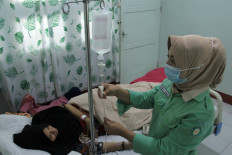
Single-class hospital care scheme will not affect premiums yet, BPJS says
The Healthcare and Social Security Agency (BPJS Kesehatan) has said a recent regulation on standardized inpatient care for National Health Insurance (JKN) policyholders will not affect premiums for at least a year.



Economy 1 year ago
PREMIUM
Hospitals win, insurers lose as medical claims surge on rising costs
As the number of health claims rise, industry analysts are urging insurers and hospitals to review their risk-sharing schemes to avoid transferring the burden from the former to the latter, among other measures.