The Jakarta Post
Please Update your browser
Your browser is out of date, and may not be compatible with our website. A list of the most popular web browsers can be found below.
Just click on the icons to get to the download page.


Popular Reads
Top Results
No results found. Please check your search term and try again
Can't find what you're looking for?
View all search results
Popular Reads
Top Results
No results found. Please check your search term and try again
Can't find what you're looking for?
View all search resultskpk-law-revision
Opinion 6 years ago
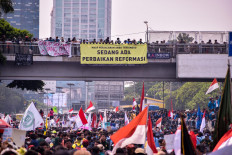
A requiem for 'Reformasi' as Joko Widodo unravels Indonesia's democratic legacy
For weeks, Jokowi has been under intense pressure from civil society and street protesters to issue an emergency decree to revoke the new KPK law, but so far he has declined. This is largely because he’s under even stronger pressure from political parties to keep the law in place.
Business 6 years ago
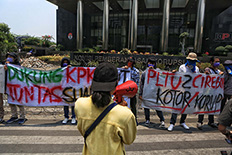
‘Corruption hampers investment’: Economists urge Jokowi to issue Perppu on KPK Law
Forty scholars from various universities at home and abroad have endorsed the letter, including University of Indonesia economist Faisal Basri and Prof. Budy Resosudarmo of Australia National University.

Politics 6 years ago
PREMIUM
KPK's role in doubt as new law takes effect
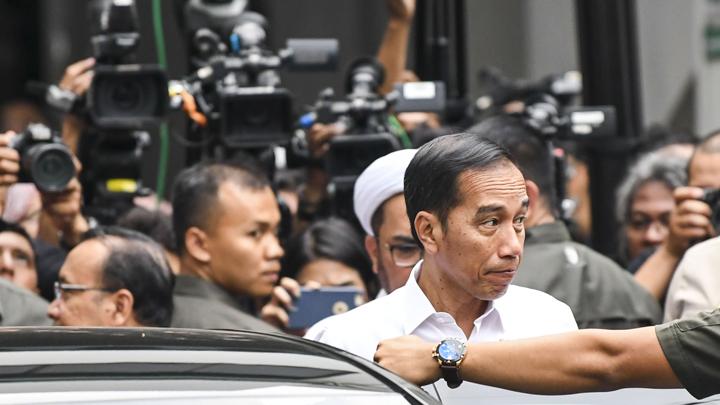
By default, the revised law takes effect 30 days after being passed by the House of Representatives as President Joko “Jokowi” Widodo has yet to issue a government regulation in lieu of law (Perppu) to revoke the bill, which many observers have warned will weaken the antigraft body.

Opinion 6 years ago
No honeymoon for Jokowi and Ma'ruf after inauguration
As this is his second (and last) term in office, understandably some expect Jokowi to slow down in his approach to work. But that isn’t likely to happen. We may see the opposite; he will work even harder and longer than previously.
Opinion 6 years ago
PREMIUM
Smoke and mirrors raise threat of authoritarianism return
The government’s nod to the revision of the Corruption Eradication Commission (KPK) Law and its pick of controversial KPK commissioner candidates have seriously undermined the credibility of President Joko “Jokowi” Widodo’s commitment to corruption eradication.
Opinion 7 years ago
PREMIUM
Nationwide student marches: A moral force despite the odds
The latest nationwide student demonstrations should be seen as a progressive movement to save the future of Indonesian democracy. The following are a few factors that affect the movement’s growth and sustainability.
National 7 years ago
PREMIUM
Student protesters agree to meet Jokowi — but only on two conditions
President Joko “Jokowi” Widodo’s appeal to open talks with student protesters has been rejected, with several university student bodies dismissing the possibility of any meeting unless the country’s leader answers their demands.
Editor's Picks
Popular
- Popular discontent is justified. Authoritarianism is not the answer
- Recentralization concerns in fiscal, education heighten
- Govt under pressure as 3 million home drive hits cracks
- Safeguarding Indonesia's AI future
- Sugarcane farmers query House over sugar imports
- Power exports to Singapore hinge on regulatory clarity
- Thousands huddle in Bangkok shelters as Thai flood damages seen at $320m
- Prabowo turns to experts to tackle peatland fires after swipe at researchers
- Palestine test for UN ‘resilience’, says Indonesia
- Oil prices spike after Trump rejects Iran truce offer


