TheJakartaPost
Please Update your browser
Your browser is out of date, and may not be compatible with our website. A list of the most popular web browsers can be found below.
Just click on the icons to get to the download page.


Popular Reads
Top Results
No results found. Please check your search term and try again
Can't find what you're looking for?
View all search results
Popular Reads
Top Results
No results found. Please check your search term and try again
Can't find what you're looking for?
View all search resultsThousands rally in Bulgaria against corruption, call for judicial reform
The protests in the capital Sofia and several other towns and cities across the Black Sea nation are the latest in a series of rolling demonstrations and come as Bulgaria prepares to adopt the euro on Jan. 1.
Change text size
Gift Premium Articles
to Anyone
Share the best of The Jakarta Post with friends, family, or colleagues. As a subscriber, you can gift 3 to 5 articles each month that anyone can read—no subscription needed!
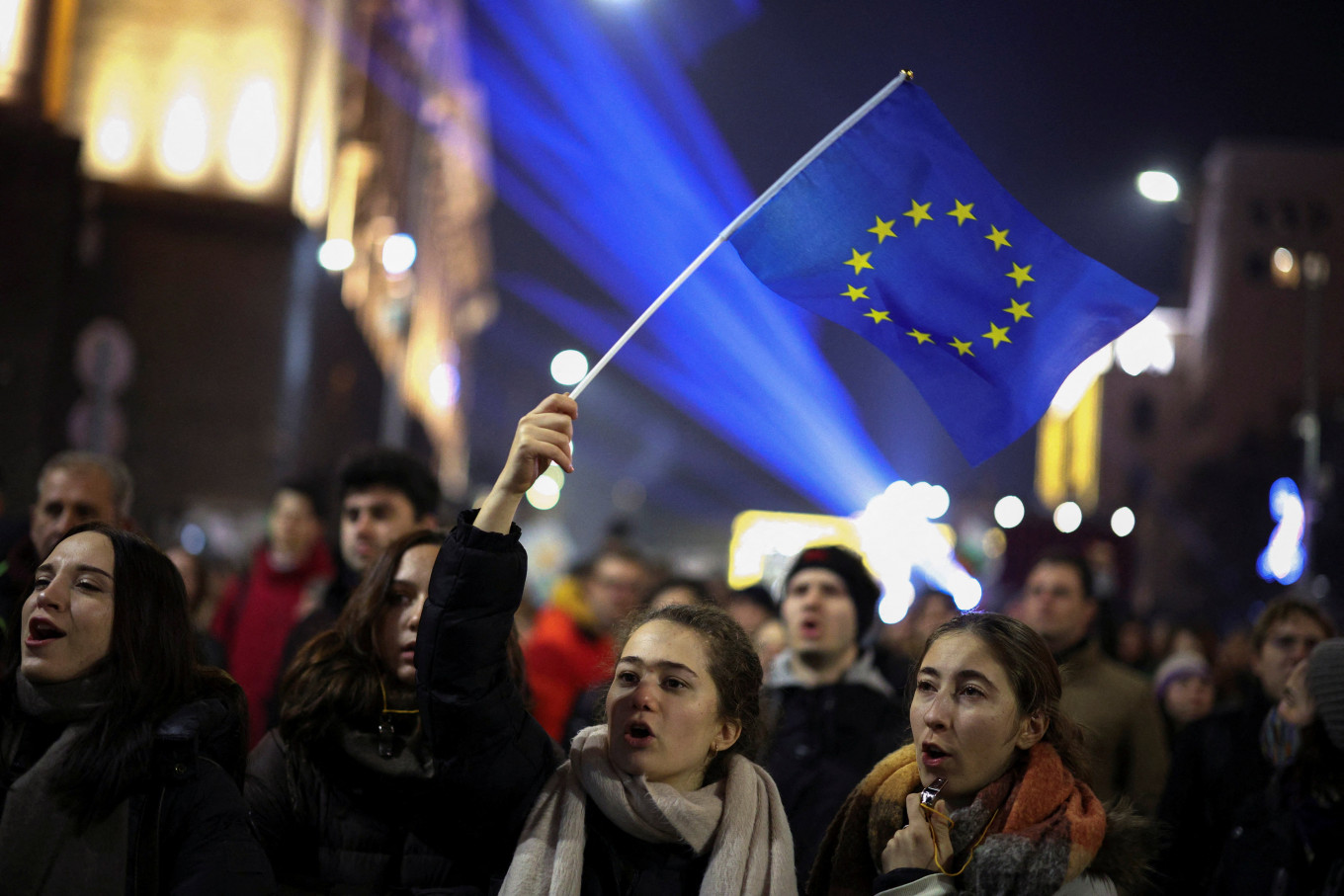 People gather to demonstrate after parliament opposition urged more protests after the government collapsed in a tax dispute, Sofia, Bulgaria, December 18, 2025. (Reuters/Spasiyana Sergieva)
T
housands of Bulgarians protested on Thursday evening against the outgoing government, calling for fair elections and judicial reform to tackle what they describe as endemic corruption in the European Union's poorest member state.
The protests in the capital Sofia and several other towns and cities across the Black Sea nation are the latest in a series of rolling demonstrations and come as Bulgaria prepares to adopt the euro on Jan. 1.
The outgoing government, in power since January, had looked set to oversee the transition to the euro, but Prime Minister Rosen Zhelyazkov handed in his government's resignation last week after weeks of street protests against state corruption and a new budget that would have increased taxes.
Protesters on Thursday held Bulgarian and EU flags. One sign read "This is not farce."
"Everything about it [the government] is extremely brazen. Shameless. Such arrogant behavior defines this government," said Shisman Nikolov, a 48-year-old salesman.
"Society does not respect people who consider themselves above others."
The president, Rumen Radev, is holding consultations with parties, but if they refuse or fail to form the government, he will appoint an interim government and call a snap election.
Bulgaria, a NATO member state, has held seven national elections in the past four years as consecutive governments failed to keep control of a fractured parliament.
Kalina Yurukova, 21-year-old student, said: "If you steal constantly, you must think you are above everyone else. And for people who are arrogant and have not a shred of shame, I cannot have respect or associate myself with them.”
Earlier this month, the government withdrew its 2026 budget plan, the first drafted in euros, due to the mass protests. Opposition parties and other organizations said they were protesting against plans to hike social security contributions and taxes on dividends to finance higher state spending.
The protests began in late November when Zhelyazkov's government, composed of three parties, proposed a draft budget that included an increase in social security contributions and taxes on dividends to finance higher state spending.
Some of that spending was earmarked for police, security services and the judiciary—the very bodies that many Bulgarians have grown to despise over years that have seen Bulgaria ranked as one of the EU's most corrupt countries. The budget was withdrawn, but popular anger has persisted.
Many were already upset by other government actions, including a perceived crackdown on the liberal, pro-EU opposition that saw Blagomir Kotsev, mayor of the coastal resort of Varna, jailed for months on allegations of corruption, which he strongly denies.
The protests swelled and by Wednesday tens of thousands of people were on the streets of cities and towns across Bulgaria calling for the government to step down.