TheJakartaPost
Please Update your browser
Your browser is out of date, and may not be compatible with our website. A list of the most popular web browsers can be found below.
Just click on the icons to get to the download page.


Popular Reads
Top Results
No results found. Please check your search term and try again
Can't find what you're looking for?
View all search results
Popular Reads
Top Results
No results found. Please check your search term and try again
Can't find what you're looking for?
View all search resultsCeasefire holds, but half a million Cambodians remain displaced four days on
The Cambodian Ministry of Interior reported that 5,192 displaced persons returned home during the latest reporting period, but large populations remain in temporary shelters or host communities, particularly in Banteay Meanchey, Oddar Meanchey and Preah Vihear provinces.
Change text size
Gift Premium Articles
to Anyone
Share the best of The Jakarta Post with friends, family, or colleagues. As a subscriber, you can gift 3 to 5 articles each month that anyone can read—no subscription needed!
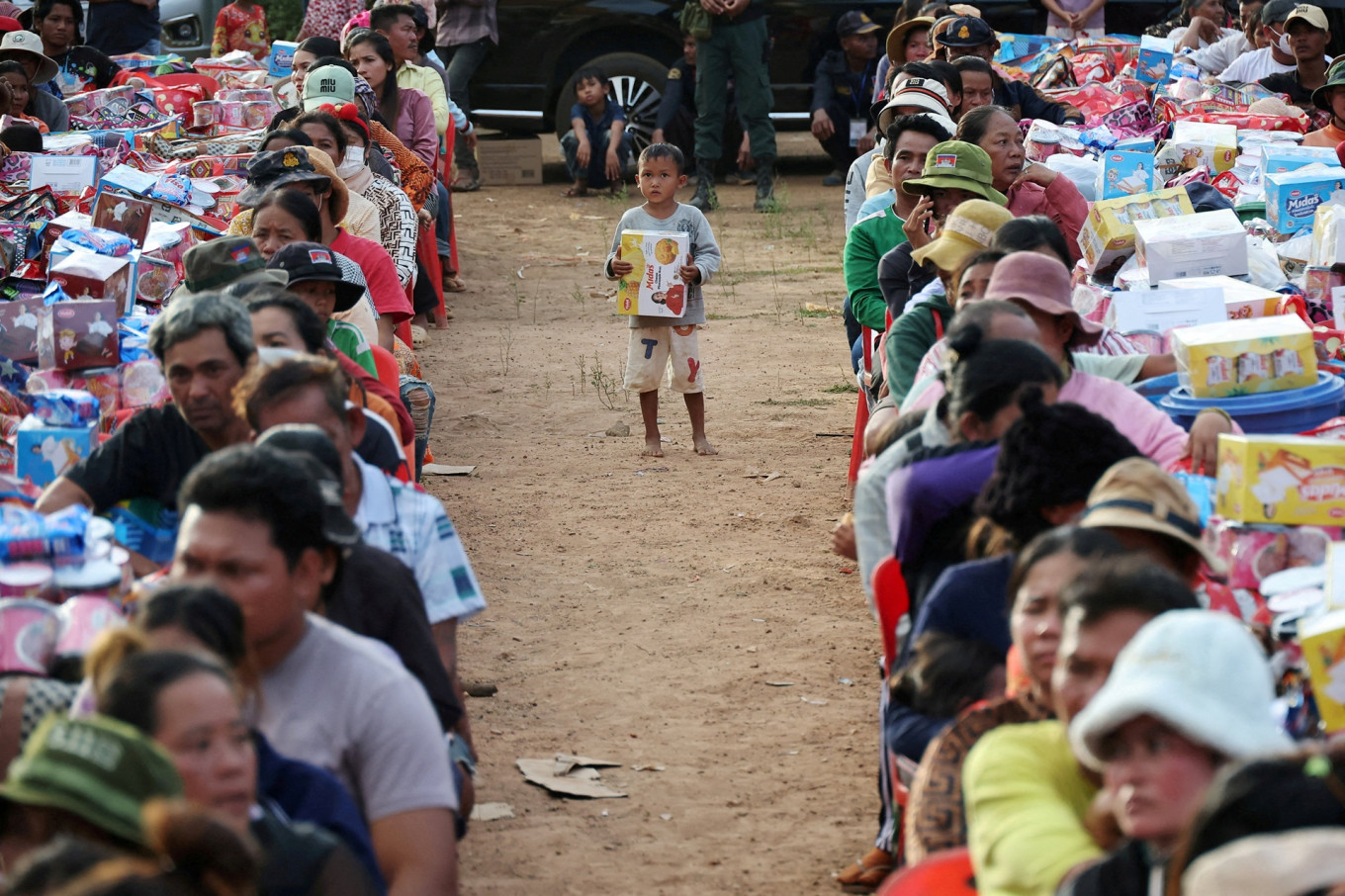 A boy holding a supply stands among people waiting to collect supplies at Batthkav refugee camp in Chong Kal, Oddar Meanchey Province, Cambodia, on Dec. 12, 2025, amid clashes between Thailand and Cambodia along a disputed border area. (Reuters/Kim Hong-Ji)
F
our days after a ceasefire between Cambodian and Thai forces took effect, more than half a million civilians remain displaced, underscoring the scale of humanitarian disruption despite growing stability along the border, according to the Cambodian Ministry of Interior.
A government press release issued on Jan. 1 said the ceasefire, implemented from 6 p.m. on Dec. 31, 2025 to 1 p.m. on Jan. 1, had brought calm to affected areas and enabled some families to return home.
However, the overall situation on the ground remains fragile, with 512,263 people still unable to return to their villages due to safety concerns, damaged infrastructure and unexploded ordnance.
The ministry reported that 5,192 displaced persons returned home during the latest reporting period, but large populations remain in temporary shelters or host communities, particularly in Banteay Meanchey, Oddar Meanchey and Preah Vihear provinces.
In Banteay Meanchey alone, 321 schools and seven hospitals or health centers remain closed, while only limited government services have resumed. In Preah Vihear, 61 schools and 14 health facilities are still not operational.
Oddar Meanchey has seen the widest disruption, with more than 200 schools and dozens of local administrative offices remaining closed due to security concerns.
The Interior Ministry said the situation is complicated by extensive damage to civilian infrastructure.
According to preliminary assessments, at least 117 civilian houses were damaged, along with schools, government offices and religious sites. Additional damage was recorded at private homes, hotels, gas stations, rice barns, bridges and roads, as well as electricity facilities.
Authorities also cited the presence of unexploded ordnance as a major obstacle to resettlement.
While calm has largely returned, officials stressed that the process of restoring normal life will take time.
“The ceasefire allows people to return, but only when safety can be guaranteed,” the ministry said, noting that 84 villages remain inaccessible and require further clearance and assessment before residents can go back.
The Ministry of Interior said it is coordinating with national and local authorities to accelerate rehabilitation efforts, including repairing damaged homes, restoring public services and ensuring security in affected areas.
Preparations for resettlement have been completed in 172 villages, but many families remain in limbo.
The statement by the Interior Ministry also reaffirmed that the ceasefire does not compromise Cambodia’s sovereignty or territorial integrity, emphasising that border issues will continue to be addressed through existing international mechanisms.
The government reiterated its support for Prime Minister Hun Manet’s “Quiet but Not Silent” approach, which it said contributed to the safe return of 18 detained Cambodian soldiers.
While the return of calm has been welcomed, the scale of displacement highlights the long road to recovery.
For thousands of families still waiting in temporary shelters, the ceasefire marks only the first step toward rebuilding their lives after weeks of instability along the border.