TheJakartaPost
Please Update your browser
Your browser is out of date, and may not be compatible with our website. A list of the most popular web browsers can be found below.
Just click on the icons to get to the download page.


Popular Reads
Top Results
No results found. Please check your search term and try again
Can't find what you're looking for?
View all search results
Popular Reads
Top Results
No results found. Please check your search term and try again
Can't find what you're looking for?
View all search resultsRohingya survivors expect UN's highest court to find Myanmar committed genocide
Myanmar has denied accusations of genocide and said the 2017 offensive that forced at least 730,000 Rohingya from their homes and into neighboring Bangladesh was a legitimate counterterrorist operation.
Change text size
Gift Premium Articles
to Anyone
Share the best of The Jakarta Post with friends, family, or colleagues. As a subscriber, you can gift 3 to 5 articles each month that anyone can read—no subscription needed!
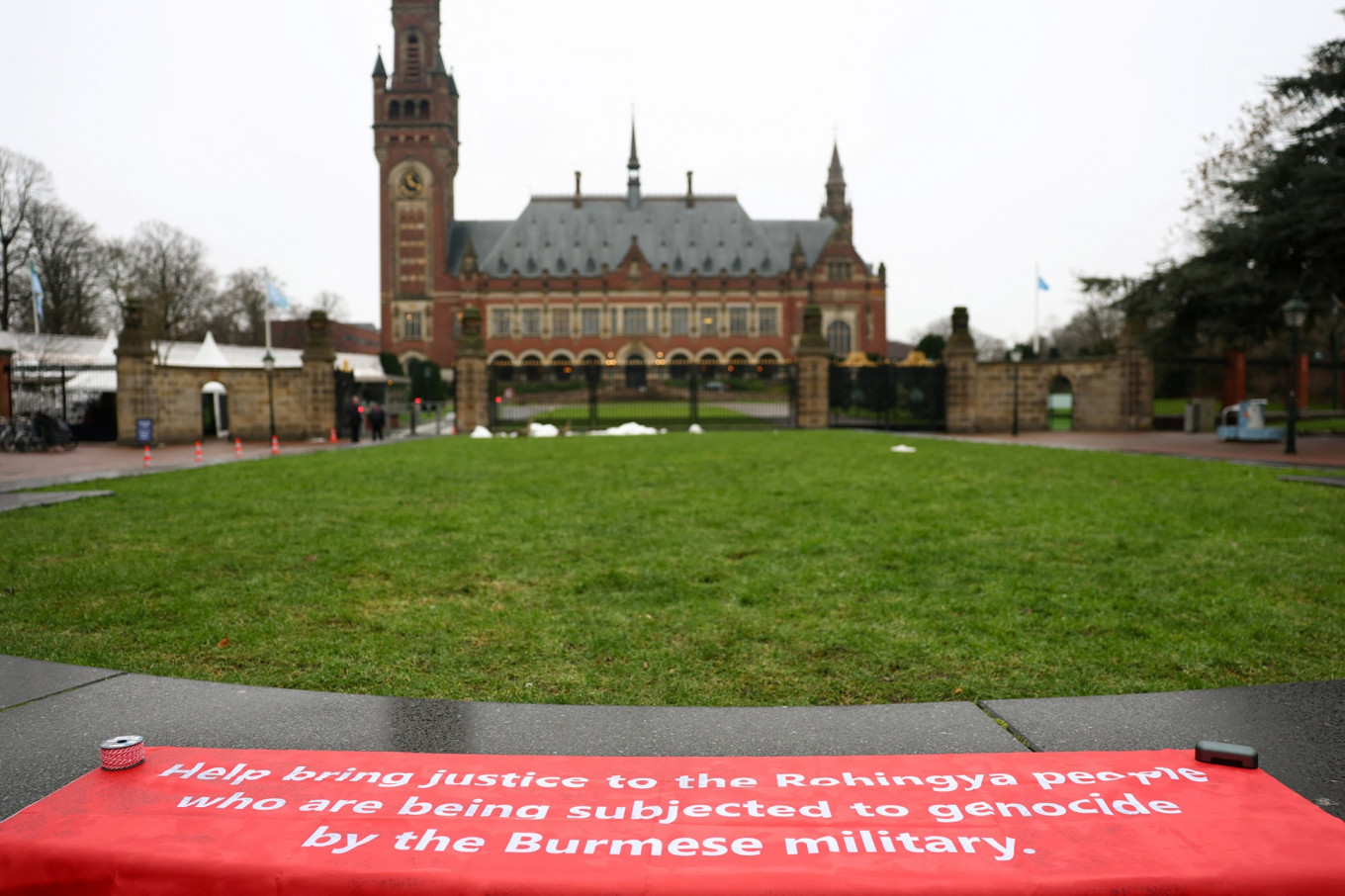 A banner in support of the Rohingya people is seen outside the International Court of Justice (ICJ) in The Hague, Netherlands on Jan. 17, 2026, as the court starts two weeks of hearings in a landmark case brought by Gambia, which accuses Myanmar of committing genocide against the Rohingya, a minority Muslim group. (Reuters/Piroschka van de Wouw)
R
ohingya survivors of the 2017 military crackdown in Myanmar expect the International Court of Justice (ICJ), the United Nations' highest court, to rule the country committed genocide against them, they said on Friday.
A judgment is expected in three-to-six months' time following three weeks of hearings at the court in the Hague that is also known as the World Court.
The outcome of the case will have repercussions beyond Myanmar, including affecting South Africa’s genocide case at the court against Israel over the war in Gaza.
In their final submissions this week, lawyers for Gambia, a mainly Muslim country that brought the case, told the court that the only reasonable conclusion to be drawn from Myanmar's conduct is that it intended to destroy the Rohingya as a group.
Myanmar has denied accusations of genocide and said the 2017 offensive that forced at least 730,000 Rohingya from their homes and into neighboring Bangladesh was a legitimate counterterrorist operation.
Speaking on Friday on the sidelines of a meeting of survivors of mass atrocities, Yousuf Ali, a 52-year-old Rohingya refugee who says he was tortured by the Myanmar military, said he believed the court would declare a genocide had been committed.
"The world has witnessed us suffering for so many years [...] how we were deported, how our homes were destroyed and we were killed," he said.
A UN fact-finding mission concluded the offensive had included "genocidal acts" and survivors recounted killings, mass rape and arson.
At the international court, Myanmar's lawyers said the fact-finding mission was biased and that its conclusions did not have the standard of proof needed for a finding of genocide.
Gambia's Justice Minister Dawda Jallow asked the court to reject Myanmar's arguments and said a judgment declaring genocide would help to break Myanmar's "cycle of atrocities and impunities".