The Jakarta Post
Please Update your browser
Your browser is out of date, and may not be compatible with our website. A list of the most popular web browsers can be found below.
Just click on the icons to get to the download page.


Popular Reads
Top Results
No results found. Please check your search term and try again
Can't find what you're looking for?
View all search results
Popular Reads
Top Results
No results found. Please check your search term and try again
Can't find what you're looking for?
View all search resultsSweeping election win promises no free hand for PM Takaichi
Change text size
Gift Premium Articles
to Anyone
Share the best of The Jakarta Post with friends, family, or colleagues. As a subscriber, you can gift 3 to 5 articles each month that anyone can read—no subscription needed!
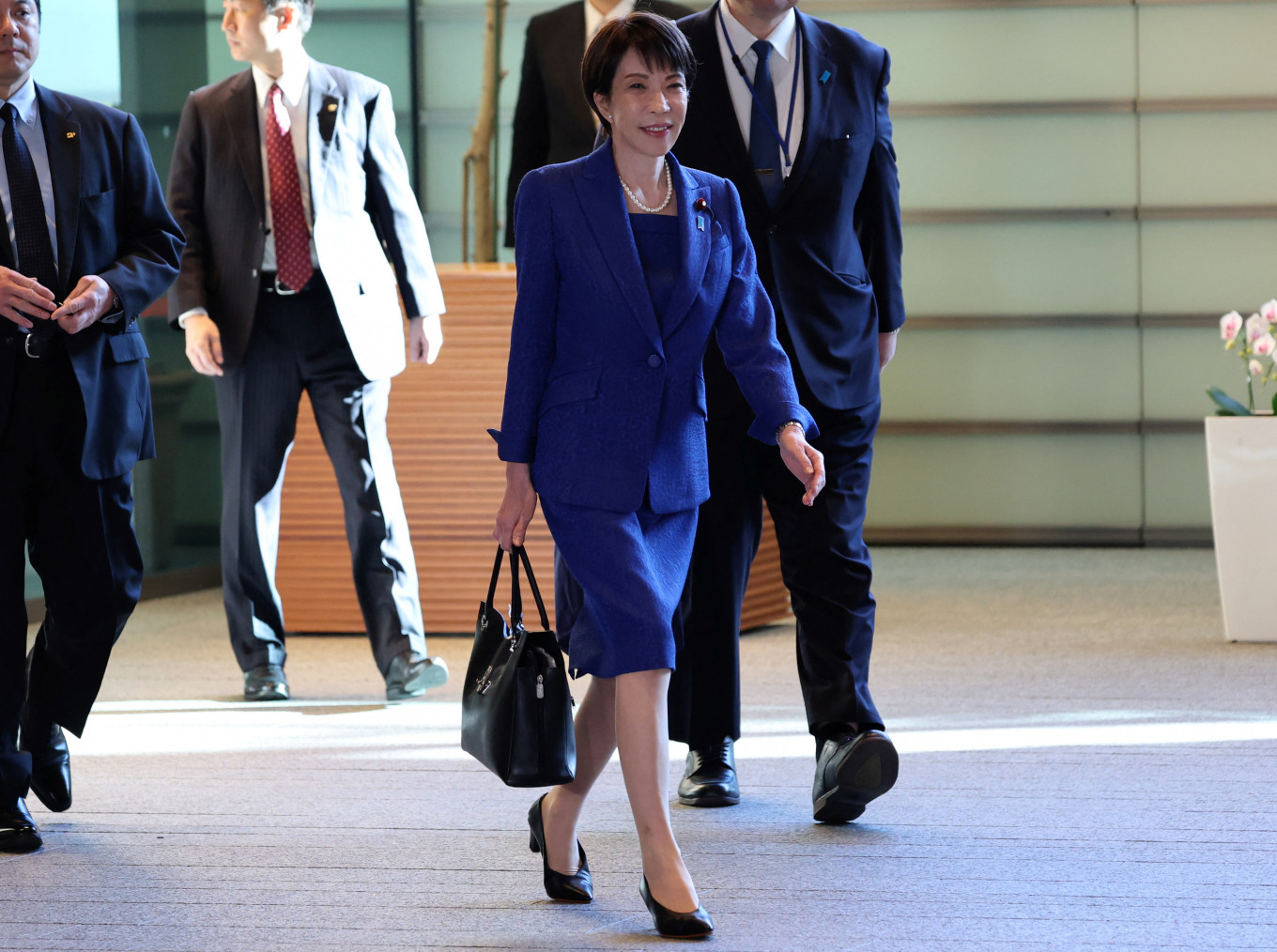 Japanʼs Prime Minister Sanae Takaichi arrives on Jan. 23, 2026 at the Prime Minister’s Office in Tokyo. (Reuters/Kim Hyung-Hoon)
P
rime Minister Sanae Takaichi may hope to build on the momentum of her ruling coalition's landslide victory in Sunday's election, but a divided parliament likely for years to come means no smooth ride as premier.
Takaichi appears tempted to draw some cues from her mentor and the country's longest-serving premier Shinzo Abe, whose aggressive economy-boosting policies and drastic reworking of the country's postwar defense posture have drawn parallels with hers.
The country's first female prime minister received a clear mandate from the public, with her Liberal Democratic Party alone securing a two-thirds majority in the 465-member House of Representatives, a feat that bodes well for her staying in power for the long term.
But political experts warn that the road ahead will not be easy. The ruling camp's lack of a majority in the House of Councillors means that cooperation from opposition parties is essential for legislative work, while scandals also loom over the party despite its strong comeback.
Known as a fiscal dove whose recent comments were taken as favoring a weak yen, Takaichi must also address global concerns about her expansionary policy stance that could further worsen Japan's fiscal health and shake market confidence.
Since taking office in October, Takaichi's Cabinet has enjoyed relatively high support, at about 60 to 70 percent. But support for the LDP itself has hovered around 30 to 40 percent, showing little recovery from levels seen under her predecessor, Shigeru Ishiba.
Junsuke Matsuura, an associate professor at Keio University's Faculty of Law, described the election result as a textbook example of the "coattail effect," in which a popular leader boosts the electoral prospects of other candidates from the same party.
Before the election, the conservative ruling bloc of the LDP and the Japan Innovation Party had been clinging to a slim majority in the lower house with some independents' support.
The coalition was formed earlier in October after the end of a 26-year alliance between the LDP and the Komeito party, which then launched the new opposition Centrist Reform Alliance with the Constitutional Democratic Party of Japan in January. The CRA suffered heavy losses in the shadow of the ruling coalition's victory.
Matsuura added that the election victory is likely to give Takaichi momentum toward her reelection in the next LDP leadership race scheduled for the fall of 2027, raising the possibility that she could remain in power for an extended period.
He predicts that, mindful of Abe, Takaichi will try to highlight what she calls her "responsible yet aggressive" fiscal stance and other economic policies while sometimes showing her political identity on diplomacy and defense.
Takaichi is known for sharing Abe's hawkish security views and dovish approach to fiscal management. He pushed his "Abenomics" policy mix of bold monetary easing and fiscal stimulus that weakened the yen and lifted Japanese share prices, before he was assassinated during an election campaign speech in 2022.
Still, analysts project that things will not suddenly become easy for Takaichi, since the ruling camp remains in a minority in the 248-member upper house, which cannot be dissolved, with the LDP's 101 seats and the JIP's 19.
Under Japan's Constitution, the lower chamber can enact legislation even if it is rejected by the upper house, provided it is passed again by a two-thirds majority or more.
However, Matsuura cautioned that the mechanism is time-consuming, as the upper house can use up to 60 days to deliberate on a bill and the lower house needs to spend time again discussing it before a second vote.
Moreover, at the special Diet session convened after the election, deliberations on the fiscal 2026 initial budget are expected to eat up much time, leaving limited space for other legislation.
"It does not mean that anything can simply be repassed" with a two-thirds majority, said Matsuura, an expert on Japan's upper house.
The members of the upper chamber serve six years and half of the seats are contested every three years. Following its heavy loss in the 2025 upper house election, the LDP will likely face difficulties until at least the 2031 race, the experts say.
Matsuura stressed that relations between the LDP and opposition forces, especially the upper house's second-largest opposition Democratic Party for the People, will remain important and that he expects the government to continue to show "consideration" for them.
He also said that the LDP's ties with the JIP, its current coalition partner, will not be "easy to sever" given the upper chamber dynamics.
Izuru Makihara, a professor at the University of Tokyo's Research Center for Advanced Science and Technology, said that the more seats the ruling parties obtain, the more necessary the coordination work between the government and the coalition will become.
Takaichi's decision to dissolve the lower house was reportedly made without sufficient prior coordination with senior LDP figures.
Calling the decision "largely her own," Makihara said at a recent webinar hosted by the Foreign Press Center Japan that Takaichi's governing style with limited consultation with the ruling parties could eventually lead to a "deadlock" if it continues.
As inflation has hit ordinary households, due in large part to a feeble yen that raises import costs, economic measures remained a top priority for voters.
Chihiro Okawa, a political science professor at Kanagawa University, said Takaichi may find it easier in the short term to advance her aggressive economic policies but they will still be constrained by Japan's fiscal realities.
Despite the nation's public debt being over twice the size of its gross domestic product, most parties including the LDP campaigned on cutting or abolishing the consumption tax, fueling concerns about fiscal deterioration and contributing to a weaker yen and higher long-term interest rates.
"It is rare to see an election draw this much attention to market reactions," Okawa said, adding that Takaichi's government will be required to address the issue cautiously.
Okawa also said that issues which came under scrutiny during the election campaign, such as media reports about Takaichi's alleged ties to the Unification Church, a controversial religious group, could continue to pose problems.
Experts noted that many lawmakers previously disciplined over the LDP's high-profile slush fund scandal revealed in 2023 ran for this election backed by the party, a development likely to prolong public distrust in politics.