The Jakarta Post
Please Update your browser
Your browser is out of date, and may not be compatible with our website. A list of the most popular web browsers can be found below.
Just click on the icons to get to the download page.


Popular Reads
Top Results
No results found. Please check your search term and try again
Can't find what you're looking for?
View all search results
Popular Reads
Top Results
No results found. Please check your search term and try again
Can't find what you're looking for?
View all search resultsFor fintech, challenges and opportunities lie ahead
Change text size
Gift Premium Articles
to Anyone
Share the best of The Jakarta Post with friends, family, or colleagues. As a subscriber, you can gift 3 to 5 articles each month that anyone can read—no subscription needed!
 Set as preferred source
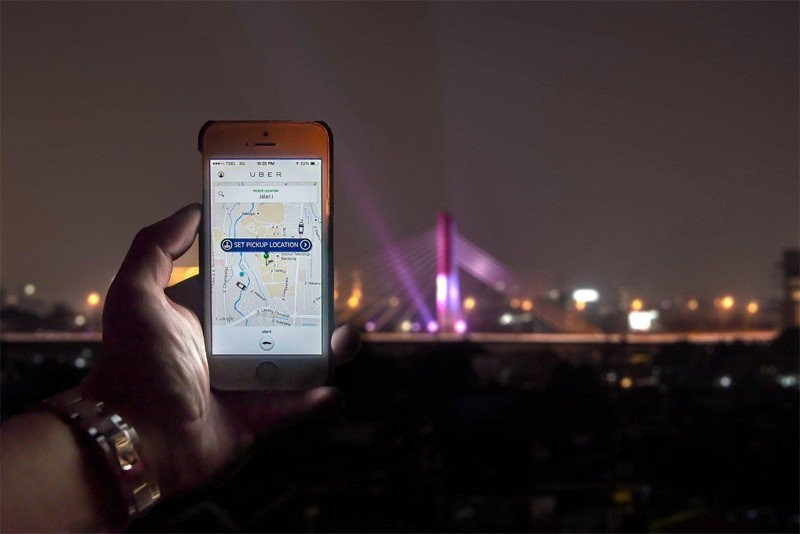 A netizen using Uber application with Bandung's Pasupati Bridge as background. (Uber/-)
T
he wave of financial technology companies, more popularly called fintech firms, has affected our lives in many ways, including in Indonesia, as fintech offers simplicity, speed, cohesiveness and streamlined processes.
Many fintech players, such as Doku, Uang Teman, Iwak, Tanihub, Amartha, Go-Pay, Investree and many more, are already offering a variety of services in Indonesia.
The fintech industry had evolved considerably because of the rapid development of technology, the inception of the internet and the wide penetration of smartphones.
What is interesting is that the fintech market has not even reached its tipping point, at least in the US or Europe. Statistics reveal that only a minor fraction, about 1 percent of North American consumer banking revenues, has moved to new digital modes.
However, the growth of fintech cannot be ignored. Research conducted by Citi in March 2016 stated that investments in private fintech companies increased 10 times in the past five years.
The industry’s growth, however, has sparked a controversy.
Some saw it as a disruption of technology while others construed it as a technology enabler for financial services.
Banking sectors consider fintech as a threat as some fintech players have targeted profitable areas of the banking industry, particularly payment services.
Jamie Dimon, CEO of JP Morgan, said, “Silicon Valley is coming. There are hundreds of startups with a lot of brains and money working on various alternatives to traditional banking.”
Fintech had revolutionized the way financial services are provided to consumers.
For example: streamlining payments, integrating billing, e-payments, crowdfunding, comparing financial products and others.
Soon perhaps our younger generation may be more familiar with the term “debit access” and “credit access” than “debit card” and “credit card”, said John Stumpf, Wells Fargo’s CEO, in 2015.
On the other hand, some experts encourage a collaboration instead of competition between financial institutions and fintech players as it could bring benefits for both of them.
The financial institutions can take advantage of the disruptive nature of the role and culture of fintech that may spark innovation without being limited by the constraint of the financial institution’s infrastructure and culture.
For fintech, teaming up with financial institution providers can provide access to payment markets and regulatory payments-market experiences.
China has been successful and taken a lead in the fintech market. The two largest fintech companies are Chinese: Ant Financial (online payments) and Lufax (peer-to-peer loans).
The success story of fintech in China is mainly driven by a combination of the following factors: a high population, a low access to banking services, a high penetration of mobile phones and internet networks and relaxed regulations.
These driving factors are actually quite similar to existing conditions in Indonesia. Only about 36 percent of adults in a population of about 250 million have bank accounts in Indonesia.
Our penetration of mobile phones is relatively high (notwithstanding that our telecommunications infrastructures are still under-developed) with only 33 percent using mobile devices for banking services. These factors combined with our relatively strong macroeconomic growth offers a huge opportunity in the fintech industry.
No wonder many fintech players both international and local are entering into our market.
As all of those non-legal factors seem promising, our focus then turns to legal factors. It is essential to know whether our regulatory framework would be able to support the growth of our fintech industry, which will be discussed in the following manner:
In a fintech seminar last month, the government reiterated its commitment to support and nurture the growth of the fintech market (including e-commerce activities) in Indonesia.
In telecommunications sectors, the government is expanding its network coverage by laying out fibre optics lines throughout Indonesia under the Palapa ring project.
This will serve as a telecommunications backbone for both voice and data communications, which is essential for the fintech industry.
In relation to the government’s policy, the government has also issued an e-commerce road map initiated by the Communications and Information Ministry and a financial inclusion program led by the Financial Services Authorities (OJK).
At this front, it is clear that the commitment of the government is solid.
There is no single unified regulation ruling the fintech industry. Fintech matters (e.g. data privacy, know your customer, consumer protections, e-contract, data centers, e-commerce) are regulated through various sectoral regulations, which could overlap one another.
There are certain implementing regulations — which are instructions from higher regulations — that have not been issued to date (e.g. data privacy, electronic certificates and others). These situations arguably could create uncertainty for fintech players because they will be lacking guidance.
In responding to this situation, at the moment the government (which is led by the OJK) is drafting a fintech regulation that will be issued later this year. We hope the proposed regulation can provide clear guidance on how the fintech industry should be shaped.
The enforceability of the e-contract is a crucial aspect as all fintech activities basically rest on the enforceability of e-contracts. The information technology law has actually regulated and recognized the validity and legality of e-contracts since 2008.
In practice some parties still hesitate over whether the courts would enforce the e-contracts. It is actually more of a practical question rather than a theory of law.
Although there are also many factors that could influence the court decision, which may not be immediately apparent on the face of the court document in question, the court should not hesitate to recognize and enforce e-contracts so long as they are made in accordance with the prevailing laws and applicable contractual principles.
The Indonesian fintech market is indeed a promising market for fintech players. Our demographic composition and macroeconomics situation are becoming primary factors for attracting fintech business models to Indonesia.
In boosting the growth of the fintech industry, the government should also focus on providing a clear, predictable and sustainable legal framework for the fintech industry.
What is important is that the government should be able to take the right approach in regulating this nascent industry so it can have the opportunity to grow properly.
________________________________
The writer works as a counsel at Widyawan & Partners in association with Linklaters. The views expressed are his own.