Enjoy This Gifted Article!
You're reading this thanks to a The Jakarta Post subscriber.
Access is available for 30 days. For unlimited access, consider subscribing.
Can't find what you're looking for?
View all search resultsCan't find what you're looking for?

View all search resultsFrequent blackouts aren't just engineering failures. They are the cost of a bureaucratic monologue that treats energy security as a state secret.
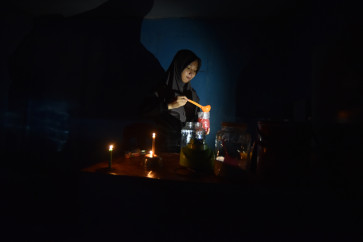
hen the lights went out across parts of Sumatra last month, followed by load shedding across the Java-Bali grid of state electricity firm PLN last week, the instinctive response was familiar: Find the broken point. Was it a tripped transmission line, a malfunctioning generator or a technical fault somewhere within the vast network architecture?
Yet over years of working across energy data, policy discussions and public communication, I have learned that infrastructure rarely fails in isolation. Beneath every technical disruption is a social story about institutions, incentives and the ways information is shared or withheld.
What we witnessed recently was not merely an electrical disturbance. It was a symptom of a system under strain from administrative bottlenecks and rigid structures, made more fragile by a long-standing tendency to keep energy governance behind closed institutional doors.
In that sense, Indonesia’s power disruptions reveal an uncomfortable truth: Grid resilience is not just about steel, coal or reserve margins; it is about trust.
For years, particularly during the 35,000-megawatt landmark project expansion over the past decade, the dominant narrative surrounding the national power system was one of abundance. The country supposedly possessed ample, even excessive, generating capacity. "Overcapacity" became less of a technical description and more of an institutional reassurance.
But narratives, when repeated often enough, harden into assumptions.
Quietly, conditions shifted: Post-pandemic demand recovered, operational constraints tightened, margins narrowed. The buffer that once appeared comfortable gradually evaporated while the public narrative remained entirely unchanged.
The result is a widening gap between expectation and reality. When a system long touted as abundant suddenly relies on load shedding, public confusion is inevitable. Many are left asking what changed, and why no one saw it coming.
These disruptions also remind us that energy security can be compromised by something as routine as administrative delay.
The recent strain on coal supplies did not originate in the mines or at power plants; it began with a bureaucratic adjustment that shifted approvals for the mining sector’s work and budget plan (RKAB) to an annual cycle. What seemed like a simple procedural change created a massive bottleneck at the start of the year. Because domestic coal prices are regulated to keep electricity tariffs stable, these approval delays quickly translated into commercial pressure along the supply chain.
Recent reporting highlights tightening coal availability for PLN’s generation fleet, with officials acknowledging a shortfall of roughly 18-20 million tonnes against annual requirements due to unfulfilled contracts. Consequently, fuel deliveries slowed, stockpiles dwindled and several generating units were forced to operate with a coal supply sufficient for only a few days.
Yet public communication remained muted. The issue surfaced only when the impact became unavoidable: when the outages finally reached homes and businesses.
A resilient system depends on social legitimacy just as much as engineering redundancy. It requires institutions willing to communicate vulnerabilities, whether thinning reserve margins, supply chain disruptions or operational constraints, before they escalate into crises. Transparency may expose weaknesses, but silence invariably amplifies their consequences.
Although my tenure in energy and climate communication is relatively short, I have consistently encountered a pattern that scholars call the "information deficit model". This is the assumption that public disagreement or disengagement stems merely from a lack of information, and that pumping out more facts, reports and technical explanations will fix public understanding. Communication, in this framing, is a one-way street from experts to the public.
Yet energy transitions, like broader climate action, are rarely constrained by a lack of information alone. Public responses are shaped by trust, lived experience, values and the extent to which people feel included in decisions that dictate their daily lives.
Energy systems do not become more resilient through one-way broadcasts. They thrive when communication becomes a dialogue: when citizens are treated not as passive recipients of data but as active participants with knowledge, concerns and agency.
If government agencies, utilities, industry players and the public engaged in an open conversation about system constraints, moments of disruption could become opportunities for collective problem-solving rather than exercises in finger-pointing.
Centralization, after all, is not just a technological arrangement; it is a mindset. Indonesia’s electricity system, dominated by massive power plants connected through sweeping transmission networks, mirrors its broader administrative pattern. Both electricity and information flow in one direction, from the center outward.
Such systems can appear highly efficient in stable conditions, but they are inherently brittle. When a critical node fails, be it a transmission line, a fuel supply chain or a delayed administrative approval, the effects ripple instantly across the entire system because there are few autonomous layers to absorb the shock.
If Indonesia is serious about building true resilience, the response cannot be limited to faster paperwork or building additional capacity. It requires a fundamental shift toward decentralization.
Distributed renewable energy, particularly rooftop solar paired with battery storage, offers more than just a technical fix. Generating electricity closer to where it is consumed reduces dependence on long supply chains, regulatory bottlenecks and centralized infrastructure. In doing so, it eliminates single points of failure.
But the true significance goes deeper: It reshapes the relationship between citizens and the energy grid itself. Households, communities and businesses with their own generation capacity are no longer waiting passively for the lights to come back on; they become active producers of grid stability.
For too long, energy security in the country has been approached as a bureaucratic monologue: centralized, hyper-technical and detached from everyday experience. But monologues are fragile by design; they demand passive compliance where active coordination is required.
Resilience only emerges when communication becomes reciprocal: when uncertainty is acknowledged rather than hidden, when information is shared transparently with those affected and when systems are designed to distribute not just electricity but also institutional responsibility.
Keeping the lights on is no longer just a question of infrastructure. It is a question of how power, both electrical and institutional, is understood, and whether we are willing to share it.
***
The writer is director of communication and outreach at the Institute for Essential Services Reform (IESR).
Share your experiences, suggestions, and any issues you've encountered on The Jakarta Post. We're here to listen.
Thank you for sharing your thoughts. We appreciate your feedback.
Quickly share this news with your network—keep everyone informed with just a single click!
Share the best of The Jakarta Post with friends, family, or colleagues. As a subscriber, you can gift 3 to 5 articles each month that anyone can read—no subscription needed!
Get the best experience—faster access, exclusive features, and a seamless way to stay updated.