The Jakarta Post
Please Update your browser
Your browser is out of date, and may not be compatible with our website. A list of the most popular web browsers can be found below.
Just click on the icons to get to the download page.


Popular Reads
Top Results
No results found. Please check your search term and try again
Can't find what you're looking for?
View all search results
Popular Reads
Top Results
No results found. Please check your search term and try again
Can't find what you're looking for?
View all search resultsNatural rubber outlook: Average price may fall in 2022
We estimate an average TSR20 price of $1.54 per kg in 2022, lower than the 2021 average price of $1.67.
Change text size
Gift Premium Articles
to Anyone
Share the best of The Jakarta Post with friends, family, or colleagues. As a subscriber, you can gift 3 to 5 articles each month that anyone can read—no subscription needed!
 Set as preferred source
I
ndonesia is very rich in natural resources. No wonder that Indonesia is among the world’s important resource-exporting countries.
Indonesia produces massive amounts of crude palm oil (CPO), coal, nickel, natural rubber, copper and many other commodities. The reopening of the global economy in 2021 created huge demand for such commodities, and hence drove up the prices of most commodities.
For example, coal and CPO prices rose significantly by 109.2 percent year-to-date (ytd) and 21.0 percent ytd, respectively. As a result, Indonesia’s export performance reached record highs in October and November. Cumulatively, Indonesia’s export value grew an impressive 42.6 percent year-on-year (yoy) in the January-November period.
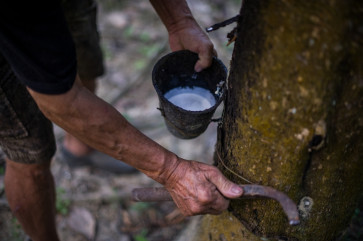
The natural rubber industry also benefited from the global economic reopening. The global reference price for TSR20 rubber on the Singapore Exchange (SGX) was US$1.7 per kilogram on Monday, an increase of 13.7 percent ytd.
However, rubber prices increased at a relatively lower rate compared to other Indonesian commodities. In a more detailed view, rubber prices moved sideways throughout 2021 in the range of $1.5 to $1.8.
Unlike other commodities, rubber failed to break its record price in 2021. So why did rubber price move differently compared to other commodities?
First, approximately 55 percent of the world’s rubber is absorbed by the automotive sector, especially in China, the United States and Japan. This is followed by the glove (19 percent) and footwear (11.15 percent) sectors.